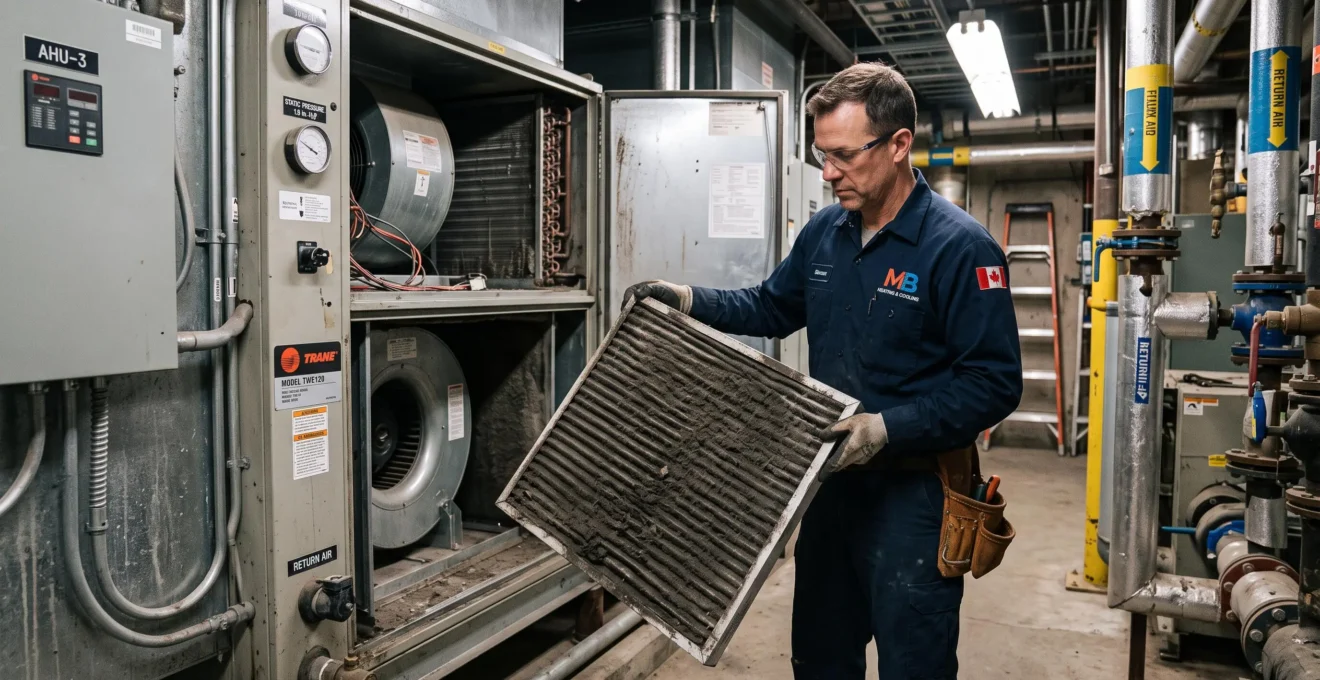
When your electricity bill jumps 20% during a Montreal heat wave and your air conditioner struggles to maintain a comfortable temperature, the culprit often hides in plain sight: a clogged filter choking your system. Natural Resources Canada confirms that a dirty filter can increase energy costs and damage your HVAC system, yet this $15–$30 component receives far less attention than it deserves given its outsized impact on equipment performance and household budgets.
The relationship between filter cleanliness and system strain follows a predictable mechanical cascade. Restricted airflow forces blower motors to work harder against increased resistance, compressors compensate by running longer cycles to maintain target temperatures, and components designed for smooth operation face mounting stress with each operating hour. Understanding this progression transforms filter maintenance from a forgettable chore into a strategic investment protecting equipment worth thousands of dollars.
This analysis examines the physical mechanisms linking filter obstruction to equipment overload, quantifies the financial consequences of neglect, and provides maintenance schedules differentiated by equipment type and usage context. The evidence reveals how a component costing less than a restaurant meal can determine whether your HVAC system delivers its designed 15-year lifespan or fails prematurely at year nine.
- How dirty filters force your HVAC system to work harder
- What happens when your AC compressor runs under constant strain
- The hidden cost: how clogged filters inflate your energy bills
- Why ventilation systems suffer the same consequences
- How often should you clean or replace your filters
- Early warning signs your system is working too hard
- Protecting your equipment investment through strategic maintenance
How dirty filters force your HVAC system to work harder
The air filter in your HVAC system functions as the gateway controlling airflow volume entering the equipment. As dust, pet dander, pollen, and household particulates accumulate on the filter surface, they create a physical barrier that progressively restricts the volume of air passing through the system. This obstruction fundamentally alters the operating conditions your equipment faces.
Understanding the airflow restriction mechanism: A clean filter allows air to flow freely through its pleated material with minimal resistance. As the filter captures airborne particles, the accumulated debris layer thickens, creating the equivalent of breathing through a partially blocked straw rather than breathing normally. Your HVAC system experiences this same struggle with every operating cycle.
When airflow encounters the obstructed filter, pressure differential between the intake and output sides increases measurably. The blower motor must generate additional force to pull the required air volume through the restricted pathway. This elevated static pressure transforms what should be effortless air circulation into strenuous mechanical work, much like pumping water through a narrowed pipe requires more energy than flowing it through an unobstructed channel.
The compressor in your air conditioning system faces a related challenge. With reduced airflow delivering less air across the evaporator coils, the system cannot transfer heat as efficiently as designed. To maintain your target indoor temperature, the compressor compensates by operating at higher intensity or for extended periods, burning additional electricity to overcome the performance deficit created upstream by the clogged filter.
For homeowners considering an equipment upgrade, understanding how these mechanical factors interact can make the decision easier, whether the goal is to maintain an existing system or find an air conditioning unit suited to your home that matches the property’s specific requirements. Variable-speed technology can adapt more effectively to changes in airflow, but even advanced systems remain subject to the same fundamental physics: excessive restrictions can increase strain and reduce overall efficiency.
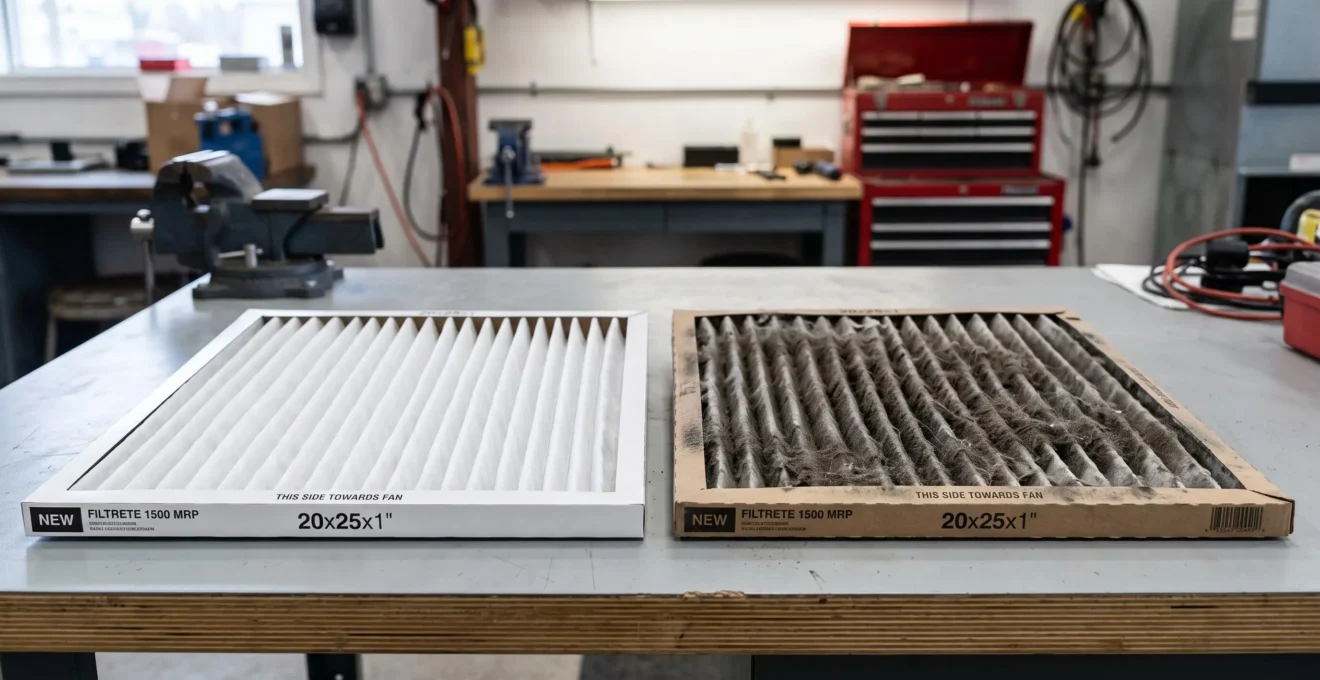
The severity of this strain correlates directly with the degree of obstruction. A filter at 50% capacity restriction doesn’t merely reduce performance by half—it forces your blower motor to overcome exponentially increasing resistance, similar to how breathing difficulty intensifies rapidly as airway obstruction worsens rather than declining in linear proportion to the blockage percentage.
What happens when your AC compressor runs under constant strain
The compressor represents the most expensive single component in your air conditioning system, and sustained operation under stress-inducing conditions initiates a predictable deterioration timeline. Understanding this progression reveals why a neglected $20 filter can trigger a repair bill exceeding $1,000.
The failure cascade follows this mechanical sequence: restricted airflow creates insufficient heat exchange at the evaporator coil, forcing the compressor to maintain compression longer to achieve the required cooling effect. This extended runtime under elevated workload generates excess heat within the compressor housing. The thermal overload stresses lubricants, seals, and mechanical components designed for intermittent duty cycles rather than continuous heavy operation.
As heat accumulates, the system’s thermal protection mechanisms engage, shutting down the compressor before damage occurs. The system cools briefly, then restarts—only to repeat the cycle minutes later. This pattern, known as short cycling, subjects mechanical components to the most stressful operating condition: frequent starts and stops rather than smooth continuous operation. Bearings, pistons, and electrical contacts wear exponentially faster under this regime compared to normal cycling patterns.
Warranty implications of maintenance neglect: Many manufacturers require documented proof of regular maintenance, including filter changes, to honour warranty coverage. Compressor failure attributed to restricted airflow from neglected filters may void your warranty protection, leaving you responsible for the full replacement cost when the damage was entirely preventable.
According to data from HomeStars, a Canadian platform connecting homeowners with verified HVAC contractors, the average air conditioning compressor replacement costs approximately $1,200 CAD, including parts and labour. This figure represents the financial endpoint of the deterioration timeline—a cost that dwarfs the cumulative expense of regular filter maintenance over the same period.
Maintenance vs. Breakdown: 5-Year Cost Comparison
| Cost Category | Regular Maintenance | Neglected Maintenance |
|---|---|---|
| Filter replacements (quarterly) | $300–$600 | $60–$120 |
| Energy overconsumption | Baseline | $250–$500 cumulative |
| Compressor failure risk | Minimal | $1,200+ (single incident) |
| Total 5-year cost | $300–$600 | $1,510–$1,820+ |
Beyond immediate replacement costs, premature compressor failure shortens overall equipment lifespan. A well-maintained residential air conditioning system typically delivers 12–15 years of service. Systems operating under persistent strain from clogged filters often fail at the 8–10 year mark, requiring complete unit replacement years ahead of schedule and eliminating the final third of the equipment’s designed service life.
Even modern inverter technology and variable-speed compressors, while more adaptable to changing conditions than fixed-speed predecessors, cannot fully compensate for chronic airflow restriction. These advanced systems may mask the symptoms longer through their operational flexibility, but the underlying mechanical stress accumulates regardless of the technology’s sophistication.
The hidden cost: how clogged filters inflate your energy bills
The mechanical strain imposed by clogged filters translates directly into measurable financial impact through elevated electricity consumption. Natural Resources Canada states explicitly that dirty filters increase energy costs, confirming what equipment physics predicts: restricted airflow forces systems to consume more power to deliver the same cooling or heating output.
2/3 of home energy
According to Natural Resources Canada, approximately two-thirds of the energy consumed in an average Canadian household goes toward heating and cooling—making HVAC efficiency the single largest lever for controlling utility costs.
When the blower motor works against increased pressure differential, it draws additional electrical current to generate the force required to move air through the obstructed filter. Simultaneously, the compressor operates for extended periods or at higher intensity to compensate for reduced heat exchange efficiency caused by insufficient airflow across the coils. Both effects compound to create overconsumption that appears on your electricity bill month after month.
For a household in Laval running a 12,000 BTU split system during Montreal’s summer months, this overconsumption accumulates across approximately 120 operating days between June and September. Using Hydro-Québec’s residential rate of approximately $0.073 per kWh, even modest efficiency losses translate into surcharges ranging from $25–$75 per cooling season depending on usage intensity and obstruction severity. Over the system’s designed lifespan, this represents $375–$1,125 in pure energy waste—money that buys nothing except compensating for an easily preventable maintenance failure.
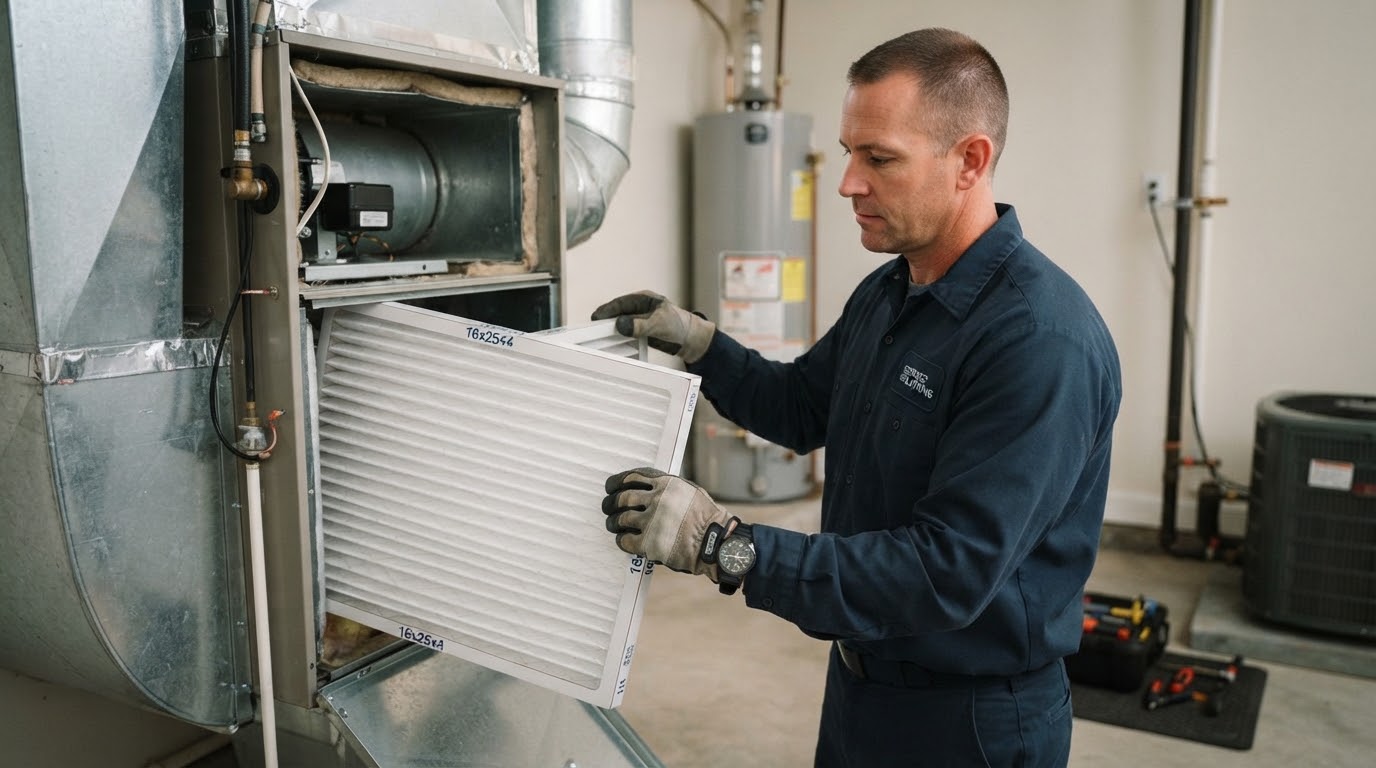
The return on investment calculation presents stark clarity. A quality pleated filter costs $15–$30 and protects against monthly overconsumption potentially reaching $10–$25 during peak usage periods. The filter pays for itself within the first month of the cooling season through energy savings alone—before accounting for its protection of components worth hundreds or thousands of dollars.
Provincial electricity rate variations across Canada modify the absolute dollar amounts but not the fundamental economics. Ontario households paying Hydro One’s rates experience proportionally similar waste, while residents in provinces with lower electricity costs see reduced dollar figures but identical percentage inefficiencies. Regardless of your provincial utility, you’re paying to overcome an obstruction that shouldn’t exist rather than to cool or heat your living space.
This hidden cost operates particularly insidiously because it lacks visibility. Unlike a sudden repair bill that triggers immediate attention, the gradual monthly overconsumption blends into normal utility fluctuations and seasonal variations. Many homeowners attribute rising summer electricity bills entirely to increased usage during heat waves, never recognizing that a significant portion stems from equipment inefficiency rather than legitimate conditioning demand.
Why ventilation systems suffer the same consequences
The mechanical principles governing air conditioning systems apply equally to the ventilation equipment common in Canadian residential construction. Heat Recovery Ventilators (HRV) and Energy Recovery Ventilators (ERV) face identical airflow restriction challenges when their filters accumulate debris, with additional performance consequences specific to their heat exchange function.
ERV vs. HRV distinction: Both systems recover thermal energy from exhaust air to precondition incoming fresh air, reducing heating and cooling loads. HRV systems transfer heat only, while ERV systems additionally transfer moisture. Despite this functional difference, both rely on unobstructed airflow through filters to maintain designed efficiency, making filter maintenance equally critical for either technology.
According to Canada Mortgage and Housing Corporation (CMHC), the federal Crown corporation providing authoritative residential construction and maintenance guidance, dirty or clogged filters can lower ventilation efficiency in these systems. The restriction imposes the same blower motor strain described in air conditioning contexts, forcing the ventilation fan to work harder against elevated static pressure to move the required air volume through the heat exchanger core.
ERV and HRV systems carry particular importance in Canadian climate conditions. During Québec winters with outdoor temperatures reaching -25°C, an efficiently operating heat recovery system can recapture 75–80% of the heat from outgoing stale air to preheat incoming fresh air. This recovered thermal energy represents heating cost avoided—energy your furnace or heat pump doesn’t need to generate because the ventilator recovered it from air that would otherwise be wasted.
When filters become obstructed, heat recovery efficiency degrades measurably. Restricted airflow reduces the air volume passing through the heat exchanger core, diminishing the total thermal energy transfer even if the percentage efficiency per unit of air remains constant. Your heating system must compensate for the recovery shortfall, consuming additional energy to bring incoming frigid air up to comfortable temperature—energy that should have been recovered through proper ventilation system operation.
CMHC provides specific maintenance guidance for these systems, recommending that homeowners clean or replace HRV filters every two months to maintain optimal performance. This more frequent interval compared to typical air conditioning filter schedules reflects the continuous year-round operation of ventilation systems, which accumulate particulate loading faster than seasonally operated cooling equipment.
The financial implications mirror those in cooling contexts but operate year-round rather than seasonally. A ventilation system with clogged filters forces your heating system to work harder throughout the six-month Canadian winter, accumulating waste across the season when energy consumption peaks and utility bills reach their annual maximum. The inefficiency compounds precisely when household energy budgets face the greatest pressure.
How often should you clean or replace your filters
Establishing an appropriate filter maintenance schedule requires matching standard baseline recommendations to your specific equipment type, usage intensity, and environmental factors. Generic advice to “change filters every three months” ignores the substantial performance variations between different operating contexts.
| System Type & Context | Baseline Frequency | Factors Requiring More Frequent Service |
|---|---|---|
| Residential AC/furnace (standard use) | Every 3 months | Pets, urban environment, construction nearby, allergy sufferers |
| Residential AC/furnace (intensive use) | Every 1–2 months | Multiple pets, heavy traffic area, smokers in household |
| HRV/ERV systems | Every 2 months | High outdoor pollution, renovation work, new construction |
| Commercial/high-occupancy spaces | Monthly | Industrial proximity, high-traffic retail, dusty operations |
For a household in Laval with two children including one with seasonal allergies, the standard three-month interval represents a starting point rather than a fixed rule. The presence of allergy sufferers constitutes a modifying factor warranting increased frequency—both for indoor air quality benefits and to prevent the airflow restriction that triggers equipment strain. A two-month schedule during peak pollen seasons (spring and fall) better serves both health and equipment protection objectives.
The distinction between cleaning and replacing depends on your filter type. Modern pleated disposable filters, typically rated MERV 8–13 for residential applications, require replacement when dirty. Their dense pleated material cannot be effectively cleaned, and attempting to wash them damages the filter media. Conversely, permanent electrostatic filters installed in some systems can be removed, vacuumed to remove surface debris, and washed with mild soap and water—a five-minute maintenance task according to CMHC guidance on HRV maintenance.
Seasonal usage patterns also influence optimal scheduling. A split system air conditioner operating intensively from June through September accumulates four months of debris during the cooling season. Changing the filter at the season’s midpoint (late July) and again before winter storage ensures the equipment never operates for extended periods under restriction. This seasonal approach concentrates maintenance during active-use periods while avoiding unnecessary changes during dormant months.
Smart home technology increasingly simplifies maintenance scheduling. Modern thermostats can track system runtime hours and alert homeowners when accumulated operating time reaches the threshold warranting filter service. Some advanced HVAC systems incorporate filter restriction sensors that monitor actual pressure differential, triggering maintenance reminders based on measured obstruction rather than elapsed time. These technologies eliminate the guesswork, particularly valuable for households where usage patterns vary substantially between seasons or years.
- Remove the filter from its housingMost residential filters slide out from return air grilles or furnace cabinets with minimal force. Note the directional arrows on the filter frame to ensure correct reinstallation orientation.
- Perform the light transmission testHold the filter up to a light source such as a window or lamp. A clean filter allows substantial light to pass through the pleated material. If light transmission is severely reduced or blocked, the filter requires immediate replacement regardless of elapsed time since the last change.
- Compare to visual referenceWhen installing a new filter, photograph it for future comparison. Evaluate your current filter against this reference image to assess debris accumulation visually. If more than 50% of the visible filter surface appears discoloured or blocked, replace the filter.
- Check for physical damageInspect the filter frame, sealing edges, and pleated material for tears, gaps, or separation. Any physical compromise allows unfiltered air to bypass the filter media, defeating its purpose while still restricting airflow through the remaining intact portion.

The most reliable schedule combines calendar-based baseline intervals with visual inspection checkpoints. Mark quarterly filter changes on your household calendar as non-negotiable maintenance dates, while conducting visual inspections monthly during peak usage seasons. This hybrid approach captures scheduled preventive maintenance while allowing responsive adjustments when inspection reveals accelerated debris accumulation from temporary conditions like nearby construction or seasonal pollen surges.
Early warning signs your system is working too hard
Recognizing the signals that indicate existing strain allows intervention before minor inefficiency progresses to component failure. HVAC systems provide multiple observable indicators when operating under airflow restriction stress, each linked to specific mechanical consequences of the obstruction.
- Short cycling (frequent on-off patterns)Normal compressor operation involves 15–20 minute run cycles followed by appropriate off periods. Short cycling describes cycles under 7–10 minutes, indicating the system reaches thermal shutdown thresholds prematurely due to inadequate airflow cooling the compressor. This pattern dramatically accelerates mechanical wear on startup-stressed components.
- Unusual operational noisesWhistling or high-pitched sounds indicate air forcing through restricted passages at high velocity. Grinding or labouring motor sounds suggest the blower working against excessive resistance. These acoustic changes reflect mechanical components operating outside designed parameters, warning of mounting stress before visible failure occurs.
- Uneven temperature distributionRooms distant from the air handler receiving insufficient cooling or heating indicate reduced air circulation throughout the duct system. Inadequate airflow volume fails to deliver conditioned air effectively to remote zones, creating hot or cold spots despite the system running continuously.
- Unexplained utility bill increasesElectricity consumption rising 15–25% compared to equivalent periods in previous years, without corresponding changes in usage patterns or occupancy, suggests efficiency degradation. The overconsumption directly reflects elevated power draw from equipment working harder to overcome restriction-induced performance losses.
- Ice formation on outdoor AC unitFrost or ice accumulating on the exterior condenser coils during cooling operation indicates refrigerant flow imbalances typically caused by restricted airflow through the indoor evaporator. The reduced heat exchange allows refrigerant temperatures to drop below freezing, creating visible ice that further impedes heat transfer.
Each warning signal connects to the underlying airflow restriction through identifiable cause-and-effect relationships. Uneven cooling occurs because insufficient air volume cannot distribute the available cooling capacity throughout the duct system—the restriction limits the transport medium rather than the cooling generation itself. Short cycling results because inadequate airflow across the evaporator coil prevents proper compressor cooling, forcing thermal protection systems to shut down the equipment before reaching normal cycle completion.
Distinguishing filter-related problems from other system failures requires observing symptom patterns. Multiple simultaneous signals strongly suggest airflow restriction: a combination of short cycling, uneven temperatures, and elevated bills points toward systematic airflow problems rather than isolated component failures. Single symptoms in isolation may indicate other issues—for example, short cycling accompanied by burning smells or repeatedly tripped circuit breakers suggests electrical problems requiring immediate professional diagnosis.
When warning signals appear, implement a diagnostic sequence before committing to professional service costs. First, inspect and replace the filter immediately, documenting the change date. Monitor system performance for 48–72 hours of normal operation. If symptoms resolve completely—short cycling stops, temperatures equalize, unusual noises cease—the filter was indeed the root cause, and maintaining proper future intervals prevents recurrence.
If symptoms persist after filter replacement or if you observe severe indicators like burning smells, electrical problems, or refrigerant leaks alongside the airflow signals, professional diagnosis becomes necessary. The filter change eliminates one variable, but continuing problems indicate deeper mechanical or electrical failures requiring specialized tools and expertise. Attempting DIY repairs on refrigerant systems, electrical components, or sealed compressor units risks both personal safety and equipment damage that converts a repairable problem into a full replacement necessity.
Protecting your equipment investment through strategic maintenance
The evidence from Natural Resources Canada, Canada Mortgage and Housing Corporation, and verified contractor data establishes that regular filter maintenance operates as the highest-return equipment protection action available to homeowners. A $20 component changed quarterly prevents compressor failures exceeding $1,200, eliminates seasonal energy waste reaching $50–$100 annually, and preserves the designed 12–15 year equipment lifespan that premature strain can cut short by 30–40%.
For households currently experiencing the warning signals—rising bills, uneven cooling, unusual system noises, or short cycling patterns—the immediate action path offers both diagnostic value and potential resolution. Replace your filter today, monitor performance for three days, and observe whether symptoms resolve. This single maintenance step, requiring 10 minutes and under $30, answers the critical question of whether you’re facing a simple maintenance deficit or a developing mechanical failure requiring professional intervention.
The mechanical cascade from restriction to overload to failure follows predictable physics regardless of equipment sophistication, climate zone, or building type. Understanding this progression transforms filter maintenance from a forgettable chore easily postponed into a strategic equipment protection decision with quantifiable return on investment. The choice between quarterly $20 filter changes and eventual $1,200+ compressor replacement represents one of residential maintenance’s clearest cost-benefit calculations—and one where the evidence unambiguously favours prevention.