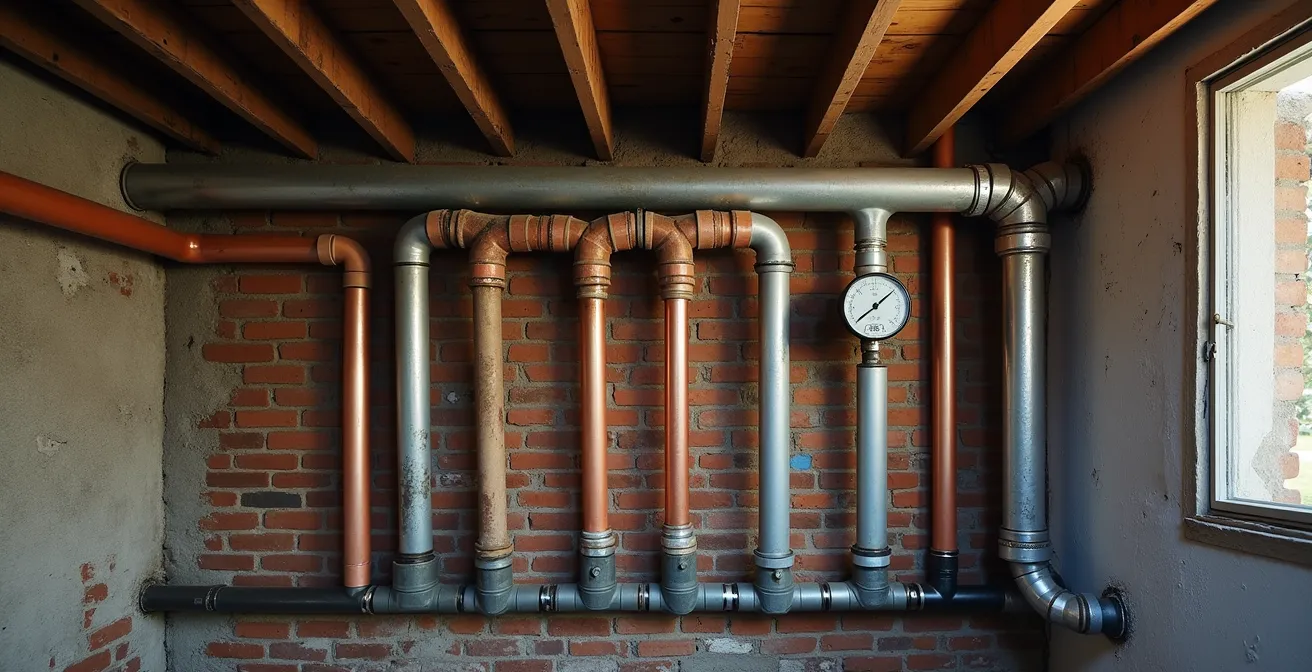
The low water pressure on your top floor isn’t a single fault; it’s a symptom of a systemic imbalance in your Montreal plex’s unique plumbing ecosystem.
- Elevation loss, aging pipes (often galvanized), and simultaneous tenant demand create a constant pressure-demand conflict.
- Effective solutions require targeted upgrades like pressure-balanced valves, VFD booster pumps, and properly balanced recirculation systems—not just one isolated fix.
Recommendation: Begin with a complete system diagnosis, from the city water inlet in your basement to the top-floor showerhead, to understand the true source of the imbalance before investing in repairs.
As the owner of a triplex in Plateau-Mont-Royal, the complaint is all too familiar: the shower on the third floor is little more than a trickle, especially when someone downstairs flushes a toilet. The common advice is to check for clogged aerators or assume your old pipes are simply failing. While these can be contributing factors, they rarely tell the whole story. In Montreal’s iconic multi-story buildings, the plumbing operates as a complex, interconnected system where the laws of physics are in a constant battle with the demands of modern living.
Simply blaming “old pipes” or “gravity” misses the point. The real issue is a loss of hydraulic equilibrium. This is the delicate balance between the water pressure supplied by the city, the inevitable pressure drop from elevation, the friction inside the pipes, and the sudden demands from multiple units. A toilet flush isn’t just a flush; it’s a sudden, high-volume demand that steals pressure from the rest of the system, causing that infamous shower temperature spike.
But what if the solution wasn’t just a single, expensive fix like a complete repiping? What if the key was to diagnose the system like a specialist, identifying the precise points of conflict and implementing targeted, often more affordable, upgrades? This guide is designed for you, the plex owner. We will move beyond the platitudes and delve into the specific hydraulic challenges of Montreal architecture. We’ll explore why pressure drops, how hot water systems fail, and what you can do to restore balance, comfort, and value to your property.
This article provides a structured approach to understanding and resolving these complex issues. By examining each component of your building’s plumbing, from the shower valves to the main drain stack, you’ll gain the knowledge needed to have an informed conversation with a CMMTQ-certified professional and make the best investment for your building’s long-term health.
Summary: A Systemic Approach to Plex Plumbing Problems
- Why Does Flushing the Toilet Scald the Person in the Shower?
- How to Get Hot Water Instantly on Top Floors Without Wasting Liters?
- Booster Pump or Pressure Tank: Which Solves Low Flow Issues Best?
- The Error of Poorly Secured Pipes That Creates Water Hammer Noise
- When to Balance Your Circulation Lines: Signs of Uneven Heating
- Why Do Cast-Iron Pipes Crack Vertically After 60 Years?
- Why Does Pressure Drop by 0.43 PSI for Every Foot of Elevation?
- How to Solve Low Water Pressure Issues in a 4-Story Walk-Up?
Why Does Flushing the Toilet Scald the Person in the Shower?
This dangerous and uncomfortable phenomenon is a classic sign of a pressure-demand conflict in an unbalanced plumbing system. In older Montreal plexes with traditional piping, the hot and cold water lines supplying a shower are not independent. When a toilet is flushed, it demands a large volume of cold water instantly. This “steals” cold water pressure from the shower line, causing the mix to become suddenly, and dangerously, hot. The root cause is that the shower valve cannot compensate for the abrupt pressure change on its cold-water side.
The solution is not to tell tenants not to flush, but to upgrade the hardware to valves that can maintain a balanced temperature regardless of pressure fluctuations. Pressure-balanced valves or, even better, thermostatic mixing valves, are designed for this exact scenario. They have an internal mechanism that automatically reduces the hot water flow to match the drop in cold water pressure, keeping the output temperature stable and safe. In fact, since the Quebec government updated its codes, these modern valves are mandatory for new constructions and major renovations, highlighting their importance for tenant safety.
Case Study: Plateau-Mont-Royal Triplex Pressure Balancing Upgrade
A typical pre-1960s triplex in the Plateau, with its original 1/2-inch galvanized pipes, was experiencing severe shower scalding. The owner hired a CMMTQ-certified plumber to upgrade all three units to pressure-balanced valves. The total cost was approximately $400 per shower. This single upgrade not only eliminated the scalding risk entirely but also increased the perceived property value, allowing for a modest rent increase of $50/month per unit. The investment paid for itself in under a year through increased rental income and tenant satisfaction.
For any plex owner, addressing this issue is a priority for both liability and tenant retention. Here are the key steps to follow for a proper installation:
- Hire a CMMTQ-certified plumber to assess your existing plumbing system. They will verify that your pipe sizes meet the requirements of the Quebec Plumbing Code.
- Obtain any necessary permits from your local Montreal borough (arrondissement) before beginning the work, as modifications to plumbing systems often require them.
- Choose between pressure-balanced and thermostatic mixing valves. Thermostatic valves offer superior performance and have been mandatory in Quebec for new constructions since the code update that came into force on July 11, 2024.
- Schedule the installation during low-usage times to minimize disruption for your tenants.
- After installation, ensure the plumber tests and sets the maximum temperature limits to comply with Quebec’s safety regulations for multi-unit dwellings.
How to Get Hot Water Instantly on Top Floors Without Wasting Liters?
The long wait for hot water on the top floor is not just an annoyance; it’s a significant waste of water and energy. In a typical Montreal triplex, the water heater is in the basement. When a hot water tap is turned off upstairs, the water sitting in the long vertical pipe cools down. The next person who needs hot water must run the tap until all that cold water is purged, wasting time, water, and money.
The most effective solution to this problem is a hot water recirculation system. This system creates a loop that slowly and continuously moves hot water from the water heater up to the furthest fixture and back again, ensuring that warm water is always near the tap. This dramatically reduces the wait time from minutes to mere seconds. Modern recirculation pumps are energy-efficient and can be controlled by a timer or an on-demand button to minimize electricity use. Paired with good pipe insulation, a recirculation system is a major quality-of-life upgrade for tenants and a smart investment for owners.

As the illustration shows, these pumps are compact units installed near the water heater. They connect to the hot water line and a dedicated return line (or use the existing cold water line in some systems) to create the essential circulation loop. The benefits in water and energy savings can be substantial over time, making it an attractive upgrade for eco-conscious owners and tenants.
Before investing, it’s crucial to understand the costs and potential returns for a building in Montreal. The following analysis breaks down the common options for a typical plex, considering installation, Hydro-Québec costs, and savings. A system with a timer-based pump, for instance, could prevent 8,000 to 10,000 liters of water from being wasted annually.
| System Type | Installation Cost (CAD) | Annual Hydro-Québec Cost | Water Savings/Year | ROI Timeline |
|---|---|---|---|---|
| On-Demand Pump | $800-1200 | $15-25 | 5,000-7,000L | 2-3 years |
| Timer-Based Pump | $600-900 | $40-60 | 8,000-10,000L | 3-4 years |
| Pipe Insulation Only | $150-300 | $0 | 2,000-3,000L | 1 year |
Booster Pump or Pressure Tank: Which Solves Low Flow Issues Best?
When the fundamental problem is that the city’s pressure is insufficient to reach the top floor with adequate force, you need to add energy to the system. The two primary solutions are a booster pump and a pressure tank. A standard booster pump is an in-line device that kicks in when it detects a drop in pressure, effectively “pushing” water with more force. A pressure tank, on the other hand, holds a reserve of water under pressure, releasing it when a tap is opened to supplement the flow.
For a multi-unit building like a Montreal plex, a standard booster pump can be noisy and inefficient, running at full power for even small demands. A pressure tank is quieter but can take up significant space and may not provide enough sustained pressure for multiple simultaneous uses. This is where a third option, the Variable Frequency Drive (VFD) booster pump, becomes the superior choice for plexes. A VFD pump intelligently adjusts its motor speed based on real-time demand, providing consistent pressure while using significantly less energy. It’s quieter, more efficient, and better suited for the variable needs of a multi-tenant building.
Case Study: Rosemont Duplex VFD Installation Success
A pre-1970s duplex in Rosemont was struggling with pressure drops from 50 PSI at the street to a mere 25 PSI on the upper floor, making showers and appliances ineffective. After consulting a plumber, the owner invested in a VFD booster pump. The system now maintains a consistent 45 PSI throughout the building, regardless of demand. The intelligent pump reduced energy consumption by an estimated 40% compared to a traditional booster pump, offering a better tenant experience and lower operating costs for the owner.
The decision between these systems involves a trade-off between upfront cost, operating cost, noise, and space. The following table provides a clear comparison to help Montreal plex owners make an informed choice.
| Feature | Booster Pump | Pressure Tank | VFD Booster Pump |
|---|---|---|---|
| Purchase/Installation Cost | $1,500-$2,500 | $800-$1,500 | $2,500-$4,000 |
| Noise Level | Moderate (55-65 dB) | Silent | Low (40-50 dB) |
| Space Required | 2 sq ft | 6-10 sq ft | 3 sq ft |
| Hydro-Québec Annual Cost | $80-120 | $0 | $40-60 |
| Best For | Consistent demand | Variable demand | Multi-unit buildings |
The Error of Poorly Secured Pipes That Creates Water Hammer Noise
That loud banging sound you hear when a faucet or valve is shut off quickly is called water hammer (or hydraulic shock). It’s not just a nuisance; it’s a sign of a potentially damaging problem. The noise is caused by the kinetic energy of the moving water having nowhere to go when its flow is abruptly stopped. This creates a high-pressure shockwave that travels back through the pipes, causing them to vibrate and bang against the building’s structure. Over time, this can loosen fittings, damage joints, and even cause pipes to burst.
The primary cause is often poorly secured pipes. In many older Montreal buildings, the original pipe straps and hangers have corroded or loosened over the decades. This allows the pipes to move freely, amplifying the shockwave’s effect. While tightening straps on exposed pipes in the basement is a task a handy owner can perform, pipes inside walls require a professional. The definitive solution is the installation of water hammer arrestors. These small devices contain a piston or a diaphragm that absorbs the shockwave, protecting the plumbing system.
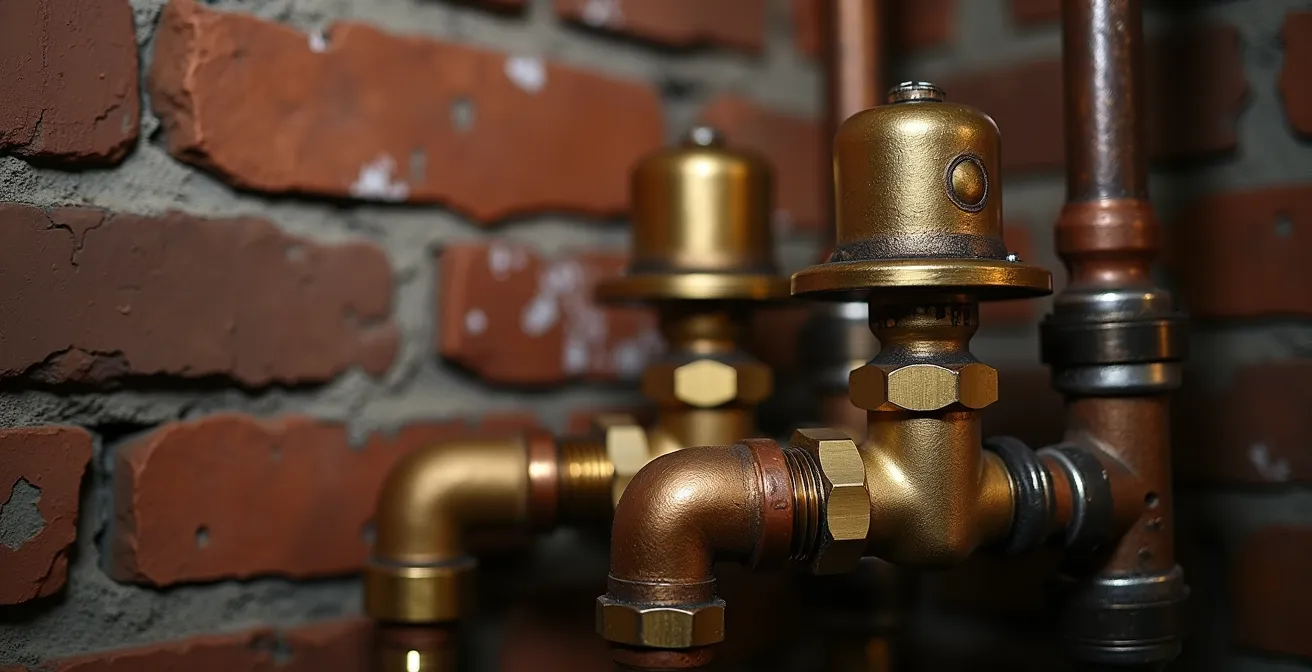
As shown, these arrestors are typically installed near appliances with quick-closing valves, like washing machines and dishwashers, which are the most common culprits. For a plex owner, addressing water hammer is crucial for preserving the integrity of the plumbing infrastructure. Here is a guide to what you can inspect yourself versus when you need to call a CMMTQ-certified professional.
- DIY-Safe Tasks: You can inspect exposed basement pipes for loose straps or corroded metal hangers. Tightening accessible pipe clamps with basic tools can often reduce minor noise.
- Professional Required: Any work on pipes inside walls, the installation of water hammer arrestors at appliance connections, or a complete replacement of pipe straps on main lines should be done by a certified plumber.
- Strategic Arrestor Locations: A plumber will recommend installing them near washing machine hookups, dishwasher supply lines, and any other quick-closing valves found in your units.
- City Investigation: If the banging persists even after securing pipes and installing arrestors, it’s wise to call 311. The City of Montreal’s waterworks department can check for city-side pressure issues that might be contributing to the problem.
When to Balance Your Circulation Lines: Signs of Uneven Heating
Even with a hot water recirculation system installed, you may still face a frustrating problem: the first-floor unit gets hot water in seconds, while the top-floor unit still has a significant wait. This indicates an unbalanced circulation loop. Water, like electricity, follows the path of least resistance. In a simple loop, most of the hot water will circulate through the shortest branch (the first floor) and neglect the longer, higher-resistance path to the top floor.
The signs of an unbalanced system are clear: a major disparity in hot water arrival times between different units. In some buildings, the difference in hot water arrival time between third-floor and first-floor units can reach 2 minutes vs 10 seconds. This defeats the purpose of the recirculation system for some tenants and leads to continued water waste. The solution is to install balancing valves on each branch of the recirculation loop. These valves allow a plumber to precisely adjust the flow rate to each unit, adding resistance to the lower floors and forcing more water to travel to the top floors. This ensures that every unit receives hot water in a roughly equal amount of time, achieving true hydraulic equilibrium for your hot water system.
Case Study: Mile End Triplex Balancing Valve Installation
The owner of a triplex in the Mile End had a recirculation pump but still received complaints from the top-floor tenant about a one-minute wait for hot water. A specialized Quebec plumber was hired to install manual balancing valves on each of the three branches of the recirculation loop. Using a flow meter, the plumber carefully adjusted each valve to equalize the flow. The result was a dramatic improvement: all three units now receive hot water within 15-20 seconds. This not only improved tenant satisfaction but also led to an estimated 30% reduction in water waste from running taps.
Balancing is a fine-tuning process that requires expertise and the right tools, but it’s the final step in perfecting a hot water delivery system in a multi-unit dwelling. It turns a “good” system into a “great” one, ensuring fairness and efficiency for all tenants. If you’ve invested in recirculation but still hear complaints, balancing is almost certainly the missing piece of the puzzle.
Why Do Cast-Iron Pipes Crack Vertically After 60 Years?
While most of this guide focuses on water supply lines, the drainage system is an equally critical part of your building’s health. In many Montreal plexes built before the 1970s, the main vertical drain pipe (the “stack”) is made of cast iron. After 60-80 years, these stacks are prone to a specific type of failure: long, vertical cracks. This isn’t caused by a single event, but by decades of slow degradation. The primary culprit is graphitic corrosion, a process where the iron in the pipe leaches out, leaving behind a brittle graphite structure that has little mechanical strength. Combined with the seasonal shifting of Montreal’s clay-rich soil putting stress on the building’s foundation, these weakened pipes can easily crack under their own weight.
A cracked stack is a serious issue that can lead to sewer gas leaks (a health hazard), chronic drain backups, water damage, and pest infestations. As an owner, knowing the warning signs is critical for catching the problem before it becomes a catastrophic failure. These signs are often subtle at first but will worsen over time.
Key warning signs of impending cast-iron stack failure in a plex include:
- Persistent sewer odors in the basement, particularly near the base of the vertical stack.
- Recurring drain backups that affect multiple floors at the same time.
- Visible moisture, dark stains, flaking rust, or a white, chalky substance (efflorescence) along the length of the stack.
- Gurgling sounds from drains on upper floors when a toilet is flushed in a lower unit.
- New cracks appearing in the foundation near where the stack goes through the basement floor.
If you notice these signs, it’s imperative to have the stack inspected by a plumber, often with a camera. If a crack is confirmed, you have a few repair options, each with different costs and levels of disruption.
| Repair Method | Cost Range (CAD) | Duration | Tenant Disruption | Longevity |
|---|---|---|---|---|
| Pipe Relining/Coating | $5,000-$8,000 | 1-2 days | Minimal | 15-25 years |
| Full Stack Replacement | $10,000-$15,000 | 3-5 days | Significant | 50+ years |
| Spot Repairs | $1,500-$3,000 | 1 day | Moderate | 5-10 years |
Why Does Pressure Drop by 0.43 PSI for Every Foot of Elevation?
This is the fundamental, non-negotiable law of plumbing physics that every multi-story building owner must confront. For every foot you want to lift water, you lose exactly 0.433 pounds per square inch (PSI) of pressure. This is called static head loss. It has nothing to do with the age or condition of your pipes; it’s simply the energy required to overcome gravity. Think of it as the weight of the column of water standing in the pipe.
Let’s apply this to a typical Plateau-Mont-Royal triplex. The third-floor showerhead might be about 25 feet higher than the city water main entering your basement. The pressure loss just from this elevation is 25 feet * 0.433 PSI/foot = 10.8 PSI. This means that even before accounting for any friction from pipes, bends, or valves, the third floor has nearly 11 PSI less pressure than the basement. According to data from the city, in a typical Plateau-Mont-Royal triplex with 25 feet of elevation, this results in a 10.75 PSI pressure loss.
This is where the city’s supplied pressure becomes critical. According to local plumbing experts, residential water pressure should ideally be between 40-60 PSI for fixtures to work correctly. However, the pressure supplied by the City of Montreal can vary significantly by neighborhood, ranging from a low of 40 PSI to a high of 80 PSI. If your street is on the lower end of that range, say 50 PSI, after subtracting the ~11 PSI for static head loss, your top floor is left with only 39 PSI. As one analysis of Montreal water pressure notes, this is borderline low for adequate performance, especially if multiple fixtures are used at once. This single calculation explains why top-floor units are always the first to experience pressure problems and why a booster pump is often a necessity, not a luxury.
Key Takeaways
- Low top-floor pressure is a system problem, not a single fault. It’s a mix of elevation loss (0.43 PSI/foot), pipe friction, and shared demand.
- Solving symptoms is key: Pressure-balanced valves fix scalding, and recirculation systems provide instant hot water, directly improving tenant satisfaction.
- For a multi-unit plex, a Variable Frequency Drive (VFD) booster pump is often the most efficient long-term solution to low base pressure, saving energy and reducing noise.
How to Solve Low Water Pressure Issues in a 4-Story Walk-Up?
Resolving low water pressure in a multi-story building is not about finding a single magic bullet. It’s about a methodical process of diagnosis and implementing a combination of solutions that restore the building’s hydraulic equilibrium. As we’ve seen, the problem is multi-faceted, involving the unchangeable laws of physics, the age of your building’s infrastructure, and the specific needs of your tenants. The final solution is a strategic plan that addresses each of these factors.
Your role as the owner is to become an informed project manager. You must understand the potential causes, know what to look for, and be able to ask the right questions when you bring in a CMMTQ-certified professional. The ultimate goal is to move from reactive repairs to a proactive strategy that ensures the comfort and safety of your tenants while protecting the long-term value of your investment. This requires a comprehensive action plan that covers everything from initial diagnosis to final implementation, always keeping local Montreal and Quebec regulations in mind.
By following a structured approach, you can systematically identify and eliminate the sources of your pressure problems, ensuring that every unit in your building has reliable and sufficient water flow. This is the path to solving the problem once and for all.
Your Action Plan for Solving Low Water Pressure
- Diagnose the System: Start with a simple $20 pressure gauge from a hardware store to measure your incoming pressure at the main inlet. Check for mineral clogs in faucet aerators and showerheads. Identify your pipe material (copper, galvanized steel, or PEX) to understand potential friction and clogging issues.
- Rule Out Municipal Issues: Before investing in major work, call 311. Verify the current city-side pressure levels for your street with the Montreal waterworks department to ensure the problem isn’t external to your building.
- Get Multiple, Qualified Quotes: Contact at least three different CMMTQ-certified plumbers for estimates. A qualified professional is non-negotiable for this kind of work. Provide each with your own pressure readings and observations.
- Weigh the Solutions: Based on the professional diagnoses and your building’s age, compare the long-term solution of repiping versus the more immediate fix of a booster pump (preferably a VFD model). Consider the ROI of each option.
- Plan and Execute the Work: Once a solution is chosen, notify all tenants at least 48 hours in advance of any water shutoff. Verify permit requirements with your specific borough (arrondissement), as they can vary across Montreal. Schedule the work for low-usage periods to minimize disruption.
To ensure your building has a safe, efficient, and reliable plumbing system, the next logical step is to begin the diagnostic process outlined in the action plan. Start today by measuring your incoming pressure and inspecting your fixtures. This first step will empower you with the data needed to have a productive conversation with a plumbing professional and restore hydraulic equilibrium to your property.