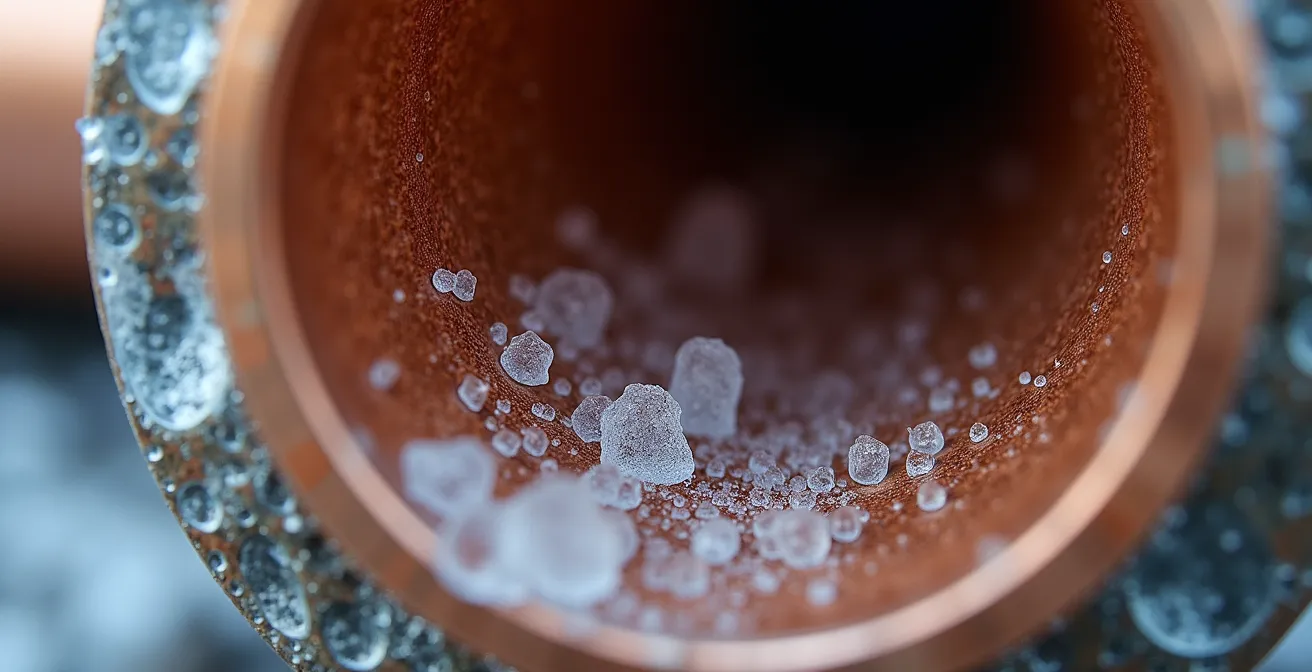
In Montreal, the primary threat to plumbing isn’t a single frozen pipe, but the cumulative structural damage from relentless thermal cycling, which systematically degrades material integrity and shortens asset lifespan.
- Freeze-thaw cycles induce material fatigue, causing micro-fractures in copper and brittleness in PVC, leading to premature failure.
- Aging infrastructure, particularly cast iron, is highly susceptible to graphitic corrosion, a predictable failure mechanism that turns seemingly stable pipes into significant financial liabilities.
Recommendation: Shift from reactive repairs to a proactive material-science-based assessment of your portfolio’s plumbing to accurately forecast capital expenditures and mitigate long-term risk.
For a real estate investor in Montreal, every asset is a line item on a balance sheet, with a predictable lifespan and maintenance schedule. Yet, plumbing systems in this climate often defy simple depreciation models. The common narrative focuses on the acute crisis of a burst pipe in a January cold snap—a costly but seemingly random event. Standard advice revolves around basic winterization: insulating pipes, shutting off outdoor taps, and maintaining a minimum indoor temperature. While not incorrect, this advice dangerously overlooks the more insidious and costly threat.
The true enemy of plumbing longevity in Quebec is not a singular event, but a chronic condition: material fatigue driven by thousands of relentless thermal expansion and contraction cycles. From a structural engineering perspective, a pipe in Montreal is not a static component; it is an active system under constant, cyclical stress. This process of expansion and contraction, season after season, induces micro-fractures, weakens joints, and accelerates chemical degradation in ways that materials in more temperate climates never experience. It’s a hidden tax imposed by the environment on your asset’s structural integrity.
This analysis moves beyond the emergency-repair mindset to provide an investor-focused, forward-looking assessment. We will dissect the primary failure mechanisms affecting different plumbing materials under the unique geomechanical and thermal stresses of the Montreal environment. By understanding the ‘why’ behind the premature aging of these systems, you can more accurately forecast risk, plan capital expenditures, and ultimately protect the long-term value of your real estate portfolio.
This article provides a material-by-material analysis of how Quebec’s climate impacts your plumbing infrastructure, allowing for a more strategic approach to asset management. The following sections break down the specific risks and solutions for your properties.
Summary: The Hidden Tax: Why Quebec’s Climate Accelerates Plumbing Degradation in Real Estate Assets
- Why Ground Shifts During Thaw Misalign Your Main Sewer Line?
- How to Install Frost-Free Sill Cocks to Survive Montreal Winters?
- Copper or PVC: Which Material Resists Thermal Expansion Cycles Better?
- The Error of Using Rigid Glue in Spaces Subject to Thermal Shock
- When to Replace Exposed Pipes: The 15-Year Rule for Cold Climates
- Why Do Cast-Iron Pipes Crack Vertically After 60 Years?
- Type L vs. Type M Copper: Which Lasts Longer in Residential Use?
- Copper vs. PEX: Which Is the Safer Choice for Montreal Water Quality?
Why Ground Shifts During Thaw Misalign Your Main Sewer Line?
The structural integrity of a building’s plumbing extends beyond its interior walls and into the ground itself. In Montreal, the annual spring thaw introduces a powerful geomechanical force that can compromise your most critical and expensive plumbing component: the main sewer line. As the frozen ground thaws, it doesn’t do so uniformly. Water saturation and ice lensing create differential settlement, where sections of soil shift and heave at different rates. This movement imposes immense shear and bending stresses on the buried sewer line, a component that was installed with the assumption of a stable foundation.
For older properties, this risk is magnified by the material itself. Cast iron was the standard for decades, and many buildings in Montreal’s established neighbourhoods rely on it. A case study of Montreal’s aging infrastructure highlights that cast iron pipe was commonly used in the greater Montreal area 30 plus years ago, now corrosion is setting in. This aging material, already weakened by internal corrosion, has very little flexibility. When the ground shifts, a rigid cast iron pipe cannot bend; instead, its joints fail, or the pipe itself fractures, leading to blockages, backups, and costly excavations.
While some metallurgical research shows that gray cast iron pipes can have a 100+ years service life under ideal conditions, the combination of internal corrosion and external ground stress in Quebec dramatically shortens this timeline. For an investor, a property’s sewer line material is a critical due diligence item. A cast iron main in an area with significant ground frost is not a century-long asset but a ticking liability requiring proactive inspection and potential replacement with more flexible modern materials like PVC or ABS.
How to Install Frost-Free Sill Cocks to Survive Montreal Winters?
An outdoor faucet, or sill cock, is a primary vulnerability for water intrusion and freeze damage in any Montreal property. A traditional sill cock leaves a residual amount of water in the portion of the pipe that passes through the exterior wall, an area highly exposed to sub-zero temperatures. This inevitably leads to freezing, expansion, and a burst pipe inside the wall, causing significant water damage before it’s even detected. The solution is not better insulation, but better engineering: the frost-free sill cock.
A frost-free model is designed with a long stem that places the actual shut-off valve deep inside the heated envelope of the building. When you turn off the handle, the water supply is cut 12-18 inches inside the wall, and the remaining water in the exterior portion of the stem drains out automatically. This leaves the exposed section of the pipe empty and immune to freezing. The installation must be precise: the sill cock needs to be installed with a slight downward pitch towards the outside to ensure proper drainage. This is a crucial detail that distinguishes a professional installation from a failed one.
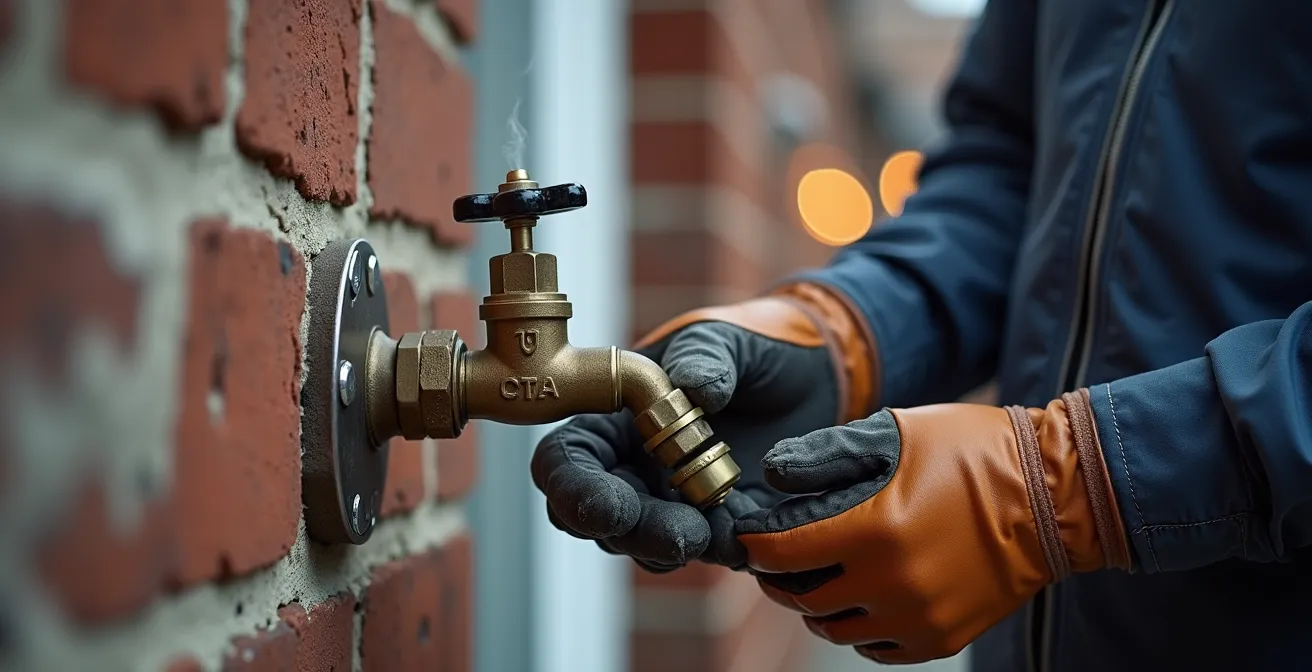
Upgrading to frost-free sill cocks is not just a best practice; it aligns with the preventative principles mandated for new construction and major renovations. Indeed, the Quebec Construction Code’s Chapter III – Plumbing continually updates its requirements to enhance building resilience against our climate. For a property investor, retrofitting all exterior faucets to frost-free models is a low-cost, high-impact capital improvement that eliminates a common and expensive point of failure, protecting the building’s structural integrity and preventing costly insurance claims.
Your Proactive Winter Plumbing Audit
- Identify Vulnerable Zones: Systematically map all plumbing lines running through unheated areas of your properties, such as garages, attics, basements, and crawl spaces. Pay special attention to pipes on exterior walls.
- Assess Insulation and Heat Tracing: For each vulnerable pipe, verify the condition of its insulation. For critical areas, evaluate the installation of thermostatically controlled heat tape or heating cables as a secondary defence.
- Schedule a Professional Vulnerability Assessment: Engage a certified plumber to perform an inspection. An expert can identify non-obvious risks, such as potential pipe rerouting needs or areas with insufficient ambient heat.
- Implement a ‘Low-Temp’ Policy: Ensure property managers and tenants understand that even when a unit is vacant, the heat must be left on and set to a safe minimum temperature (e.g., 12-15°C) to prevent a frozen-pipe catastrophe.
- Verify Main Shut-off Accessibility: Confirm that the main water shut-off valve for each property is clearly labeled, accessible, and functional. In an emergency, saving minutes can save thousands of dollars.
Copper or PVC: Which Material Resists Thermal Expansion Cycles Better?
When selecting plumbing materials for a Montreal property, an investor must think like a material scientist. The key question is not just “will it freeze?” but “how will it behave after a thousand freeze-thaw cycles?” Copper and PVC, two common materials, have fundamentally different responses to the thermal cycling stress inherent in our climate. Copper is a ductile metal. When water inside it freezes and expands, its first response is to stretch. This ductility is an advantage, giving it some resilience against a single freeze event. However, this process, known as work hardening, permanently alters its crystalline structure, making it harder and more brittle with each cycle. Over several years, a copper pipe that has been repeatedly stressed becomes fragile and susceptible to cracking under normal water pressure fluctuations.
PVC, on the other hand, is a rigid polymer. It has a significantly higher coefficient of thermal expansion than copper, meaning it shrinks more in the cold. This shrinkage puts stress on its joints and the material itself. In extreme cold, PVC enters a “glass transition” phase, becoming extremely brittle. An impact that would be harmless at room temperature can cause a brittle fracture at -20°C. While PVC is immune to corrosion, its vulnerability to impact damage and stress fractures in deep cold is a significant liability, especially for exposed or inadequately supported pipes.
A crucial insight from the PlumbWize Winter Plumbing Guide challenges a common misconception: Pipes explode from water pressure, not the ice itself. In fact, cracks often appear in a different section from the frozen area where the ice formed. This is because as ice forms and expands, it acts like a piston, creating immense hydrostatic pressure (up to 40,000 psi) in the trapped water between the ice plug and a closed faucet. The pipe fails at its weakest point, which may be a joint or a section of pipe weakened by years of thermal cycling stress.
| Material | Freeze Risk Timeline | Critical Temperature | Montreal-Specific Risk |
|---|---|---|---|
| Copper | 6-8 hours sustained freezing | Below -1°C | Work hardening from repeated cycles |
| PVC | 4-6 hours sustained freezing | Below -1°C | Brittleness in extreme cold |
| PEX | 8-10 hours sustained freezing | Below -1°C | More flexible, resists burst |
Ultimately, neither material is perfect, but PEX (cross-linked polyethylene) often emerges as a superior choice for cold climates. Its flexibility allows it to expand significantly without failing and its resistance to work hardening gives it a much longer lifespan under thermal cycling. For an investor, specifying PEX for new builds and renovations in Montreal is a strategic decision to enhance asset durability.
The Error of Using Rigid Glue in Spaces Subject to Thermal Shock
The integrity of a plumbing system is only as strong as its weakest joint. In a climate with temperature swings of over 50°C from summer to winter, the choice of adhesive for PVC or ABS pipes becomes a critical structural consideration. A common and costly error is the use of standard, highly rigid solvent cements (glues) in areas subject to significant temperature fluctuation, such as unheated basements, garages, or pipes near exterior walls. Every material has a coefficient of thermal expansion—a measure of how much it expands or contracts with temperature changes. A pipe and the rigid adhesive bonding its joints will contract at different rates as they cool.
This differential contraction creates immense stress directly at the joint. While the bond may hold for a few seasons, the repeated push and pull of thermal cycling eventually creates micro-fractures in the hardened glue or the adjacent pipe wall. The failure is often not immediate but manifests as a slow leak that can go unnoticed for months, leading to mold, rot, and significant structural damage. The failure is a classic case of material fatigue at a connection point that was not designed for dynamic movement.
The solution lies in selecting the right material for the application. For joints in non-pressurized systems (like drainage) that will experience thermal shock, flexible couplings (e.g., shielded elastomeric joints) are often a superior choice. For pressurized systems, using a more flexible, high-quality primer and cement system designed for a wider temperature range is crucial. Furthermore, ensuring that the installation complies with the latest standards is paramount. In Quebec, the RBQ announced new certification standards that professionals must adhere to, reinforcing the need for expert installation that accounts for our climate’s specific challenges. For a real estate investor, specifying the use of appropriate flexible joints or temperature-rated adhesives in renovation contracts is a small detail that prevents a major future liability.
When to Replace Exposed Pipes: The 15-Year Rule for Cold Climates
For real estate investors, establishing clear capital expenditure timelines is essential for accurate financial planning. When it comes to exposed plumbing in cold climates like Montreal’s, a simple “15-Year Rule” can serve as a prudent guideline for proactive replacement, particularly for copper or PVC pipes in unconditioned or semi-conditioned spaces like basements, crawl spaces, and attics. This isn’t based on the pipe’s total theoretical lifespan, which can be much longer, but on a realistic assessment of its exposure to accelerated asset lifespan degradation from thermal cycling and potential freeze-thaw events.
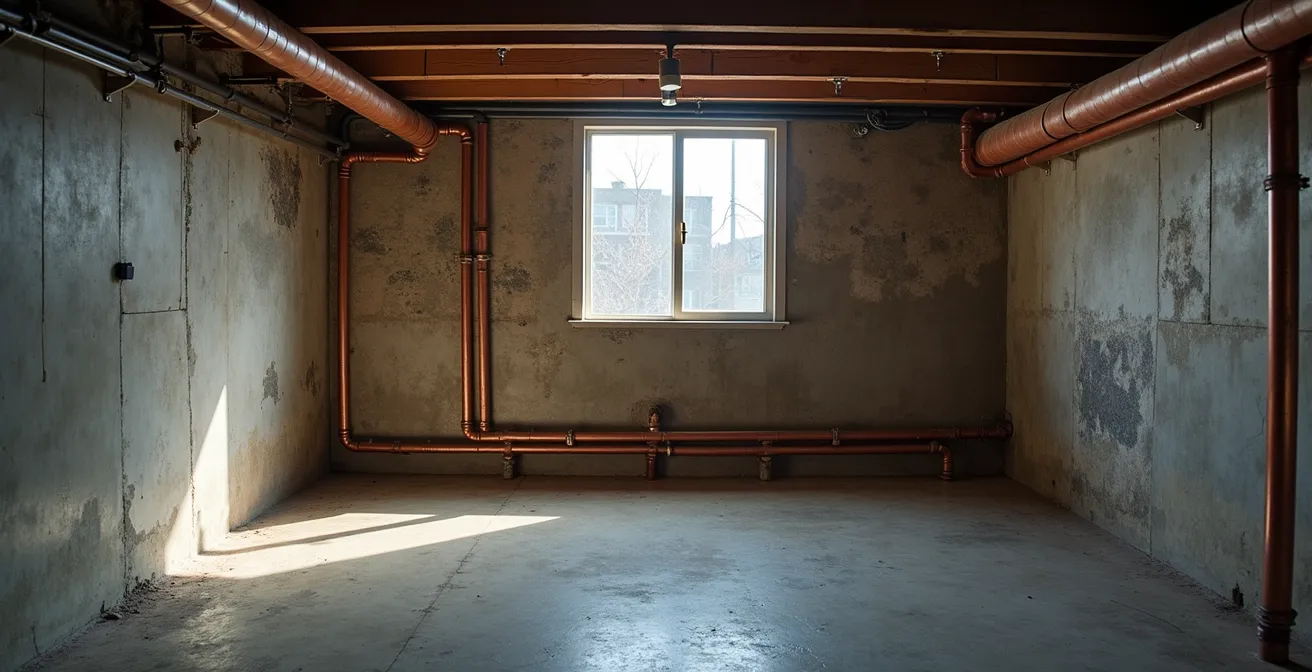
After 15 years of Montreal winters, a copper pipe has undergone thousands of micro-expansion and contraction cycles, leading to work hardening and increased brittleness. A PVC pipe has endured 15 seasons of becoming brittle in the cold, increasing its risk of fracture. While the pipes may appear fine, their resilience is diminished. They are far more likely to fail under an unexpected stressor, like a sudden pressure surge (water hammer) or a particularly deep cold snap. The risk is not theoretical; Canadian plumbing experts note that areas with extremely cold temperatures face highest risk of burst pipes, making proactive replacement a sound financial strategy.
From an investment perspective, replacing these vulnerable pipes at the 15-year mark shifts the cost from a potentially catastrophic and unpredictable emergency repair to a planned, budgeted maintenance expense. This proactive approach also presents an opportunity to upgrade to more resilient materials like PEX. While property insurance may cover sudden failures, it often doesn’t cover the slow, cumulative damage that precedes them. As noted in the Water Damage from Burst Pipes Guide, in most cases, insurance will cover this loss so ensure to have proper property insurance to cover your losses, but relying on insurance is a reactive, not a strategic, approach. Adopting the 15-Year Rule for exposed pipes in your Quebec properties is a forward-looking policy that protects asset value and stabilizes maintenance budgets.
Why Do Cast-Iron Pipes Crack Vertically After 60 Years?
The failure of old cast-iron drainpipes is not a random event; it is a predictable outcome of a slow, electrochemical process known as graphitic corrosion. For investors owning buildings from Montreal’s mid-century housing boom, understanding this mechanism is key to anticipating major capital outlays. Cast iron is an alloy of iron and carbon. Over decades of exposure to water, oxygen, and wastewater chemicals, the iron component (ferrite) corrodes away, leaving behind a brittle, porous graphite matrix. The pipe retains its original shape and dimensions, making it visually deceptive during a standard inspection, but it has lost its structural integrity.
While some home inspection data reveals that a 40-60 years life expectancy is typical, some fail after 25 years. The ultimate failure often manifests as a long, vertical crack along the top of the pipe. This occurs because the top of a horizontal drainpipe is exposed to sewer gases, particularly hydrogen sulfide, which accelerates corrosion. This localized weakening, combined with the constant stress from the building’s weight above, eventually causes the brittle graphite structure to fail under tension, splitting open along its length. A detailed study of century-old pipes confirms The controlling mechanism involved is time dependent and known as graphitic corrosion.
This process is insidious because it is invisible from the outside. A pipe can be 90% corroded but still appear intact. The first sign of trouble is often a sudden sewage backup, a foul odor, or insect infestation as the cracked pipe leaks into the ground or foundation. For a real estate portfolio, any building over 50 years old with original cast iron plumbing should be considered to have a high-risk liability. A proactive camera inspection (scoping) of the main drain lines is an essential due diligence step to assess the extent of graphitic corrosion and plan for a timely replacement before catastrophic failure occurs, turning a predictable expense into an emergency crisis.
Type L vs. Type M Copper: Which Lasts Longer in Residential Use?
Not all copper pipe is created equal. For a real estate investor in Montreal, the distinction between Type L and Type M copper is a critical factor in determining the long-term durability and value of a property’s plumbing system. The difference lies in one key variable: wall thickness. Type L has a thicker wall than Type M, while both have the same outer diameter. While Type M is often permitted by building codes for residential water distribution and is cheaper, its thinner wall makes it significantly more vulnerable to the specific stresses of a cold climate.
The primary advantage of Type L’s thicker wall is its superior resistance to both mechanical and chemical failure. Mechanically, the extra material provides a greater buffer against the work hardening and fatigue caused by repeated thermal cycling. It can withstand more freeze-thaw events before its ductility is compromised. Furthermore, it offers better resistance to the high-pressure surges caused by water hammer—the shockwave created when a valve is closed abruptly—a common stressor that can cause a thinner, fatigue-weakened Type M pipe to fail. From a corrosion standpoint, the thicker wall provides a longer lifespan, as it takes more time for pitting or general corrosion to penetrate the pipe wall.
| Type | Wall Thickness | Tensile Strength | Montreal Climate Suitability |
|---|---|---|---|
| Type L | Thicker walls | 60,000 psi (414 MPa) | Better resistance to thermal cycling |
| Type M | Thinner walls | 42,000 psi (289 MPa) | More vulnerable to water hammer stress |
For an investor, the small upfront cost savings of using Type M pipe is a false economy in the Montreal market. A system built with Type L copper represents a more robust, longer-lasting asset with a lower risk of premature failure and costly water damage. During due diligence on a potential acquisition or when planning a major renovation, specifying or verifying the use of Type L copper is a strategic choice that directly enhances the property’s resilience and reduces its long-term total cost of ownership (TCO).
Key Takeaways
- The primary threat to plumbing in Quebec is chronic material fatigue from thermal cycling, not just acute freeze-bursts.
- Older infrastructure, especially cast iron drains, carries a predictable and significant liability due to graphitic corrosion, which weakens pipes from the inside out.
- Material selection is a critical investment decision; PEX and thicker-walled Type L copper offer superior long-term resilience against Montreal’s climate-specific stresses compared to PVC and Type M copper.
Copper vs. PEX: Which Is the Safer Choice for Montreal Water Quality?
The final decision in plumbing material often comes down to a choice between the traditional standard, copper, and the modern alternative, PEX (cross-linked polyethylene). From a structural and performance standpoint in the Montreal climate, PEX holds a clear advantage. Its inherent flexibility allows it to expand by a significant amount if water freezes inside it, making it highly resistant to bursting. It is immune to corrosion and is not susceptible to the work-hardening fatigue that plagues copper under thermal cycling. This makes PEX a mechanically more resilient and longer-lasting choice for a climate that imposes constant dynamic stress on plumbing systems.
However, the question of “safety” introduces the variable of water quality. Copper has natural antimicrobial properties, which can help inhibit bacterial growth within the pipes. PEX does not share this property. On the other hand, the slightly acidic water found in some municipal supplies, including Montreal’s, can cause copper to leach into the drinking water over time. While typically not at harmful levels, it can impart a metallic taste. Furthermore, the joints in a copper system are soldered using a flux, and improper flushing after installation can leave contaminants in the system. PEX systems use mechanical fittings, eliminating the risk of solder-related contaminants.
For an investor, the balance of risk and benefit leans heavily toward PEX in the Montreal context. The profound structural advantages of PEX—its resistance to freeze-bursting and immunity to material fatigue from thermal cycling—directly address the primary environmental threats to an asset’s plumbing. These benefits far outweigh the more subtle and manageable considerations related to water quality. Modern PEX is manufactured to stringent safety standards (NSF/ANSI 61) to ensure it is safe for potable water. Given its superior durability and lower installation cost, PEX represents the most logical and forward-looking investment for both new construction and repiping projects in the Quebec real estate market.
To accurately assess and protect the long-term value of your real estate portfolio, the next logical step is to commission a comprehensive plumbing materials audit on your key properties. This proactive measure will identify hidden liabilities and allow you to develop a strategic capital expenditure plan based on engineering reality, not guesswork.
Frequent questions on Why Does Your Plumbing Age Twice as Fast in Quebec Weather?
At what temperature do pipes start freezing in Montreal?
Pipes can begin to freeze as soon as the ambient temperature around them drops below 0°C. The water inside starts to solidify, expanding and exerting immense pressure on the pipe walls, which is the initial stage before a potential burst.
Which pipes are most at risk in Montreal homes?
The most vulnerable pipes are those located in unheated or poorly insulated areas. This includes plumbing that runs against exterior walls with minimal insulation, as well as pipes in attics, garages, and unheated basements or crawl spaces exposed to cold draughts.
How quickly can pipes freeze in Montreal winter?
For an uninsulated pipe, it can take as little as six to eight hours of sustained freezing temperatures for the water inside to freeze solid. However, the burst often occurs during the thaw, when pressure builds up between the melting ice and a closed fixture.