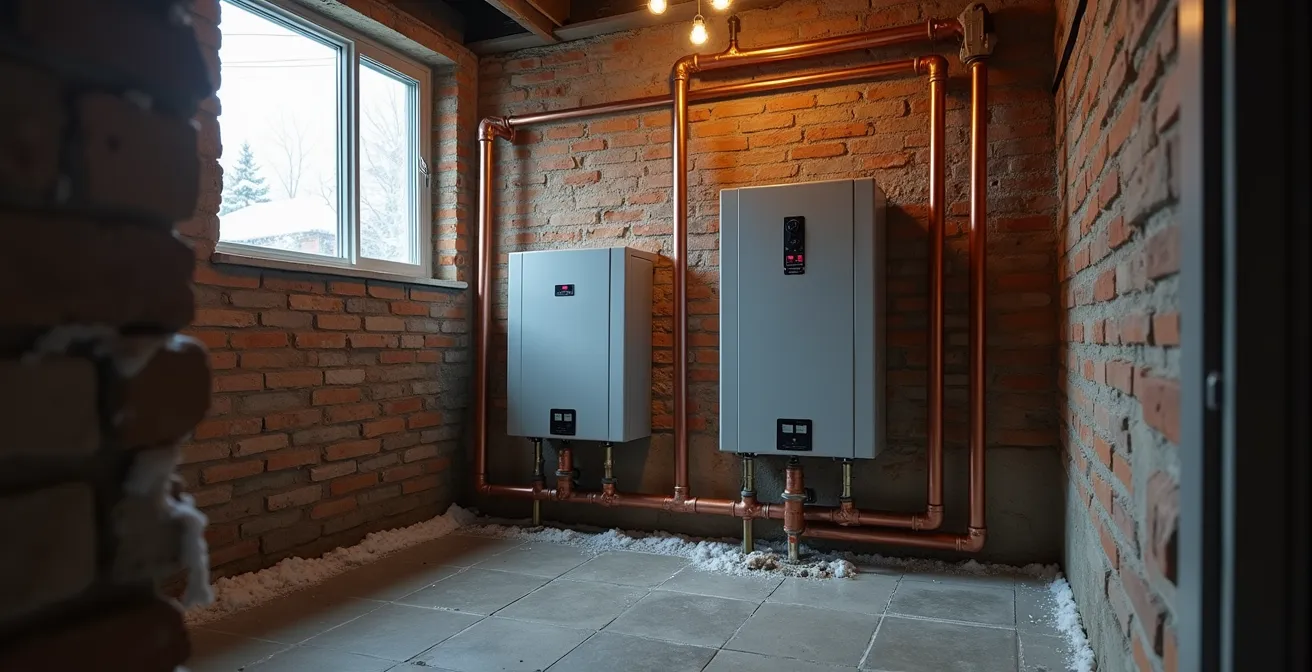
A tankless water heater in Quebec is a long-term play, with a break-even point often longer than you think due to high upfront costs and low electricity rates.
- Factor in mandatory electrical panel upgrades, which can add thousands to the initial price before the unit is even installed.
- Your unit’s real-world performance depends on its GPM flow rate’s ability to handle Montreal’s near-freezing winter water temperatures.
Recommendation: Calculate your Total Cost of Ownership (TCO), comparing the full installation price against your current tank rental fees and projected energy savings over at least 10 years before making a decision.
For many Quebec homeowners, the bulky, inefficient water tank humming away in the basement is a familiar sight—often a rental unit with a monthly fee that feels like a permanent fixture. The promise of a tankless water heater seems compelling: endless hot water, significant energy savings, and reclaiming valuable floor space. It’s presented as the modern, efficient solution for energy transition and home optimization.
However, the conversation often stops at these surface-level benefits. The reality for a homeowner in Montreal debating this switch is far more complex. The true value of a tankless unit isn’t just in its purchase price but in a series of critical, and often costly, secondary factors. The upfront investment extends well beyond the hardware, involving substantial electrical work, and the long-term performance hinges on maintenance tailored to local conditions.
But what if the key to making the right decision wasn’t just comparing energy efficiency ratings, but conducting a rigorous return on investment (ROI) analysis specific to the Quebec context? With Hydro-Québec’s unique rate structure and our demanding climate, the financial break-even point can be surprisingly distant. This analysis is about moving past the marketing and getting to the real numbers.
This article will serve as your energy consultant’s guide, breaking down the crucial financial and practical considerations. We will dissect the hidden costs, performance realities, and maintenance obligations to equip you with the data needed to determine if a tankless water heater is truly a worthwhile investment for your specific situation in Quebec.
To navigate this decision, we will explore the essential questions you need to ask, from electrical requirements and maintenance to true operational costs. The following sections provide a detailed roadmap for your analysis.
Summary: A Quebec Homeowner’s Guide to Tankless Water Heaters
- Why Does a Tankless Unit Require a 60-Amp Electrical Upgrade?
- How to Flush a Tankless Heater to Prevent Scale Buildup?
- Gas vs. Electric Tankless: Which Is More Efficient for Large Families?
- The Mistake of Undersizing GPM Flow Rate for Winter Temperatures
- Where to Mount the Unit to Reclaim Maximum Closet Space?
- On-Demand vs. Storage Tank: Which Is Cheaper at current kWh Rates?
- Central Boiler vs. In-Suite Tankless: Which Is Better for Penthouses?
- Is the Energy Star Label Worth the Extra Cost for Water Heaters?
Why Does a Tankless Unit Require a 60-Amp Electrical Upgrade?
The primary reason an electric tankless water heater demands a significant electrical upgrade is its method of operation: instantaneous, high-power energy consumption. Unlike a storage tank that slowly heats water over time using a modest 30-amp circuit, a tankless unit needs to raise cold water temperature by over 35°C in seconds. This requires a massive, immediate surge of power, typically demanding two dedicated 40-amp or 60-amp breakers.
For many older Montreal homes, which may still operate on a 100-amp main panel, this is a non-starter. The panel simply lacks the capacity to handle this load alongside other household appliances. Consequently, the installation of a tankless unit often necessitates a full panel upgrade to 200 amps. This isn’t a simple component swap; it’s a major electrical project that involves a licensed Maître Électricien and coordination with Hydro-Québec.
This upgrade is the most significant “hidden cost” of going tankless. While the unit itself might cost $1,000 to $2,000, the electrical work can easily eclipse that figure. In fact, according to Montreal plumbing contractors, electrical panel upgrades can cost from $2,000 to $5,000 or more, depending on the complexity of the job. This capital expenditure dramatically alters the ROI calculation and must be the first financial checkpoint for any homeowner considering the switch.
Before even pricing out tankless models, the first step is a professional assessment of your home’s electrical infrastructure. This will determine if the project is financially viable from the outset. The process for this essential prerequisite is rigorous and involves multiple steps, including obtaining proper permits and passing inspections as mandated by the Quebec Construction Code.
How to Flush a Tankless Heater to Prevent Scale Buildup?
While tankless heaters eliminate the risk of a tank rupture, they introduce a new mandatory maintenance task: descaling. The water in Montreal is considered moderately hard; Montreal’s water hardness typically ranges from 110-140 PPM (parts per million). This means it contains dissolved minerals like calcium and magnesium that, when heated rapidly, precipitate out and form limescale. This scale buildup coats the interior of the heat exchanger, acting as an insulator.
This buildup has two detrimental effects. First, it forces the unit to work harder and consume more energy to achieve the target water temperature, eroding your expected energy savings. Second, if left unchecked, the scale can restrict water flow and eventually cause the unit to overheat and fail, leading to a costly replacement. Therefore, flushing the unit every 12 to 18 months is not optional—it’s essential for protecting your investment and maintaining its efficiency.
The flushing process involves circulating a specialized descaling solution (usually a food-grade acid like vinegar) through the unit for about an hour using a small pump and a set of service valves. Homeowners can purchase a DIY kit, but it requires some technical comfort. Alternatively, a professional plumber can perform the service. Factoring this recurring task into the total cost of ownership is crucial for an accurate ROI analysis.
The choice between DIY and professional service comes down to a trade-off between cost and convenience. Below is a breakdown of what a Montreal homeowner can expect, highlighting the severe financial consequence of neglecting this critical maintenance.
| Service Type | Cost Range | Frequency Needed | Time Required |
|---|---|---|---|
| DIY Flush Kit | $150-250 | Every 12-18 months | 2-3 hours |
| Professional Service | $250-400 | Every 12-18 months | 1-2 hours |
| Replacement if Neglected | $3000+ | After 5-7 years | 4-6 hours |
Gas vs. Electric Tankless: Which Is More Efficient for Large Families?
For a large family in Quebec, the choice between a gas and an electric tankless water heater hinges on a balance of raw power, operational cost, and environmental considerations. In terms of pure heating capacity, natural gas units typically offer a higher GPM (gallons per minute) output at a given temperature rise. This makes them better suited for households with high simultaneous demand, such as running two showers and a dishwasher at the same time, a common scenario for a large family.
However, the Quebec context adds a crucial layer to this decision. From an environmental and long-term cost perspective, electric models have a distinct advantage. This is because, as energy analysts often point out, since Quebec’s electricity grid is powered by 99% renewable hydro, using an electric unit results in nearly zero direct carbon emissions. Furthermore, Hydro-Québec’s rates are among the most competitive in North America, making the operational cost of electric heating very attractive.
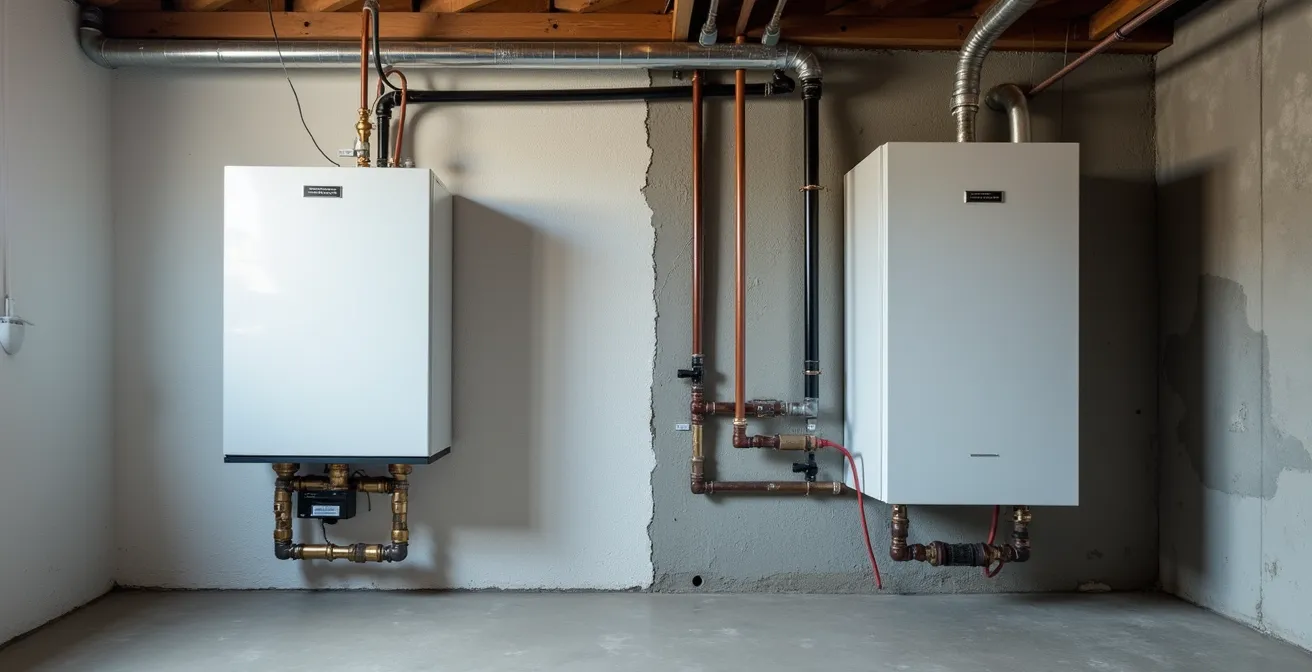
The trade-off is system resilience. While electric units are clean and efficient, they are completely dependent on the power grid. As many Quebecers know from experience with ice storms, power outages can be a serious concern. In such an event, a natural gas heater would continue to provide hot water, offering a level of resilience that an electric model cannot. Some experts express reservations about relying solely on electric units in Quebec precisely because of these unique climate-related vulnerabilities. For a large family, the inconvenience of having no hot water during an extended winter outage could be a significant factor.
Ultimately, the “most efficient” choice is not just about the unit’s energy factor rating. For a large Quebec family, it requires weighing the superior simultaneous output and resilience of gas against the cleaner, and often cheaper-to-run, power of an electric model drawing from the province’s vast hydro resources.
The Mistake of Undersizing GPM Flow Rate for Winter Temperatures
Perhaps the single biggest mistake a Quebec homeowner can make when selecting a tankless water heater is underestimating the impact of our severe winters on performance. The “gallons per minute” (GPM) rating advertised on a unit is not an absolute figure; it is directly dependent on the required “temperature rise”—the difference between the incoming cold water temperature and the desired hot water output (typically around 42°C or 107°F).
In summer, the incoming water from Montreal’s municipal supply might be 15°C (60°F), requiring a temperature rise of only 27°C. However, in the depths of winter, Montreal’s winter inlet water temperature drops to approximately 4°C (40°F). This means the unit must work much harder to achieve a temperature rise of 38°C. This increased demand drastically reduces the unit’s maximum GPM output. A heater that can supply 5 GPM in the summer might only supply 3 GPM in January.
Undersizing the unit for winter conditions leads to frustrating real-world problems. It can result in a lukewarm shower if another tap is turned on, or fluctuating water temperatures. This is where the promise of “endless hot water” breaks down. To avoid this, it’s crucial to size the unit based on winter performance and your household’s peak simultaneous usage. A consultant would advise calculating your maximum simultaneous GPM need and then choosing a model that can meet that need with a 38°C temperature rise.
Failing to account for this temperature delta is the primary cause of dissatisfaction with tankless systems in cold climates. It’s a costly error that locks you into a system that underperforms when you need it most. A proper GPM audit is therefore a non-negotiable step in the selection process.
Your GPM Calculation Checklist for Montreal Winters
- List all hot water fixtures in your home (e.g., showers, kitchen sink, dishwasher, laundry).
- Calculate your realistic simultaneous usage needs (a typical modern shower uses 2-2.5 GPM, a faucet uses 1-1.5 GPM).
- Ensure your calculation uses Montreal’s 4°C inlet temperature, which requires a significant 38°C temperature rise for a standard hot shower.
- Add a 20-30% capacity buffer to handle extreme cold snaps when temperatures drop well below -20°C and inlet water is even colder.
- For larger or split-level homes, consider if a recirculation pump is needed to reduce wait times for hot water at distant fixtures.
Where to Mount the Unit to Reclaim Maximum Closet Space?
One of the most celebrated benefits of a tankless water heater is its compact, space-saving design. In Montreal, where space in older homes, triplexes, and condos can be at a premium, this is a major selling point. By replacing a 40 or 60-gallon tank—which can occupy 10-15 square feet of floor space—with a wall-mounted unit the size of a small suitcase, you can reclaim an entire utility closet or a significant portion of your basement.
The key to maximizing this benefit lies in strategic placement. Unlike a tank, which is bound to the floor, a tankless unit offers mounting flexibility. The ideal location balances three factors: proximity to main plumbing lines, access to the required electrical or gas connection, and the potential for new space utilization. Many homeowners in areas like the Plateau-Mont-Royal choose to mount their units directly on a basement or utility room wall, immediately freeing up the floor area for storage, a small workshop, or even laundry appliances.
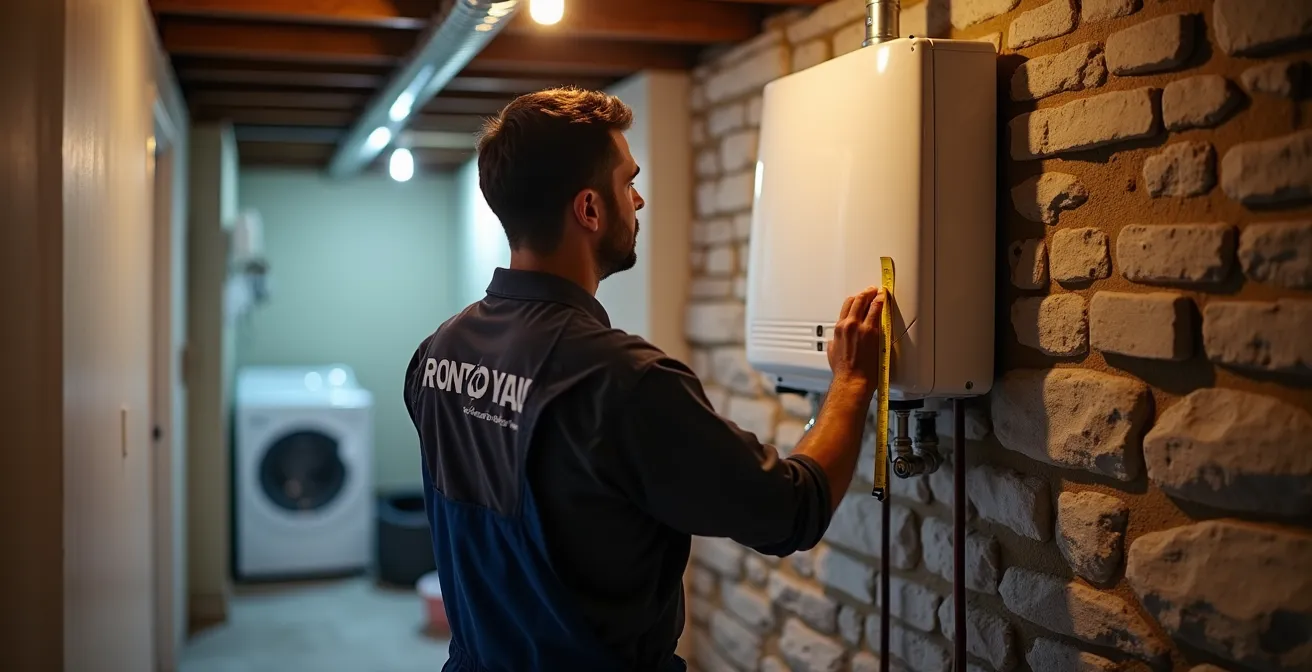
While the temptation is to hide it away, accessibility for maintenance is crucial. The unit must be installed in a location where a technician can easily access the service valves for the annual descaling flush. It also requires proper clearance from walls and other objects as specified by the manufacturer for ventilation and safety. A professional installer will help identify a location that meets both code requirements and your space-reclamation goals.
For those in apartments or condos, indoor electric tankless models are often the most logical solution, as they don’t require the extensive venting that gas units do. A small unit can often be tucked away inside a kitchen or bathroom cabinet, freeing up precious closet space that was once dedicated to a small storage tank. The value of this reclaimed space should be considered a tangible part of the return on your investment.
On-Demand vs. Storage Tank: Which Is Cheaper at current kWh Rates?
This is the central question for any homeowner focused on ROI. At first glance, the answer seems obvious. A conventional storage tank constantly reheats a large volume of water to compensate for “standby loss”—heat that dissipates through the tank walls into the surrounding air. This can account for 15-20% of its total energy use. A tankless heater, by contrast, has virtually zero standby loss because it only consumes energy when you turn on a hot water tap.
This fundamental difference in operation is why tankless water heaters are significantly more energy-efficient. However, efficiency does not automatically equal massive cost savings, especially in Quebec. Hydro-Québec’s residential “Rate D” is among the lowest in North America. While a tankless unit might use less energy, each kilowatt-hour it saves is worth less financially than it would be in a high-cost energy market like Ontario or California.
To find the true cost difference, you must calculate the Total Cost of Ownership (TCO). This involves adding the high upfront installation cost (including electrical upgrades) to the projected annual operating costs and comparing that total to the cost of continuing to rent and operate your existing tank over the same period. The key is the break-even point: how many years will it take for the accumulated energy savings to pay off the initial investment?
The following table provides a generalized analysis for a Quebec homeowner, illustrating the long-term financial dynamics. It shows that while annual savings are real, the payback period is not immediate.
| Water Heater Type | Annual Energy Cost | Lifespan | Standby Loss |
|---|---|---|---|
| Electric Storage Tank (60 gal) | $450-550 | 10-12 years | 15-20% energy loss |
| Electric Tankless | $300-400 | 15-20 years | Zero standby loss |
| Break-even Point | 5-7 years with Hydro-Québec rates | ||
Central Boiler vs. In-Suite Tankless: Which Is Better for Penthouses?
For residents of Montreal penthouses or high-rise condos, the hot water decision involves an additional layer of complexity: building regulations and infrastructure. Many condo buildings utilize a central boiler system that supplies hot water to all units, with the cost embedded in the monthly condo fees. In this scenario, installing a private in-suite tankless heater is often not feasible or permitted.
However, in buildings where each unit is responsible for its own hot water, a tankless heater becomes a very attractive option. For a penthouse, which often has higher-end finishes and a greater demand for space efficiency, replacing a bulky in-suite storage tank with a compact tankless unit can be a significant upgrade. It frees up valuable closet or utility space and offers the luxury of continuous hot water for large soaker tubs or multi-head showers.
The primary hurdle is getting approval from the syndicat de copropriété (condo board). The board’s main concern will be the electrical load. An electric tankless heater’s high power draw could potentially strain the building’s overall electrical infrastructure if multiple units were to install them. A formal request must be submitted, typically including a detailed installation plan from a licensed plumber and an assessment of the electrical impact.
The approval process in Quebec is formal and requires diligence. A homeowner must:
- Review the condo’s declaration and bylaws for any restrictions on plumbing or electrical modifications.
- Prepare a detailed plan with technical specifications from certified professionals.
- Formally submit the request to the syndicate, addressing potential impacts on building systems.
- Obtain written approval and ensure all liability insurance documentation is in order before any work begins.
For a penthouse owner, the benefit of on-demand hot water and reclaimed space is high, but it must be weighed against the administrative process and potential infrastructure limitations of a multi-unit dwelling.
Key Takeaways
- The true cost of a tankless heater must include potential electrical panel upgrades, which can double the initial investment.
- Sizing the unit for Montreal’s 4°C winter water temperature is critical to avoid poor performance and buyer’s remorse.
- The financial break-even point in Quebec is longer than in other regions due to low electricity rates, requiring a 7-10 year ROI calculation.
Is the Energy Star Label Worth the Extra Cost for Water Heaters?
The Energy Star label is widely recognized as a benchmark for energy efficiency. For appliances like water heaters, a certified model promises lower energy consumption and reduced utility bills. This often comes with a higher upfront purchase price. As an energy consultant, the question I must answer is: does this premium deliver a positive return on investment for a Quebec homeowner?
Surprisingly, for tankless water heaters in Quebec, the math is not always favourable. While an Energy Star model is incrementally more efficient, the actual dollar savings are muted by Hydro-Québec’s already low electricity rates. The premium paid for the label might be several hundred dollars, but the additional savings it generates each year could be minimal. In fact, some analyses suggest that the payback period for Energy Star models in Quebec can be 15-20 years—longer than the expected lifespan of the unit itself. In this scenario, paying the premium would result in a net financial loss.
However, there is a crucial exception: government grants. Programs like Quebec’s Rénoclimat program often provide financial assistance for installing high-efficiency home systems. To be eligible for these grants, the water heater must typically be an approved, high-efficiency model, which often means it needs to be Energy Star certified. If a significant grant is available, it can completely offset the premium cost of the Energy Star label, making it an immediately worthwhile choice.
Therefore, the decision should not be based on the label alone. A homeowner must first investigate current provincial and federal grants. If a grant effectively covers the cost difference, choosing the Energy Star model is a clear win. If no such grants are available, it is often more financially prudent to choose a standard-efficiency tankless model from a reputable brand and invest the savings elsewhere.
To determine if a tankless system is the right financial and practical move for your home, the next logical step is to get a detailed assessment from both a licensed Maître Électricien to evaluate your panel’s capacity and a certified plumber to calculate your specific GPM needs.