
For a Montreal restaurateur, a grease trap is not just plumbing hardware; it’s a critical defense against specific regulatory liabilities and operational failures unique to Quebec.
- Failing to account for Montreal’s extreme winter temperatures leads to rapid FOG solidification and costly blockages.
- Using prohibited additives like enzymes results in direct violations of the Quebec Construction Code and city fines, even if they seem to work temporarily.
- Ignoring mandatory CMMTQ certification for installers invalidates your setup and exposes you to severe RBQ penalties from day one.
Recommendation: Base your grease trap strategy on a worst-case scenario analysis—factoring in peak winter conditions and strict local codes—not just on generic flow rate calculations.
Opening a restaurant in Montreal is a high-stakes venture where every detail counts. While you focus on the menu, staff, and ambiance, a critical piece of infrastructure often gets overlooked until it causes a catastrophic failure: the grease trap. Many new owners believe that simply installing a unit based on seating capacity is enough. They follow generic advice about “regular cleaning” and consider the job done. This is a significant miscalculation in the demanding regulatory and climatic environment of Quebec.
The reality is that a grease trap in Montreal operates under unique pressures. The conversation can’t just be about preventing clogs; it must include the specific physics of fats, oils, and grease (FOG) in sub-zero temperatures, the non-negotiable mandates of the Régie du bâtiment du Québec (RBQ), and the financial penalties enforced by the city for non-compliance. Standard practices that work elsewhere can lead to emergency shutdowns and hefty fines here.
This guide moves beyond the basics. We will not just tell you to “follow the rules.” We will dissect the most common and costly errors Montreal restaurateurs make regarding their grease interceptors. The true key to compliance and operational efficiency lies not in simply having a grease trap, but in understanding how to manage it as a strategic asset against the specific challenges of this city. From material selection against effluent acidity to the absolute prohibition on certain additives, we will outline the practical, regulatory-focused steps to ensure your system is a safeguard, not a liability.
This article provides a detailed breakdown of the critical factors you must consider. From understanding the impact of winter on your pipes to the legal requirements for installation and maintenance, each section is designed to equip you with the knowledge to make informed, cost-effective decisions for your establishment.
Summary: Navigating Grease Trap Regulations and Realities in Montreal
- Why Do Fats, Oils, and Grease Solidify Faster in Winter Pipes?
- How to Clean a Manual Grease Trap Without Violating Sanitation Codes?
- Stainless Steel or Polyethylene: Which Trap Lasts Longer in Acidic Environments?
- The Error of Skipping Monthly Pump-Outs That Results in City Fines
- When to Use Bacterial Additives to Reduce Pumping Frequency?
- Why High PSI Cuts Grease While Low PSI Just Moves It?
- The Error of Ignoring RBQ Codes That leads to Heavy Fines
- Why Does Hydro-Jetting Clean Drains Better Than a Mechanical Snake?
Why Do Fats, Oils, and Grease Solidify Faster in Winter Pipes?
The primary function of a grease trap is to cool wastewater, allowing fats, oils, and grease (FOG) to separate and float to the top. However, in Montreal, the external environment dramatically accelerates this process, creating a significant operational risk. During winter, drain lines, especially those with any exposure to exterior walls or unheated spaces, are subjected to frigid ambient temperatures. This creates a “shock cooling” effect on the warm effluent leaving your kitchen sinks and dishwashers.
Research shows that drain pipes become vulnerable to freezing when temperatures drop below -4°C, a common occurrence during Montreal winters. While the water itself may not freeze instantly due to its flow, the FOG it carries is far more sensitive. As the greasy water passes through cold pipe sections, the FOG rapidly solidifies and adheres to the pipe walls, layer by layer. This process is much more aggressive than the gradual buildup seen in warmer climates. An undersized or improperly maintained exterior interceptor can become completely ineffective.
The consequences of this rapid solidification are severe. In extreme cold, which can reach -30°C in Montreal, water can freeze inside pipes already narrowed by grease, blocking flow entirely. This can lead to wastewater backing up into your kitchen—a health code violation and an operational nightmare. Furthermore, the pressure from the blockage can crack pipes at their weakest points, such as joints and valves, leading to expensive emergency repairs. This is not a simple clog; it’s a systemic failure directly caused by underestimating the impact of local climate on your plumbing infrastructure.
How to Clean a Manual Grease Trap Without Violating Sanitation Codes?
Properly cleaning a grease trap is not just a matter of hygiene; it is a regulated process in Montreal. Improper cleaning or disposal can lead to the same fines as not having a trap at all. The goal is to remove the captured FOG and solid waste from the premises entirely, not to flush it further down the drain. Using hot water, detergents, or emulsifiers to break up the grease inside the trap and wash it away is a direct violation of municipal bylaws, as the grease will simply re-congeal downstream and cause blockages in the public sewer system.
The City of Montreal and surrounding municipalities mandate that the waste from a grease trap be removed by a licensed waste hauler. This ensures the FOG is transported to a designated processing facility and not illegally dumped. As a restaurateur, you are required to obtain and keep a service manifest or receipt from the hauler for every pump-out. This documentation is your proof of compliance during a health or sanitation inspection. Failure to produce these records can result in significant penalties.
To avoid regulatory liability, cleaning must be methodical. It involves completely skimming the solidified FOG layer, scraping the baffles and walls, and removing the solid food waste that has settled at the bottom. This collected waste must be placed in a sealed container for pickup by your licensed hauler. As stated by Municipal Grease Trap Regulations, “The use of biological additives, including enzymes, into drainage pipes leading to grease capturing equipment is prohibited”, making manual removal the only compliant method.
Action Plan: Montreal-Compliant Manual Grease Trap Cleaning
- Turn off all water supply to the kitchen fixtures connected to the trap to prevent new flow during cleaning.
- Allow the water in the trap to cool for 10-15 minutes after the kitchen closes, enabling the grease to solidify for easier removal.
- Carefully remove the grease trap’s cover, being mindful to avoid spilling any of the contents.
- Skim and scoop out the top layer of solidified FOG using a scraper, placing it directly into a dedicated waste container.
- Remove all solid food waste and sludge from the bottom of the trap and scrape the walls and baffles clean.
Stainless Steel or Polyethylene: Which Trap Lasts Longer in Acidic Environments?
The choice of material for your grease trap is a long-term investment decision that directly impacts its lifespan and maintenance costs. In a busy Montreal restaurant, the trap will be exposed to more than just FOG; it will handle a constant flow of acidic detergents, sanitizers, and food byproducts like vinegar and citrus. This creates a corrosive environment, or high effluent acidity, which can degrade certain materials over time.
This paragraph introduces a complex concept. To better understand the options, it is useful to visualize their properties. The illustration below highlights the textural differences between two common materials.
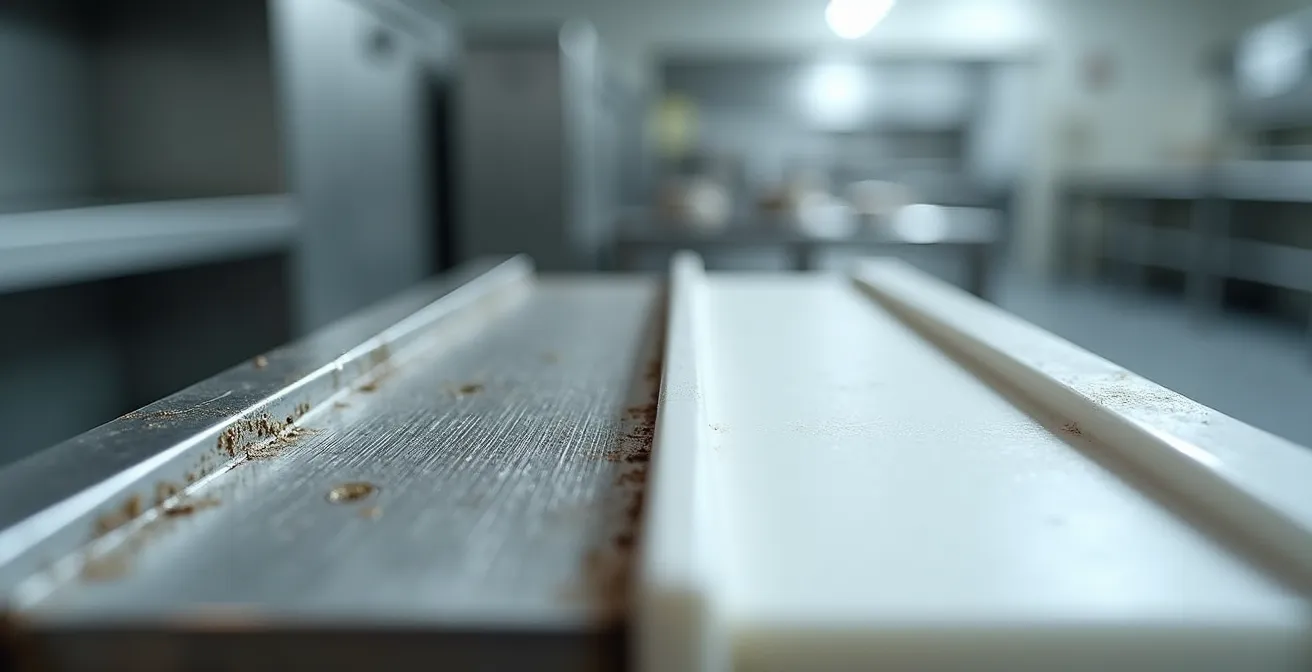
As the image shows, the materials have distinct characteristics. Stainless steel, particularly grade 304, is a common choice for its durability and heat resistance. However, it can be susceptible to pitting and corrosion over many years of exposure to highly acidic or chloride-rich waste (e.g., from certain cleaning agents). Grade 316 stainless steel offers superior corrosion resistance due to its molybdenum content but comes at a significantly higher initial cost. Polyethylene (HDPE) traps, on the other hand, are inherently resistant to a wide range of chemicals and acids, making them an excellent choice for environments with high effluent acidity. While perhaps perceived as less robust, modern HDPE traps are extremely durable and will not rust or corrode.
The following table provides a clear comparison to help you make a decision based on your restaurant’s specific menu, cleaning protocols, and budget. An establishment specializing in acidic food preparations may find polyethylene offers a better long-term value, while a standard restaurant might prefer the established track record of stainless steel.
| Material | Initial Cost | Acid Resistance | Lifespan | Best For |
|---|---|---|---|---|
| 304 Stainless Steel | High ($3000-5000) | Moderate | 15-20 years | Standard restaurants |
| 316 Stainless Steel | Very High ($4000-7000) | Excellent | 20-25 years | High-acid environments |
| Polyethylene (HDPE) | Moderate ($2000-3500) | Excellent | 15-20 years | Acidic food service |
| Polypropylene | Low-Moderate ($1500-2500) | Good | 10-15 years | Budget-conscious operations |
The Error of Skipping Monthly Pump-Outs That Results in City Fines
One of the most dangerous forms of operational negligence is inconsistent grease trap maintenance. Many restaurateurs, trying to save on service costs, push pump-outs from a monthly to a quarterly schedule, or even longer. This is a false economy that almost inevitably leads to much higher costs in the form of fines, emergency repairs, and business interruptions. The “25% Rule” is the industry standard and a common requirement in municipal bylaws: a grease trap must be pumped out once the combined FOG and solids have displaced 25% of its liquid volume. For a busy restaurant, this threshold is often reached in 30 days or less.
When a trap exceeds this capacity, it can no longer effectively separate FOG. Grease-laden water flows directly into your drain lines and, eventually, the municipal sewer. This is precisely the scenario the regulations are designed to prevent. If a sewer backup occurs in your area and an investigation traces the blockage back to FOG from your establishment, the consequences are severe. City bylaws are clear: any costs incurred by the municipality to clear a grease-blocked sewer or repair damage will be charged back to those responsible. These costs can run into thousands of dollars, far exceeding the price of regular maintenance.
The Real Cost of a Neglected Grease Trap
A Montreal restaurant that skips regular pump-outs not only risks municipal fines but also faces a high probability of an in-house emergency. A complete blockage can force a shutdown for cleaning and repairs. According to industry data, the average cost of an emergency vendor dispatch for a grease trap issue is over $960. This doesn’t include the lost revenue from being unable to operate, which can easily double or triple the financial impact of a single incident.
Ultimately, a consistent, documented pump-out schedule is not an expense; it’s an insurance policy against catastrophic operational failure and regulatory liability. Most businesses find that a monthly to quarterly cleaning schedule, depending on their volume, provides the best balance of cost and protection.
When to Use Bacterial Additives to Reduce Pumping Frequency?
The answer, according to Quebec law, is unequivocally never. This is one of the most critical and misunderstood areas of grease trap management in Montreal. A market of chemical and biological products—often marketed as “enzymes,” “bacteria,” or “drain cleaners”—claims to “digest” or “dissolve” grease, reducing the need for pump-outs. While these claims may seem appealing, the use of these agents in a food service facility is strictly prohibited by the Quebec Construction Code.
The regulation is clear and absolute. As the Quebec Construction Code, Chapter III – Plumbing, states in section B481.4.07, an operator of a food service facility “shall not use or permit the use of chemical agents, enzymes, bacteria, solvents, hot water, or other agents to facilitate the passage of FOG through a grease interceptor.” The rationale is based on simple science: these additives do not eliminate grease. They merely break it down into smaller droplets (emulsify it), allowing it to pass through the trap and into the municipal sewer system. Once in the cooler sewer lines, the grease re-congeals, causing massive blockages downstream.
A restaurateur who uses these products is fully responsible for the consequences. If a downstream blockage is traced back to your establishment, you will be liable for municipal bylaw fines and the full cost of the sewer cleanup, regardless of whether you used the additive knowingly or not. The only legally recognized methods for managing FOG are physical removal through a properly sized and maintained interceptor or the installation of an approved automatic grease removal device (AGRD) that mechanically skims and collects grease daily. Relying on additives is a direct path to non-compliance and significant financial risk.
Why High PSI Cuts Grease While Low PSI Just Moves It?
When facing a severely clogged drain line, a mechanical snake often seems like the go-to solution. However, in a commercial kitchen environment, a snake provides only a temporary fix. It typically punches a hole through the solidified grease, restoring partial flow, but leaves a significant amount of FOG clinging to the pipe walls. This remaining buildup acts as a seed for the next blockage, which often occurs within a few months. Hydro-jetting, by contrast, offers a definitive cleaning solution through the strategic application of high-pressure water.
The effectiveness of hydro-jetting lies in its force. Professional services utilize powerful pumps to deliver high-pressure water (up to 4,000 psi) through specialized nozzles. This intense pressure acts like a surgical tool, cutting through the dense, hardened layers of grease and scouring the pipe walls clean. It doesn’t just poke a hole; it restores the pipe to its full original diameter. Low-pressure systems, or even a standard pressure washer, lack the force to cut through years of accumulated FOG and will merely move the clog further down the line, potentially creating a worse problem.
This paragraph introduces a professional technique. The illustration below shows a certified technician performing this specialized service.
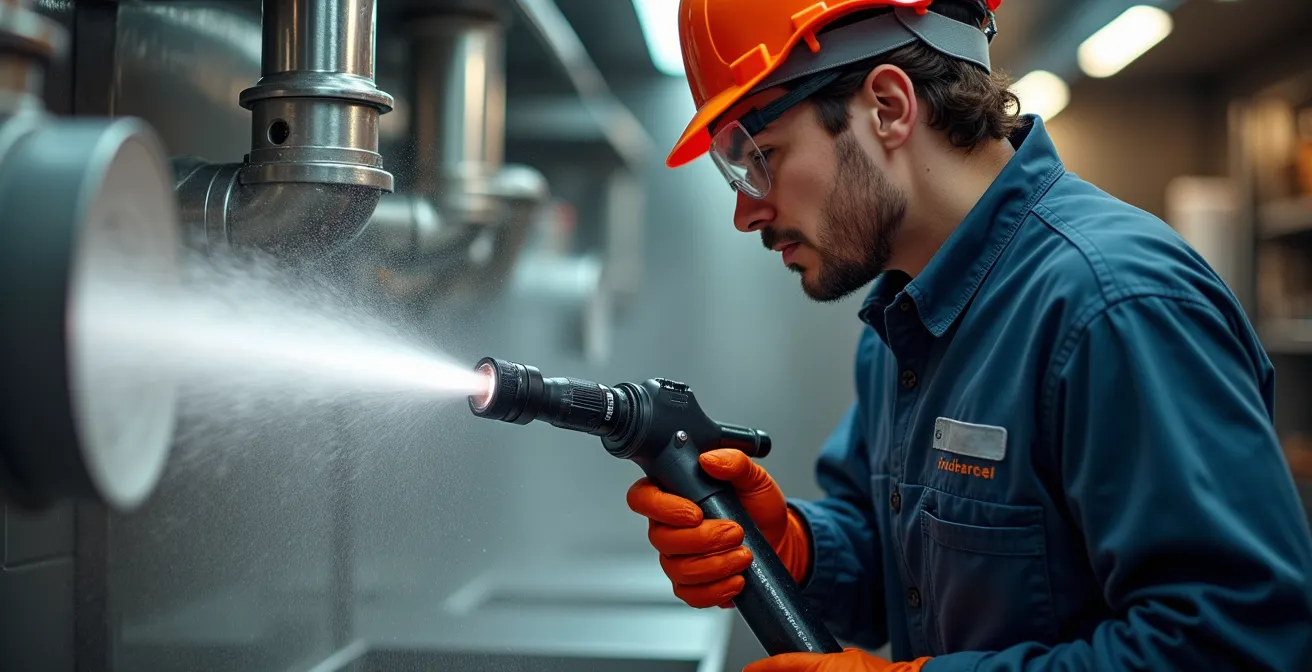
As the image demonstrates, this is a job for trained professionals. Many advanced Montreal plumbing services use a dual-system approach. They might use a lower pressure of 1500 PSI with hot water to initially break down and melt surface-level grease, leveraging thermal energy. Then, they switch to the 4,000 PSI stream to obliterate the stubborn, underlying layers and flush all debris out of the system. This combination of thermal and kinetic energy results in a flawlessly clean drain system that remains clear for much longer than a snaked line, preventing frequent and costly business interruptions.
The Error of Ignoring RBQ Codes That leads to Heavy Fines
In Quebec, the installation of plumbing systems, including grease traps, is not a job for a general handyman. It is a regulated trade governed by the RBQ and the CMMTQ (Corporation des maîtres mécaniciens en tuyauterie du Québec). One of the most severe and easily avoidable errors a new restaurateur can make is hiring an uncertified individual to install their grease trap. This single mistake can invalidate the entire system from a legal standpoint, leading to orders to remove and reinstall it correctly at a massive cost.
The CMMTQ-Certified Mandate is absolute. Only a master pipe-fitter holding this certification is legally authorized to perform the installation. Reputable commercial plumbing companies in Montreal will always highlight this certification, as it is the primary mark of legitimacy. As the team at Abe Cohen Plumbing, a long-standing Montreal service, states, “We are certified and active members of CMMTQ”. This isn’t just a marketing point; it’s a declaration of legal compliance that protects both them and their clients.
Beyond hiring a certified professional, the installation itself must adhere to strict specifications outlined in Chapter III of the Quebec Construction Code. This includes ensuring the unit is properly vented to prevent siphoning and dangerous sewer gas buildup. There are also minimum clearance requirements to ensure the trap is fully accessible for service and inspection. Furthermore, a properly specified flow control device must be installed to regulate the water entering the trap, ensuring it has sufficient retention time to cool and separate FOG. Before the installation is covered or finalized, it may require an inspection by an RBQ official. Failing to follow these steps and document the process can result in heavy fines and a failed inspection, halting your ability to open.
Key Takeaways
- In Montreal, grease trap additives like enzymes and bacteria are strictly illegal under the Quebec Construction Code and lead to heavy fines.
- Regular, documented pump-outs by a licensed hauler are not optional; they are your primary defense against city-charged sewer cleanup costs and emergency shutdowns.
- Hydro-jetting provides a true, 360-degree pipe cleaning that lasts significantly longer than mechanical snaking, representing a better long-term investment for a busy kitchen.
Why Does Hydro-Jetting Clean Drains Better Than a Mechanical Snake?
For a restaurant owner, every maintenance decision is a financial one. When faced with a slow or blocked drain, the choice between a mechanical snake and hydro-jetting can seem like a simple matter of upfront cost. A snake is cheaper for a single service call. However, this perspective ignores the total cost of ownership and the high price of business interruption. A cost-benefit analysis reveals that hydro-jetting is almost always the more financially sound strategy for a commercial kitchen.
A mechanical snake, or auger, offers a temporary solution. It bores a path through the softest part of a grease clog but leaves a substantial amount of hardened FOG on the pipe walls. This residual grease ensures that the clog will reform quickly, leading to repeated service calls. Hydro-jetting, in contrast, provides a comprehensive, 360-degree cleaning of the pipe’s interior. The high-pressure water jets scour away all buildup, restoring the pipe to its original diameter and leaving a smooth surface that is less prone to future accumulation. The results last significantly longer, often 6 to 12 months or more, compared to the 1 to 3 months of relief a snake might provide.
When you factor in the cost of business interruption—lost revenue, staff downtime, and potential damage to your restaurant’s reputation from repeated plumbing emergencies—the financial argument becomes even clearer. As the following analysis shows, the higher initial cost of hydro-jetting is quickly offset by its superior effectiveness and the dramatic reduction in emergency service calls and associated downtime.
| Method | Initial Cost | Effectiveness | Duration of Results | Annual Cost (4 blockages) |
|---|---|---|---|---|
| Mechanical Snake | $175-$300 | Temporary hole through clog | 1-3 months | $700-$1,200 |
| Hydro-Jetting | $700-$1,000 | Complete pipe cleaning | 6-12 months | $700-$2,000 |
| Business Interruption Cost | $500-$2000/incident | Frequent with snaking | Rare with jetting | $2,000-$8,000 vs. $500 |
Frequently Asked Questions about Grease Traps in Montreal
Are bacterial additives legal in Montreal restaurants?
No. The direct addition of enzymes, chemical, and bacteria treatment to an interceptor is prohibited in Quebec. These treatments only dissolve grease enough for it to enter the wastewater system, where it re-congeals and causes major problems for which the restaurateur is liable.
What happens if I use additives anyway?
The restaurateur is still responsible for municipal bylaw fines and sanitary sewer clean-up costs if additives cause downstream problems. You are not absolved of liability simply because you used a commercially available product.
What’s the only legal way to reduce pumping frequency?
The only compliant ways to potentially reduce pump-out frequency are to either install a larger capacity trap that takes longer to reach the 25% fill threshold or to invest in an automatic grease removal device (AGRD) that mechanically removes grease daily. Both options must be approved by local authorities.