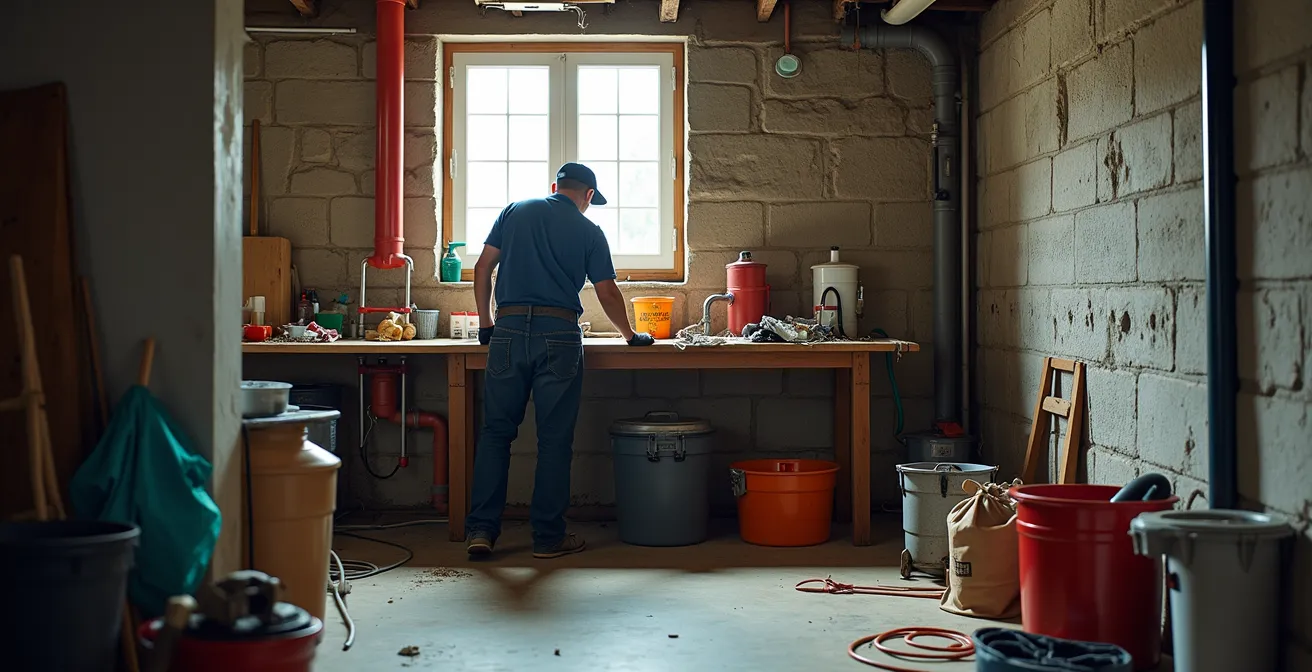
The key to replacing a cast-iron stack in a tenanted Plateau plex isn’t just about new pipes; it’s a strategic operation balancing modern diagnostics, minimal demolition, and tenant-centric scheduling.
- A camera inspection is the non-negotiable first step to avoid unnecessary and costly demolition.
- Epoxy lining can be a viable, less disruptive alternative to full replacement, preserving walls and floors.
- Scheduling the work in late spring or early fall avoids frozen ground and respects Quebec’s mandatory heating season.
Recommendation: Prioritize a diagnostic-first approach. Understand the exact cause and location of the failure before choosing between surgical replacement and trenchless lining to protect your investment and tenant relationships.
The charm of a Plateau Mont-Royal plex is undeniable, but behind the brick facades and spiral staircases lies a ticking clock: the original cast-iron plumbing. For a landlord, the sight of a weeping drain stack or a warning from an insurer is a moment of profound dread. It conjures images of demolished walls, displaced tenants, and spiraling costs. The common advice is to either brace for a full, disruptive gut job or to apply temporary patches that only delay the inevitable. This creates a false dilemma between financial ruin and tenant upheaval.
But this is a 21st-century problem that demands more than 20th-century solutions. The challenge isn’t just about replacing a pipe; it’s about performing a surgical intervention on a historic, inhabited building. The true measure of success is not just a leak-free system, but the preservation of your building’s character, your budget, and crucially, your relationship with your tenants. It requires a mindset shift from brute-force replacement to a diagnostic-led strategy.
This guide moves beyond the simple “rip and replace” mentality. We will explore a modern, strategic framework for tackling cast-iron failure in a Montreal context. We’ll analyze the root causes of pipe degradation specific to our region, evaluate the real costs and benefits of trenchless technology versus traditional methods, and outline a scheduling strategy that respects both tenants and Quebec’s strict seasonal regulations. The goal is to transform this daunting challenge from a catastrophe into a manageable, value-adding upgrade for your heritage property.
This article provides a structured approach to help you navigate this complex project. Below, the table of contents outlines the key stages of assessment, decision-making, and execution, designed specifically for the realities of managing a multiplex in Montreal.
Contents: A Strategic Guide to Cast-Iron Stack Replacement
- Why Do Cast-Iron Pipes Crack Vertically After 60 Years?
- How to Join New PVC to Old Cast-Iron with Fernco Couplings?
- Epoxy Lining vs. Replacement: Which Saves More on Demolition Costs?
- The Error of Ignoring Lead Joints in Pre-1950s Plumbing
- When to Schedule Stack Replacement to Minimize Impact on Heating?
- Why Ground Shifts During Thaw Misalign Your Main Sewer Line?
- Chemical Solvents vs. Augers: Which Is Safer for Old Pipes?
- How to Quiet Down Noisy ABS Drain Pipes in Ceilings?
Why Do Cast-Iron Pipes Crack Vertically After 60 Years?
The longevity of cast iron is legendary, with many systems outlasting their expected lifespan. However, after 60-80 years, these robust pipes often begin to fail in a specific way: with long, vertical cracks. This isn’t random decay; it’s a combination of internal corrosion and external stress. Internally, decades of exposure to acidic wastewater and sewer gases slowly corrode the pipe from the inside out. This process, known as graphitic corrosion, leeches iron from the pipe, leaving behind a brittle graphite structure that has the shape of the original pipe but lacks its strength.
Externally, the building itself exerts immense pressure. Minor foundation shifts, seasonal expansion and contraction of the structure, and vibrations all impose loads on the rigid pipe. A perfectly installed new stack can handle this, but a pipe weakened by internal corrosion cannot. It loses its tensile strength and becomes as fragile as glass. The vertical orientation of a stack concentrates these downward forces, and the pipe eventually splits along its length, which is its weakest axis under this type of stress.

In the Montreal area, this is compounded by soil conditions. While not as prevalent as in the Ottawa Valley, sensitive marine clays can be found in pockets of the region. As one soil analysis reveals, about one third of the Ottawa region contains sensitive marine Leda clay deposits, which can lose structural integrity when saturated. This geological reality means that even subtle ground movements can place immense, unforeseen shear forces on the section of the stack that passes through the foundation, accelerating its failure.
Why Ground Shifts During Thaw Misalign Your Main Sewer Line?
For any Montreal landlord, the spring thaw is a season of vigilance. While we watch for leaky roofs, a more insidious threat is happening underground. The annual freeze-thaw cycle exerts powerful forces on your building’s foundation and the buried main sewer line. When water in the soil freezes, its volume expands significantly. In fact, research shows that water in soil can freeze and expand by about 9%, a force strong enough to lift foundations and heave soil upwards. This phenomenon, known as “frost heave,” can misalign sections of your main drain.
As the ground thaws in the spring, the process reverses, but not uniformly. The soil settles, often unevenly, creating voids and shifting the ground that supports the sewer line. For a rigid cast-iron pipe, this is a recipe for disaster. A slight misalignment can crack a brittle, corroded section or, more commonly, break the seal at a joint. This creates a low point, or “belly,” in the pipe where solid waste and paper accumulate, leading to chronic backups that no amount of augering can permanently fix.
This problem is particularly acute in areas with Leda clay, a type of highly sensitive marine clay common in the St. Lawrence and Ottawa Valleys. This clay was deposited after the last Ice Age and has a unique, unstable structure. When saturated with water during the spring thaw, Leda clay can rapidly lose its strength, turning into a semi-liquid state that offers no support to the pipes buried within it. This can cause sudden, significant settling of the main sewer line, leading to catastrophic breaks or severe misalignments that require immediate and expensive excavation to correct.
The Error of Ignoring Lead Joints in Pre-1950s Plumbing
In Plateau plexes built before the 1950s, the cast-iron stack is not a single, monolithic tube. It is an assembly of sections connected with a now-obsolete method: lead and oakum joints. Oakum, a tar-impregnated fibrous rope, was packed into the bell-shaped hub of a pipe section, and then molten lead was poured over it to create a seal. For decades, this was a robust and reliable technique. However, time exposes its fundamental weakness.
As a plumbing specialist in heritage buildings notes, cast iron’s rigidity is its eventual downfall. Mister Plumber in Toronto explains the core issue clearly:
Cast iron can become brittle over time, and the forces of leverage and weight can cause it to form cracks due to its rigidity.
– Mister Plumber Toronto, Stack Pipes: Repairing and Replacing These Important Pipes
This brittleness is most dangerous at the joints. The lead, being a soft metal, can deform and sag over decades due to the building’s settling and vibrations. The oakum underneath can dry out, rot, and disintegrate, especially if exposed to sewer gases. This allows the heavy pipe sections to shift slightly, placing immense leverage on the rigid cast-iron hubs, which then crack. These failing joints are a primary source of slow leaks inside walls, leading to mould, wood rot, and the characteristic musty smell of an old building’s plumbing problems.
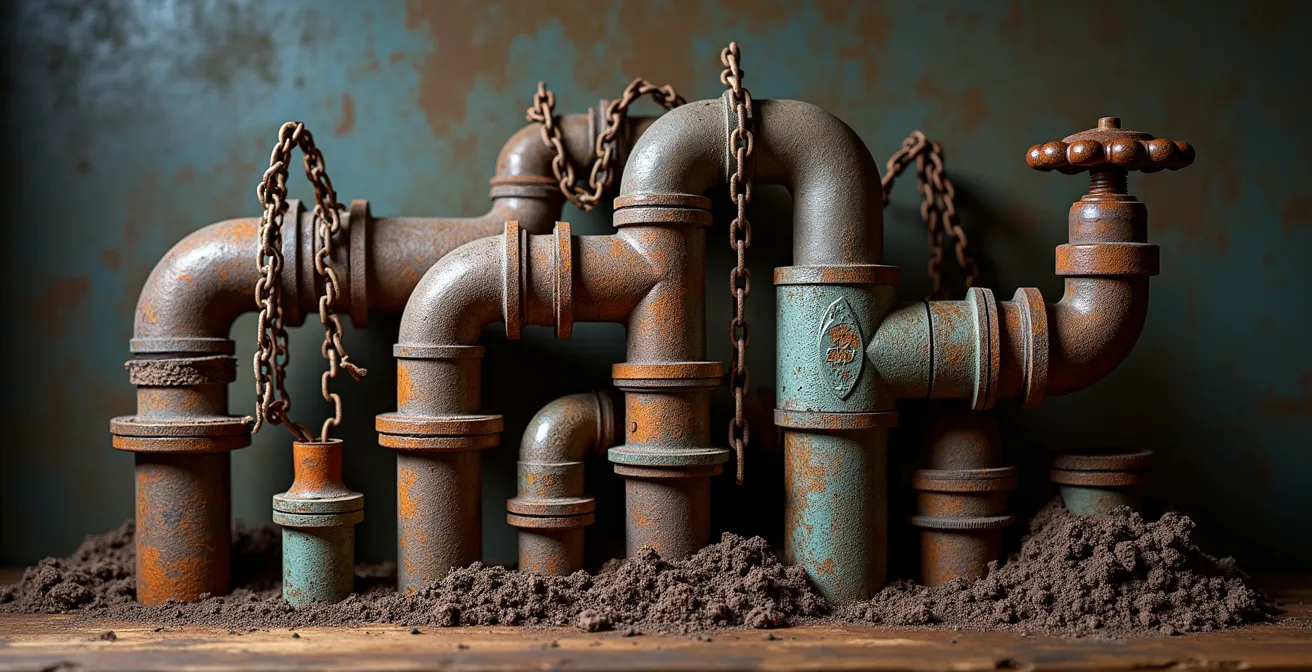
A frequent point of failure is the 90-degree bend at the base of the stack, often underground, where it transitions to the horizontal main drain. Decades of rust particles and debris accumulate in this elbow, creating a persistent blockage. The combination of a failing lead joint and a debris-filled bend creates a high-risk scenario for a major backup in the lowest level of the building.
Chemical Solvents vs. Augers: Which Is Safer for Old Pipes?
When a tenant reports a slow drain, the first instinct is often to reach for a quick fix. The two most common DIY or initial professional responses are chemical drain cleaners or a mechanical auger (snake). However, in a building with aging cast-iron plumbing, both of these “solutions” can be disastrously counterproductive. They treat the symptom—the clog—without understanding the health of the pipe itself, potentially turning a minor issue into a catastrophic failure.
Chemical solvents work by creating an exothermic reaction to dissolve organic matter. This intense heat can cause thermal shock in old, brittle cast iron, leading to new cracks. Furthermore, these harsh chemicals accelerate the corrosion of the pipe’s interior. A power auger, while effective for clearing simple blockages, is a blunt instrument. If the auger’s cutting head snags on a corroded, paper-thin section of the pipe wall or a displaced piece of a failing lead joint, it can easily shatter the pipe, causing a major leak inside a wall or ceiling.
This is why a diagnostic-first approach is non-negotiable. Before any intervention, a professional should perform a camera inspection. As the experts at Ontario Pipe Lining advise, this removes all guesswork:
Before you start ripping up floors or calling in a demolition crew, take a breath and book a sewer camera inspection service. This is the best first step — no guesswork, no assumptions. A camera gets threaded through the pipe and shows exactly where the issue is.
– Ontario Pipe Lining, How to Repair Cast Iron Sewer Pipe
A camera inspection reveals the true nature of the problem: Is it a simple clog? A belly in the pipe? A collapsed section? Or a tree root intrusion? Only with this visual evidence can you make an informed decision. The table below outlines the risks of acting blindly.
| Method | Risk to Old Pipes | Environmental Impact | Effectiveness |
|---|---|---|---|
| Chemical Solvents | Can stress brittle cast iron with heat | Harmful to wastewater treatment | Temporary solution |
| Power Auger | Can shatter compromised sections | Minimal environmental impact | May worsen cracks |
| Camera Inspection First | No risk – diagnostic only | None | Identifies real problem |
Epoxy Lining vs. Replacement: Which Saves More on Demolition Costs?
Once a camera inspection confirms that your cast-iron stack is failing, you face the primary strategic decision: full replacement or structural epoxy lining. The traditional approach, full replacement, involves opening up walls, ceilings, and sometimes floors along the entire length of the stack to remove the old pipe and install new PVC or ABS. While effective, this method is maximally disruptive and costly, not just in plumbing labour but in the extensive demolition and subsequent restoration work (drywall, plaster, tile, painting).
Trenchless epoxy lining, also known as Cured-In-Place Pipe (CIPP), offers a compelling, minimally invasive alternative. In this process, the existing pipe is first thoroughly cleaned and descaled. Then, a flexible, epoxy-saturated liner is inserted into the old pipe and inflated, pressing it against the interior walls. The epoxy cures, forming a brand-new, seamless, and structural pipe within the old one. The primary advantage is the near-total avoidance of demolition. Only a small access point is typically needed at the top or bottom of the stack.
For a landlord of a tenanted plex, the benefits are immense: work can often be completed in days instead of weeks, and tenants may only lose access to their plumbing for a few hours a day, rather than being forced to relocate. While the upfront cost of the specialized lining material and equipment can be high, the total project cost is often significantly lower when you factor in the savings on demolition and restoration. In some cases, industry estimates show that complete cast iron replacement can cost anywhere from $8,000 to $50,000 including water damage repairs, making the non-destructive nature of lining highly attractive.
The following table, based on an analysis of trenchless pipelining benefits, compares the key factors for a landlord.
| Factor | Epoxy Lining | Full Replacement |
|---|---|---|
| Base Cost | 60% less than excavation | $50,000+ for 2,000 sq ft home |
| Timeline | 3-4 days | Multi-week process |
| Tenant Disruption | Can use plumbing 20 hours/day | May require relocation |
| Floor/Wall Damage | No excavation needed | Requires floor removal |
| Warranty | 50-year transferable | Varies by contractor |
How to Join New PVC to Old Cast-Iron with Fernco Couplings?
In many cases, a full replacement isn’t necessary. A “surgical” repair, where only a damaged section of the cast-iron stack is removed and replaced with modern PVC or ABS pipe, is a cost-effective solution. The success of this hybrid approach hinges entirely on one critical component: the transition coupling. The gold standard for joining these dissimilar materials is a flexible coupling, commonly known by the brand name Fernco.
A Fernco coupling is a heavy-duty rubber sleeve with a stainless steel shear band and clamps. It’s designed to create a durable, watertight seal between two pipes of slightly different outside diameters, which is exactly the case when connecting modern plastic pipe to older cast iron. This is not a simple “hand gasket”; it is an engineered component that provides both a seal and structural support at the joint. A clean, square cut on the remaining cast-iron pipe is essential for a proper fit. A chain pipe cutter is the professional tool for this job, as it provides a much cleaner cut than a reciprocating saw or angle grinder.
The installation must be meticulous to prevent future leaks. The rubber sleeve must be fully seated on both the cast-iron and PVC pipe ends. The stainless steel clamps must then be tightened to the manufacturer’s specified torque using a torque wrench. Under-tightening will result in leaks, while over-tightening can damage the clamp or even crack the old cast-iron pipe. This is not a place to rush or guess.
Action Plan: Checklist for a Leak-Proof Transition Coupling
- Ensure the cast iron pipe is cut cleanly and squarely, with no jagged edges.
- Clean the exterior of both the cast iron and PVC pipe ends where the coupling will sit.
- Slide the flexible coupling completely onto one pipe end, then bring the second pipe into alignment and slide the coupling back to centre it over the joint.
- Use a torque wrench to tighten the stainless steel band clamps to the manufacturer’s specified inch-pounds (typically 60 in-lbs).
- After restoring water service, thoroughly inspect the joint for any signs of weeping or dripping and re-torque if necessary.
How to Quiet Down Noisy ABS Drain Pipes in Ceilings?
After successfully replacing a leaking cast-iron stack with modern ABS plastic pipe, landlords often face an unexpected new complaint from tenants: noise. The satisfying gurgle of a flushing toilet or draining sink, once muffled by the sheer mass of thick-walled cast iron, now becomes a loud, cascading waterfall sound inside the walls and ceilings. This is because the thin walls of ABS pipe do little to dampen the sound of tumbling water, a problem that can significantly impact tenant comfort and satisfaction.
Fortunately, there are several effective methods for soundproofing new drain pipes, with solutions available for different budgets and levels of disruption. The goal of all these methods is to either add mass to the pipe to block sound or to decouple the pipe from the building’s structure to prevent vibrations from travelling. Simply wrapping the pipe in standard fiberglass insulation is a common but minimally effective first step. It provides some thermal insulation but lacks the density needed for significant sound reduction.
A much better approach is to use specialized acoustic products. Mass-loaded vinyl (MLV) is a dense, flexible material specifically designed for soundproofing. Wrapping the ABS pipes in MLV before closing up the walls adds significant mass and dramatically reduces noise transmission. For the highest level of performance, especially in luxury units or directly over a bedroom, a hybrid system is best. This involves using hubless cast-iron pipe for the vertical drop (the noisiest part) where its mass is most effective, and transitioning to ABS for the horizontal runs. Combining this hybrid plumbing with acoustic wrapping and installing the ceiling drywall on resilient channels (which isolate it from the joists) creates a virtually silent drainage system. While historical data shows that properly maintained cast iron pipes can surpass a lifespan of 100 years, their acoustic properties are their most difficult-to-replicate feature.
Key Takeaways
- Never use chemical cleaners or an auger on old cast iron without a prior camera inspection.
- Epoxy lining is often more cost-effective than full replacement due to massive savings on demolition and restoration.
- The annual freeze-thaw cycle in Montreal is a primary cause of main sewer line misalignment and failure.
When to Schedule Stack Replacement to Minimize Impact on Heating?
In Montreal, scheduling major plumbing work is a strategic calculation dictated by two powerful forces: the weather and the law. For a landlord, choosing the right time to replace a stack is as critical as choosing the right method, especially for minimizing tenant disruption. The biggest constraint is Quebec’s mandatory heating season, which typically runs from October 1st to May 1st. During this period, any work that could interrupt the heating system is heavily regulated and requires careful coordination, potentially including the provision of temporary heating solutions at the landlord’s expense. This makes winter the least desirable time for a planned stack replacement.
The deep winter months (December to March) also present the physical challenge of frozen ground, making any necessary excavation for the main drain connection exponentially more difficult and expensive. Conversely, peak summer (July-August) is often the busiest season for contractors, leading to lower availability and potentially higher rates.
This leaves two optimal windows for planned stack replacements in Montreal:
- Late Spring (May-June): The ground has completely thawed, the heating season is over, and contractor schedules are often more open than in mid-summer.
- Early Fall (September-October): The weather is still mild, and the work can be completed before the heating season kicks in. This window can be tight, so it’s crucial to allow a buffer for unexpected delays.
Communicating this plan effectively with tenants is paramount. Under the rules overseen by Quebec’s Tribunal administratif du logement (TAL), landlords must provide adequate advance notice for major works. A clear schedule, an explanation of the necessity of the work, and a commitment to minimizing disruption can go a long way toward maintaining good tenant relations during a stressful project.
Ultimately, navigating a cast-iron replacement is a test of a landlord’s strategic foresight. By adopting a diagnostic-first approach and carefully weighing the options for repair and scheduling, you can protect your building, your finances, and your tenants. To ensure your plan is sound, the next logical step is to consult with a plumber who specializes in heritage buildings and camera inspections.
Frequently Asked Questions about Cast-Iron Stack Replacement
When should tenants be notified of major plumbing work?
Quebec’s TAL requires advance notice for major works – typically 30-60 days depending on scope and impact. It is always best to provide as much notice as possible, in writing, detailing the nature and duration of the work.
Can work be done during heating season if necessary?
Yes, but it’s complicated. Work affecting heating systems during the mandatory period (Oct 1-May 1) requires special coordination. You may be legally required to provide adequate temporary heating sources for your tenants, adding significant cost and complexity to the project.
How to minimize tenant complaints during stack replacement?
Proactive and transparent communication is key. Poll tenants for the least disruptive timing within the feasible work window, provide a clear and realistic daily schedule, designate a single point of contact for questions, and maintain open lines of communication throughout the project.