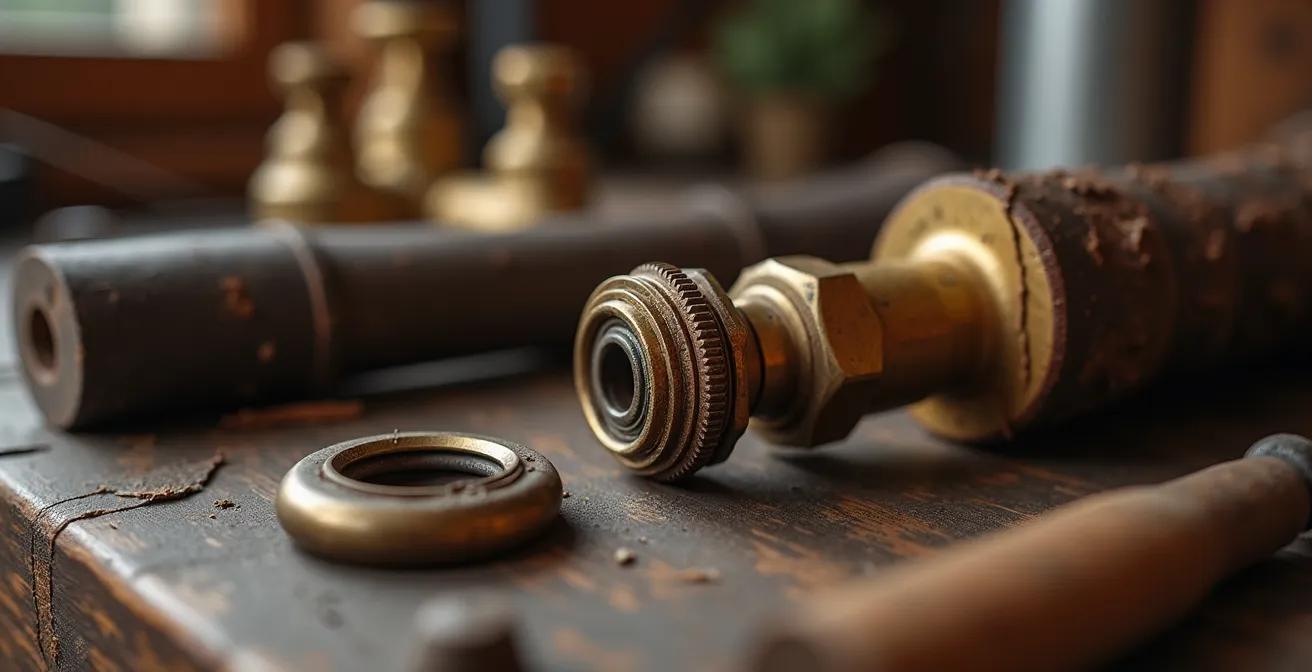
Repairing a high-end faucet is an act of stewardship that preserves its value, far surpassing the short-term convenience of replacement.
- Restoration requires a diagnostic mindset to address the root cause, not just the symptom, which is especially true with Montreal’s hard water.
- Understanding material integrity—like the threads on aged brass—is the difference between a successful repair and a costly mistake.
Recommendation: Adopt a preventive maintenance schedule for O-rings and washers to address wear before a drip ever starts, extending the life of your fixture indefinitely.
The sound of a persistent drip from a high-end faucet is more than an annoyance; for a conscious homeowner, it’s a crossroads. The conventional path often leads to a big-box store, promising a quick fix in the form of a new, gleaming fixture. This solution seems simple, but it ignores the silent cost: a beautifully engineered piece of brass and chrome, discarded to a landfill, its embodied energy wasted and its story cut short. We are told that replacement is easier, that old parts are impossible to find, and that a new warranty is the ultimate peace of mind.
But this narrative overlooks a more rewarding and sustainable philosophy. What if the true measure of a well-maintained home isn’t found in constant replacement, but in thoughtful restoration? Repairing a luxury faucet is not just about saving money or stopping a leak. It is an act of craftsmanship that honors the original design and material integrity. It’s about developing a diagnostic mindset, understanding why a component has failed, and applying a skilled hand to bring it back to life. This is especially pertinent in a city like Montreal, where heritage buildings and unique water conditions present specific challenges that generic solutions fail to address.
This guide departs from the throwaway culture. We will not simply tell you to “turn off the water.” Instead, we will delve into the craftsman’s approach. We’ll explore the art of sourcing rare parts, the precise technique of re-seating a valve on an old brass fixture, and the critical point where repair remains the wisest financial and environmental choice. It’s time to see your faucet not as a disposable commodity, but as a permanent fixture worthy of care and preservation.
This article provides a detailed roadmap for the eco-conscious homeowner. From diagnosing the problem to planning a full-scale eco-responsible renovation, each section is designed to empower you with the knowledge of a seasoned craftsman.
Summary: The Craftsman’s Guide to Faucet Restoration
- Why Are Cartridges for 10-Year-Old Faucets Hard to Find?
- How to Use a Seat Dresser to Stop Leaks in Old Brass Faucets?
- Repair Labor vs. New Purchase: Where Is the Break-Even Point?
- The Error of Stripping Threads on expensive Brass Fixtures
- When to Replace O-Rings: Before or After the Drip Starts?
- The Error of Ignoring Lead Joints in Pre-1950s Plumbing
- Why Is Refinishing a Bathtub More Eco-Friendly Than Buying New?
- How to Plan an Eco-Responsible Bathroom Renovation from Start to Finish?
Why Are Cartridges for 10-Year-Old Faucets Hard to Find?
The frustration of discovering that a cartridge for a decade-old luxury faucet is “discontinued” is a common roadblock designed to steer you towards replacement. Manufacturers often limit the production of replacement parts for older models, a practice known as planned obsolescence. This strategy creates an artificial scarcity, making a simple repair seem impossible. For high-end brands, this is compounded by proprietary designs; a cartridge from one brand is rarely compatible with another, locking you into their ecosystem and, eventually, their new product cycle.
Furthermore, the global supply chain prioritizes high-volume, current models. Stocking parts for every faucet sold over the last 20 years is not profitable for most distributors or big-box retailers. This is where the mindset must shift from a consumer to a resourceful problem-solver. The parts often exist, but they are not in the most obvious places. Specialized plumbing suppliers, particularly those catering to professional plumbers and restoration specialists in Montreal’s industrial districts, are your best allies. They often carry “new old stock” or have access to cross-compatibility charts that are not available to the general public.
The challenge is not a dead end but a test of resourcefulness. Documenting your faucet meticulously and approaching the right suppliers transforms an impossible task into a solvable puzzle. In Quebec, the “Garantie Légale” (Legal Warranty) can also be a powerful tool, as it stipulates that goods must have a reasonable service life, which includes the availability of repair parts.
Your Action Plan: Sourcing Hard-to-Find Cartridges in Montreal
- Document your faucet’s brand, model number, and take clear photos of the existing cartridge from multiple angles.
- Contact specialized plumbing suppliers beyond big-box stores, focusing on those in Montreal’s industrial areas who serve professionals.
- Search for cross-compatible or universal cartridges that are designed to fit multiple high-end brands.
- Leverage Quebec’s ‘Garantie Légale’ consumer protection law to pressure manufacturers or original retailers for parts.
- As a last resort, explore 3D printing services in Montreal for discontinued plastic components, providing them with the original part to scan.
How to Use a Seat Dresser to Stop Leaks in Old Brass Faucets?
For vintage brass faucets, particularly the compression style found in many older Montreal homes, a dripping tap is rarely a sign that the fixture is finished. More often than not, the problem lies with a worn washer or a damaged valve seat. While replacing the washer is simple, the valve seat—the small brass rim the washer presses against—can become nicked or corroded over time, preventing a perfect seal. This is where the true craft of plumbing restoration comes into play, using a tool called a seat dresser.
A seat dresser is a specialized hand tool that allows you to re-machine this surface without removing the faucet. It consists of a threaded cone that fits into the faucet body and a cutter head that, when turned, grinds away a micro-layer of the brass, creating a perfectly flat and smooth new seat. It’s a surgical procedure for your faucet, restoring its core function and honoring the material integrity of the original brass. This single action prevents a small imperfection from condemning the entire fixture to the scrap heap.
This technique is the antithesis of the replacement culture. It requires patience and a gentle touch, but it’s a skill that empowers you to preserve the character and quality of heritage fixtures. The environmental impact is not to be understated; a slow leak can waste upwards of 157 gallons of water per year, and fixing it with a simple tool avoids the significant carbon footprint of manufacturing and shipping a new faucet.
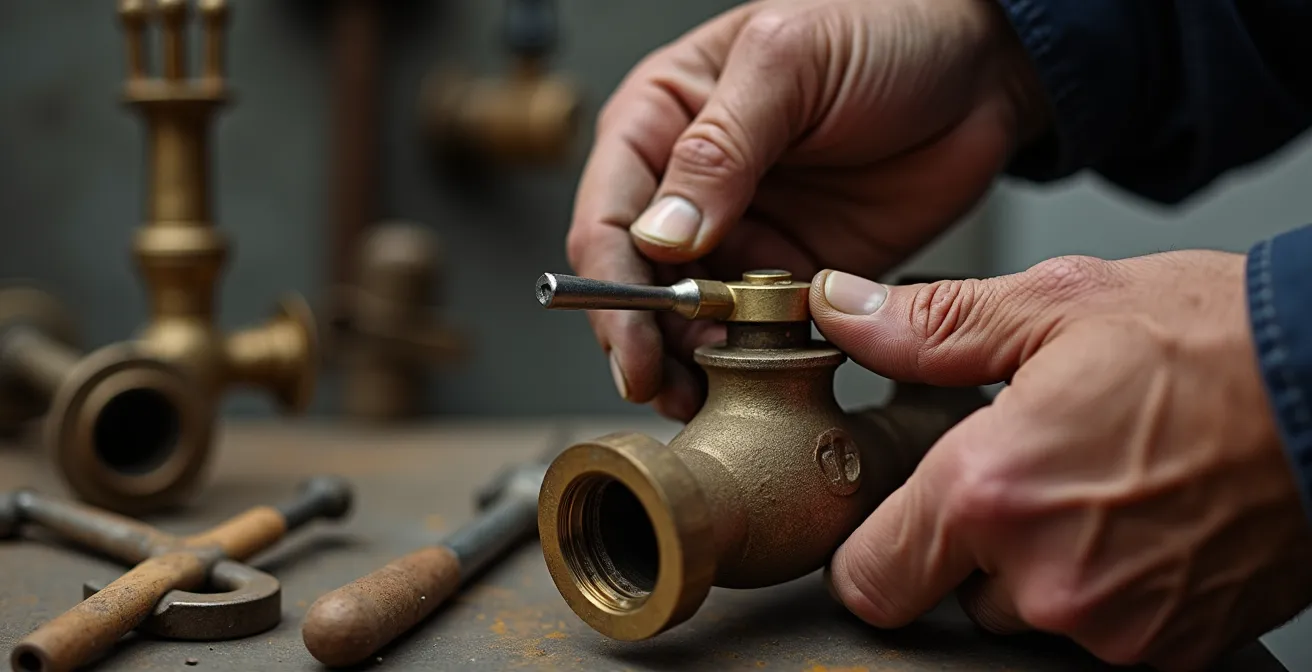
As you can see, the technique is about precision, not force. The goal is to remove the absolute minimum amount of material necessary to create a watertight seal. This careful restoration ensures the longevity of a faucet that was built to last generations, turning a common problem into an opportunity to practice genuine stewardship of your home’s resources.
Repair Labor vs. New Purchase: Where Is the Break-Even Point?
The decision to repair or replace often boils down to a financial calculation, but it’s a more nuanced equation than simply comparing the cost of a plumber to the price tag of a new faucet. The true break-even point must account for the fixture’s quality, its aesthetic value, and the long-term environmental costs. For a generic, low-cost faucet, a repair costing more than 50% of a new one is hard to justify. But for a high-end, solid brass faucet, this logic is flawed.
A luxury faucet is an investment. Its initial high cost reflects superior materials and engineering designed for longevity. A professional repair, even if it costs a few hundred dollars, is restoring a valuable asset. A new faucet of comparable quality can cost upwards of $800 to $2,000. Therefore, the financial break-even point for repair is significantly higher. As long as the repair cost is less than the price of an *equivalent quality* replacement, you are financially ahead. This calculation must also consider the retained property value; a vintage or designer faucet that matches the character of a home, especially in heritage-rich areas of Montreal like Outremont or Westmount, is an asset that a generic replacement can devalue.
The environmental break-even is even clearer. A repair generates minimal waste—perhaps a few small O-rings or a washer. A replacement sends a heavy, resource-intensive brass body to the landfill, along with all its packaging. The manufacturing of a new faucet consumes vast amounts of water and energy, a hidden cost that isn’t on the price tag.
This comparative analysis from a recent infrastructure report shows the typical financial breakdown for Montreal homeowners. While the report’s primary focus is broader, the data provides a clear framework for this specific decision, highlighting the dramatic cost difference between a simple repair and a full replacement.
| Factor | Repair Option | Replacement Option |
|---|---|---|
| Initial Cost | $150-$400 | $800-$2000+ |
| Labor Time | 1-2 hours | 2-4 hours |
| Warranty | Limited/None | 5-10+ years |
| Environmental Impact | Minimal waste | Old fixture to landfill |
| Property Value Impact | Maintains character | Modern but generic |
The Error of Stripping Threads on expensive Brass Fixtures
In the world of faucet restoration, the most heartbreaking and avoidable error is damaging the threads of an expensive brass fixture. This often happens out of impatience or the use of incorrect tools, turning a simple repair into a catastrophic failure. Brass is a relatively soft metal compared to steel. While this makes it resistant to rust, it also means its threads are susceptible to stripping or cross-threading if excessive force is applied. Once the threads on the faucet body or its connections are stripped, the fixture can no longer form a secure, watertight seal, rendering it useless.
This mistake is typically made in two scenarios: loosening a seized connection or overtightening a new one. A connection can seize due to mineral buildup from hard water. Instead of applying more force with a wrench—which will deform the soft brass—the craftsman’s approach is to apply penetrating oil and patience, allowing the oil to work its way into the threads. Using a strap wrench or pliers with rubber grips also protects the visible finish from being marred by metal tools. The “brute force” method is the enemy of fine plumbing.
When reassembling, the rule is to hand-tighten first. The connection should screw on smoothly by hand for several turns. If you feel resistance, stop immediately. You are likely cross-threading. Back it off and start again. A wrench should only be used for the final quarter-turn to snug the connection, never to force it. This respect for the material’s limits is a core principle of restoration and is what separates a professional from an amateur.
- Always use the correct size wrench; never force a tool that doesn’t fit properly.
- Apply penetrating oil and wait at least 15 minutes before attempting to loosen seized connections.
- Use a strap wrench or rubber-grip pliers to avoid damaging visible surfaces like the decorative base or handles.
- Hand-tighten all connections first, then use tools only for the final quarter-turn of compression.
- Never overtighten—the feeling of “snug” is enough. Brass threads strip more easily than steel.
When to Replace O-Rings: Before or After the Drip Starts?
The answer from a craftsman’s perspective is unequivocal: before. Waiting for a drip to start is reactive maintenance; the true path to longevity is a proactive, diagnostic mindset. O-rings are small rubber or silicone seals that are critical to the function of modern single-handle and pull-out faucets. They are wear-and-tear items, designed to degrade over time. When they fail, you get drips around the handle or leaks under the sink. By the time you see water, the O-ring has already completely failed.
In Montreal, this proactive approach is even more critical. As a case study on local water quality reveals, the city’s water is moderately hard and treated with chloramine, a combination that accelerates the degradation of common nitrile rubber O-rings. The mineral deposits can cause abrasion, while chloramine can make the rubber brittle and prone to cracking. This is why a faucet in Montreal might require O-ring replacement more frequently than in a city with softer water, even though the average Montrealer uses approximately 225 liters per day, which is less than the Quebec average.
Adopting a preventive maintenance schedule—inspecting and replacing key O-rings every 5-7 years, regardless of performance—is the secret to avoiding a “sudden” leak. It’s a small investment of time and a few dollars in parts that protects your cabinetry from water damage and extends the life of your expensive faucet indefinitely. When replacing, always opt for higher-quality silicone or Viton O-rings, which offer superior resistance to chemicals and mineral buildup.
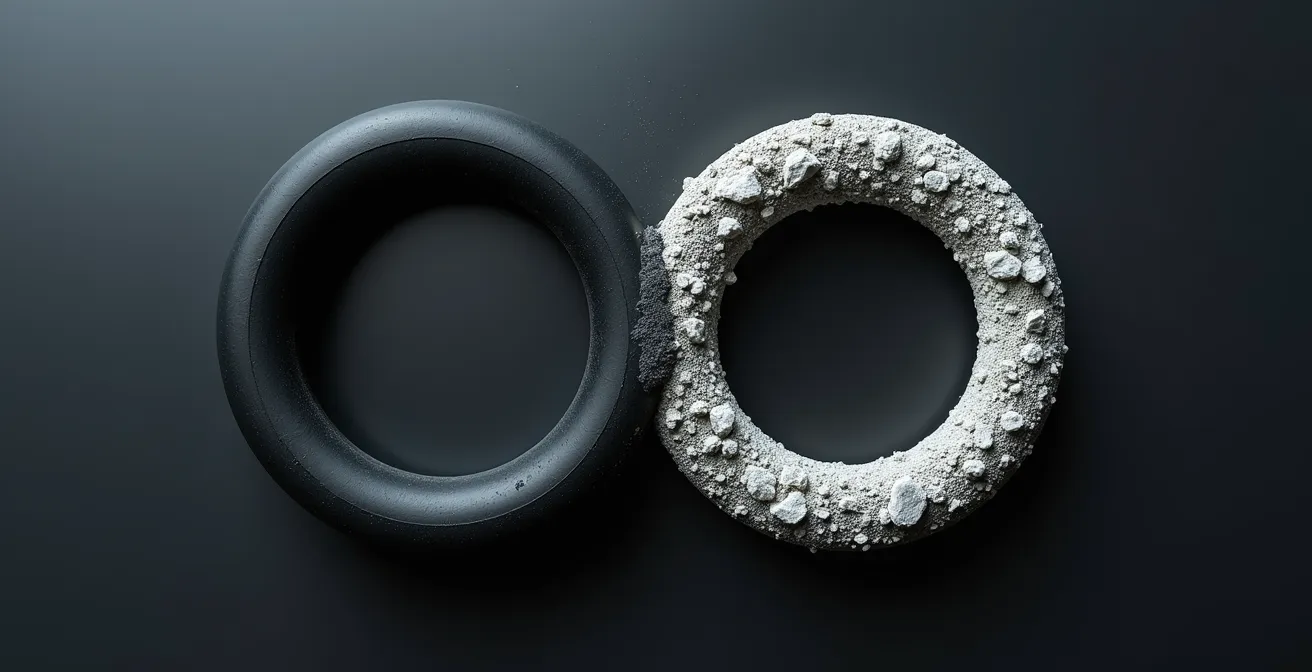
This visual comparison tells the whole story. On one side, a new, pliable seal ready to do its job. On the other, a hardened, mineral-encrusted ring that has already failed. The craftsman’s goal is to intervene while the O-ring is still in the “before” stage, preserving the perfect function of the entire assembly.
The Error of Ignoring Lead Joints in Pre-1950s Plumbing
When working on fixtures in a home built before the 1950s, particularly in older Montreal neighbourhoods, the focus must expand beyond the faucet itself to the surrounding plumbing system. One of the most critical and often overlooked dangers is the presence of lead joints and service lines. Ignoring this is not just a technical error; it’s a serious health and safety risk. Lead was a common material for plumbing pipes and solder until its toxicity was fully understood and regulated. Disturbing these old pipes, even by simply replacing a faucet, can release lead particles into your home’s water supply.
The first step before any repair in a vintage home is investigation. The City of Montreal provides a public map of known lead service lines, which is an invaluable starting point. However, this map doesn’t cover the plumbing inside your home. A professional plumber can identify lead pipes (which are dull grey, soft, and easily scratched) and soldered joints. If lead is suspected, water testing is non-negotiable, both before and after the work is completed, to ensure no contamination has occurred.
Any work that involves cutting, heating, or aggressively torquing these pipes requires strict safety protocols as mandated by the Régie du bâtiment du Québec (RBQ). This includes proper containment to capture debris and adequate ventilation. For homeowners, it’s often wisest to coordinate a faucet replacement or repair with a larger project to replace the lead service line, a program often subsidized by the city. This transforms a simple repair into a major health upgrade for your home, aligning perfectly with the ethos of responsible stewardship.
- Always check Montreal’s public lead service line map before beginning any work on a pre-1950s home.
- Test the water for lead content before and after any repairs that disturb the main plumbing lines.
- Use proper containment, ventilation, and personal protective equipment when disturbing old pipes.
- Consider coordinating your plumbing repairs with the city’s lead service line replacement program for a long-term solution.
- Always follow the safety protocols established by the Régie du bâtiment du Québec (RBQ) for working with hazardous materials.
Why Is Refinishing a Bathtub More Eco-Friendly Than Buying New?
The principles of repair and restoration extend beyond faucets to the largest fixture in the bathroom: the bathtub. The idea of ripping out a solid, cast-iron or steel tub simply because its surface is chipped or discoloured is the peak of throwaway culture. Bathtub refinishing, or reglazing, is a far more environmentally and often financially sound alternative. This process involves chemically stripping the old finish, repairing any chips or damage, and then applying a new, durable topcoat. It breathes new life into a fixture that is structurally sound.
The environmental argument is overwhelming. Demolishing and sending a cast-iron tub to a landfill generates hundreds of pounds of waste. Manufacturing its replacement consumes enormous amounts of energy and raw materials. In contrast, refinishing uses a fraction of those resources. The process keeps a perfectly good tub in service, embodying the ultimate “reduce and reuse” principle. This is particularly impactful in the context of Montreal’s wastewater challenges. As studies show, the city’s system is frequently overwhelmed during heavy rainfall, leading to the discharge of untreated sewage directly into the river from over 150 discharge outlets into the St. Lawrence River. Every product we can keep out of the waste stream reduces the overall burden on this strained infrastructure.
While the new finish may not last as long as the original porcelain (typically 10-15 years with proper care), it’s a highly effective way to postpone replacement and its associated environmental impact. It allows you to preserve the character of a vintage claw-foot tub or simply update the colour of your bathroom without the mess, cost, and waste of a full demolition. It’s a pragmatic, responsible choice that aligns perfectly with a philosophy of sustainable homeownership.
Key Takeaways
- Repairing high-end fixtures is an investment in quality and craftsmanship, not an expense.
- A diagnostic, preventive mindset is crucial for longevity, especially given Montreal’s specific water conditions.
- The most significant errors (like stripping threads) come from impatience and a lack of respect for the material’s properties.
How to Plan an Eco-Responsible Bathroom Renovation from Start to Finish?
Expanding the craftsman’s philosophy from a single faucet to an entire bathroom renovation transforms the project from a simple cosmetic update into a statement of values. An eco-responsible renovation is planned from the ground up to minimize waste, conserve resources, and create a healthier living space. The first principle is to salvage, not demolish. Before a single sledgehammer is swung, assess what can be kept. Can the solid wood vanity be refinished? Can the cast-iron tub be reglazed? Can the vintage tile be preserved?
The second principle is choosing materials wisely. This means opting for fixtures with a low-flow rating to conserve water, selecting paints with low or zero volatile organic compounds (VOCs) for better air quality, and using sustainably sourced or recycled materials for countertops and flooring. It also means investing in quality. A well-made, solid brass faucet that can be repaired for decades is a more eco-responsible choice than a cheap, disposable one that will end up in a landfill in five years.
In Quebec, homeowners have access to several programs that can make these green choices more affordable. Programs like Rénoclimat and the former RénoVert tax credit provide financial incentives for energy-efficient and eco-friendly upgrades. It’s essential to research these programs before you begin, as they often require pre- and post-renovation evaluations or the use of recognized contractors.
As detailed in this overview of available programs, planning ahead allows you to take full advantage of incentives that support your commitment to sustainability. This table provides a snapshot of some key programs available to Quebec homeowners.
| Program | Eligible Repairs | Maximum Rebate | Requirements |
|---|---|---|---|
| Rénoclimat | Energy-efficient fixtures | Up to $5,000 | Pre/post energy evaluation |
| RénoVert | Eco-friendly renovations | 20% tax credit | Recognized contractor required |
| Montreal Water Programs | Low-flow fixtures | Varies by borough | City-approved models only |
Your next step is to apply this craftsman’s philosophy. Begin by auditing your own bathroom not with an eye for what is old, but for what is well-made. Identify one fixture—a dripping faucet, a chipped tub—and commit to restoring it as your first project in conscious homeownership.