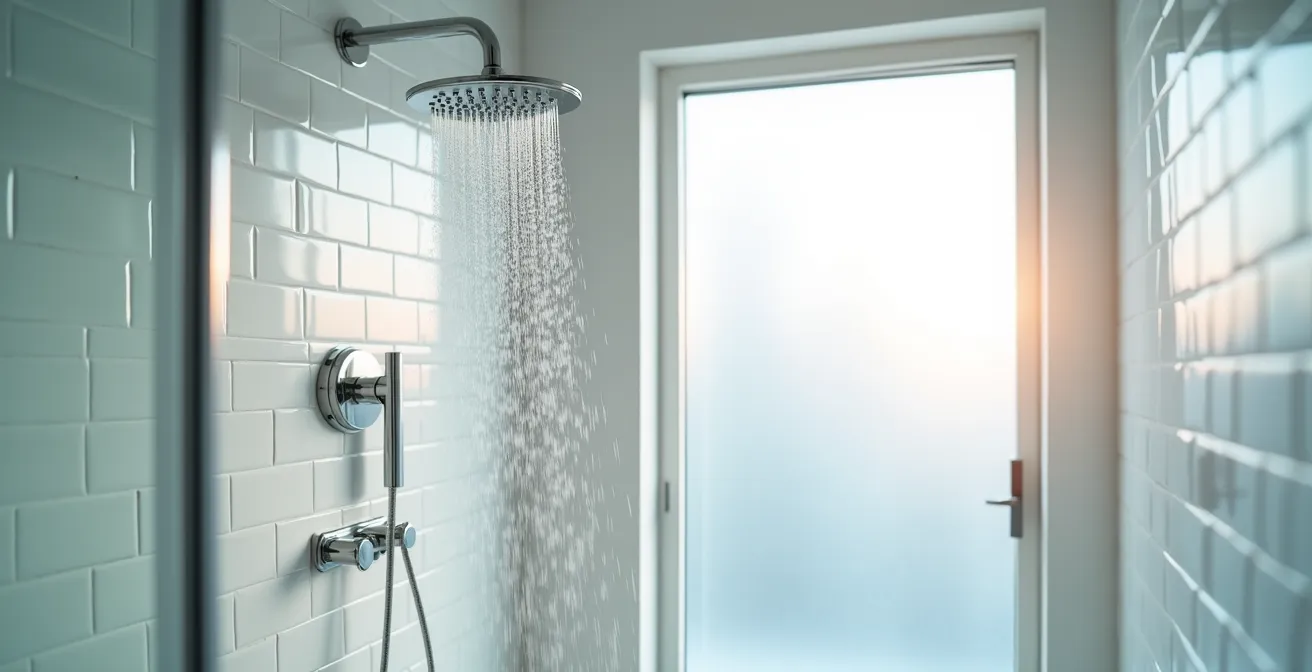
The secret to a great, water-saving shower isn’t cutting pressure; it’s mastering the physics of perception.
- High velocity, not high volume, is what creates the satisfying feeling of strong water pressure.
- Engineered aeration adds softness and coverage, but can impact water temperature—a key factor in Montreal winters.
Recommendation: First, test your current flow rate. Then, choose a modern fixture that is engineered for sensory experience, not just a low GPM number.
It’s a familiar dilemma in many Montreal households: you want to be environmentally responsible and lower that Hydro bill, but the thought of a weak, dissatisfying shower is enough to make you shiver. The common advice—”just buy a low-flow showerhead” or “take shorter showers”—often feels like a mandate for sacrifice. Many families try these solutions, only to end up with a fixture that trickles sadly or a morning routine that feels rushed and incomplete. This creates a frustrating conflict between your green ethics and your desire for a comfortable, restorative experience.
But what if the entire premise is wrong? What if the key to exceptional water conservation isn’t about giving something up, but about choosing smarter? The truth is that a powerful, satisfying shower has less to do with the sheer volume of water and more to do with the science of fluid dynamics and sensory engineering. Modern low-flow fixtures aren’t about restriction; they are about precision. They are designed to trick your senses into feeling more water than is actually being used, delivering a luxurious experience while drastically cutting consumption.
This guide will demystify the technology that separates a great eco-friendly shower from a disappointing one. We’ll explore the physics of water velocity, show you how to measure your home’s current consumption, and provide a framework for choosing a low-flow faucet or showerhead that your entire family will love. It’s time to move beyond the myth of sacrifice and embrace the era of intelligent, comfortable conservation.
text
To help you navigate these choices, this article breaks down the essential concepts and provides practical steps. Explore the topics below to become an expert in your own home’s water efficiency.
Summary: A Guide to Water Efficiency Without Compromise
- Why Does High Velocity Make Low Flow Feel Like More Water?
- How to Test Your Faucet GPM Using a Bucket and Stopwatch?
- Laminar vs. Aerated Flow: Which Is Better for Kitchen Hygiene?
- The Error of Installing Ultra-Low Flow Heads on Tankless Heaters
- When Will a $50 Eco-Showerhead Pay for Itself in Savings?
- Why Does Aerated Water Feel Softer on Hands?
- How to Retrofit Aerators to Reduce Consumption by 40%?
- How to Choose Low-Flow Faucets That Don’t Feel Weak?
Why Does High Velocity Make Low Flow Feel Like More Water?
The core of a satisfying shower experience isn’t the amount of water, but the force with which it hits your skin. This is the principle of perceived volume, and it’s all about fluid dynamics. Imagine a garden hose: a wide, slow-moving stream uses a lot of water but has little impact. Now, place your thumb over the end. The volume of water hasn’t changed, but its velocity increases dramatically, creating a powerful jet. High-efficiency showerheads use this exact principle.
Instead of just letting water fall through large holes, they channel it through smaller, precision-engineered nozzles. This constriction forces the limited water supply to accelerate, creating a high-velocity spray. This speed translates into higher kinetic energy in each droplet, so when they make contact, they feel more substantial and provide a more invigorating rinsing effect. You feel the sensation of high pressure, even though the actual flow rate, measured in Gallons Per Minute (GPM), is significantly lower.
This engineering is why a 1.75 GPM showerhead can feel just as powerful, if not more so, than an old 3.5 GPM water-guzzler. The benefit is substantial; according to the U.S. EPA, a family can save up to 2,700 gallons of water per year by switching to WaterSense certified fixtures. For a Montreal family, this also means significant savings on water heating. BC Hydro found that a household switching to a more efficient showerhead and cutting shower times slightly could reduce shower-related energy costs by more than half, saving nearly $100 per year.
How to Test Your Faucet GPM Using a Bucket and Stopwatch?
Before you can improve your water efficiency, you need a baseline. You might be surprised to find that your existing faucets and showerheads are using far more water than you think. Fortunately, you don’t need a plumber to find out. A simple, 60-second test using common household items will give you an accurate measurement of your fixture’s flow rate in Gallons Per Minute (GPM).
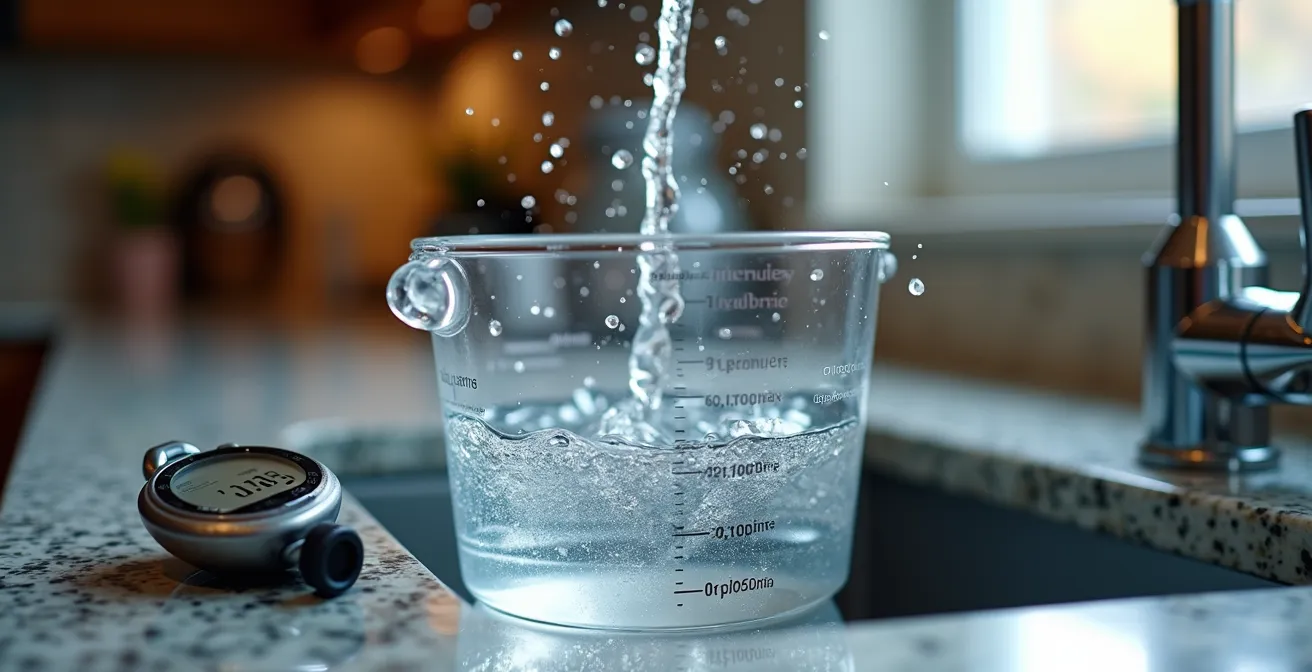
This quick diagnostic is the most important first step in your conservation journey. Follow these steps to determine your current GPM:
- Place a bucket or large measuring container (at least 1 gallon or 4 liters) under the faucet or showerhead.
- Turn the water on to the full, normal pressure you would typically use. For a shower, this usually means turning the handle all the way to hot.
- Using a stopwatch on your phone, time how long it takes to fill the container to a specific mark (e.g., the 1-gallon line).
- To calculate your GPM, divide 60 by the number of seconds it took to fill. For example, if it took 20 seconds to fill one gallon, your flow rate is 60 / 20 = 3.0 GPM.
- Compare your result to modern standards. The current federal standard for showerheads in Canada is 2.5 GPM (9.5 LPM), but high-efficiency WaterSense models operate at 2.0 GPM or less, with some using as little as 1.5 GPM.
If you find your fixtures are flowing at 2.5 GPM or higher, you have a significant opportunity to save water, energy, and money simply by upgrading.
Laminar vs. Aerated Flow: Which Is Better for Kitchen Hygiene?
When choosing a faucet, especially for the kitchen, the type of water stream is as important as the flow rate. The two most common types are laminar and aerated flow, each offering distinct advantages. Understanding their differences is key to selecting a fixture that is both efficient and hygienic for tasks like washing produce and hands.
Laminar flow devices produce a clear, solid-looking stream of water with no air mixed in. Because the water flows in parallel layers without bubbles, it doesn’t splash upon hitting a surface. This makes it ideal for high-stakes environments like hospitals and is increasingly popular in home kitchens for its clean look and hygienic properties, as it minimizes the aerosolization of bacteria from the sink onto surrounding countertops.
Aerated flow is the more traditional stream type, where air is mixed into the water. This creates a whiter, softer, more voluminous-feeling stream. While it provides excellent coverage for handwashing, the air bubbles cause the water to splash more. A significant downside of aeration is a phenomenon of thermal dilution; the air mixed into the stream cools the water. An aerated stream can experience a 5 to 15-degree temperature drop between the faucet and your hands, forcing you to turn up the hot water and waste energy.
The following table breaks down the key differences to help you decide which is best for your Montreal kitchen.
| Feature | Laminar Flow | Aerated Flow |
|---|---|---|
| Water Stream | Clear, solid stream | Misty, mixed with air |
| Splash Prevention | Minimal splashing | More splash potential |
| Temperature Retention | Better heat retention | 5-15°F temperature drop |
| Hygiene Factor | No aerosol creation | May create fine mist |
| Best Use | Kitchen tasks, produce washing | Hand washing, general use |
The Error of Installing Ultra-Low Flow Heads on Tankless Heaters
Tankless water heaters are an excellent energy-saving technology, providing hot water on demand. However, they present a unique challenge when paired with certain low-flow fixtures. Many Montreal homeowners have made this upgrade, only to find themselves waiting minutes for hot water to arrive, a phenomenon sometimes called the “cold water sandwich.” This isn’t a flaw in the showerhead, but a fundamental mismatch in technology.
Tankless heaters require a minimum flow rate to activate their heating elements. This is known as the activation threshold, typically around 0.5 to 0.75 GPM. If your new ultra-low-flow showerhead (e.g., 1.25 GPM) is running, the flow rate through the heater might be just enough to turn it on. However, because the total volume of water moving through the pipes is so low, it takes a very long time to purge the cold water that was already sitting in the plumbing lines. This wait is not only frustrating but also wastes a significant amount of water, defeating the purpose of the upgrade.
The problem is one of compatibility. You are restricting the output flow rate so much that you drastically elongate the time it takes for hot water to travel from the heater to you. To avoid this common and costly mistake, it’s crucial to check the specifications of both your heater and your intended showerhead before purchasing.
Your Action Plan: Tankless Heater Compatibility Checklist
- Check the Manual: Find your tankless heater’s manual and identify its minimum flow rate specification (in GPM or LPM).
- Verify the Fixture: Check the GPM/LPM rating clearly marked on the showerhead’s packaging.
- Ensure a Buffer: Choose a showerhead with a flow rate that exceeds the heater’s minimum threshold by at least 0.2 GPM to ensure reliable activation.
- Test Before Finalizing: After a temporary installation, test the time it takes to get hot water. If it’s unacceptably long, the fixture is not a good match.
- Consider the Sweet Spot: For most tankless systems, showerheads rated between 1.8 to 2.0 GPM offer the best balance of water savings and fast hot water delivery.
When Will a $50 Eco-Showerhead Pay for Itself in Savings?
For any family, an upgrade is an investment. The good news is that when it comes to high-efficiency showerheads, the payback period is remarkably short. A quality, well-engineered eco-showerhead typically costs between $40 and $80. Given the dual savings on water and the energy needed to heat it, this small investment often pays for itself in less than a year.

Let’s break down the math for a typical Montreal household. The primary cost associated with showering isn’t the water itself, but the electricity (via Hydro-Québec) used to heat it. According to Canadian utility estimates, a household that installs a more efficient showerhead can see significant reductions in their energy bill. For instance, BC Hydro estimates households can save nearly $100 annually just from shower-related energy costs.
With a one-time cost of $50 for the fixture and an annual return of nearly $100, the payback period is approximately six months. From that point forward, the savings go directly back into your pocket. The calculation becomes even more compelling for larger families or households with frequent shower use. Over the lifespan of the showerhead, the return on investment can be substantial, making it one of the simplest and most effective green upgrades you can make in your home.
This is not just about environmental ethics; it’s about smart financial management. Every day you wait to upgrade is another day you are effectively letting savings—and heated water—go down the drain.
Why Does Aerated Water Feel Softer on Hands?
The sensation of “softness” in water from an aerated faucet is another brilliant example of sensory engineering. It has nothing to do with the mineral content of your water and everything to do with the introduction of air. An aerator is a small, simple device at the tip of your faucet that acts as a mini mixing chamber, infusing the water stream with thousands of tiny air bubbles.
This process does two things. First, it breaks up the solid stream of water into a multitude of smaller, individual streams and droplets. This dispersion increases the surface area of the water that touches your skin, creating a feeling of fuller coverage. Second, the air bubbles act as a cushion. Instead of a single, hard jet of water, you feel a gentler, more distributed pressure. The impact of each water droplet is softened by the air mixed within it, resulting in a stream that feels discernibly softer and less harsh on your hands.
This is a carefully engineered illusion. You are feeling more volume and less impact, leading your brain to interpret the sensation as “soft.” As a technical expert from New Brunswick’s energy efficiency program explains, it’s about creating a perception of power while using less water.
Aerators compress the water stream while mixing air into the flow, and when combined with a narrow opening, it gives the feeling of higher water pressure. The aerator creates multiple small streams of water, which further adds to the feeling of higher water pressure.
– Water Corporation Technical Expert, New Brunswick Energy Efficiency Programs
Companies have even refined this principle into high-end technologies. For example, some brands use advanced techniques to create micro-fine droplets that envelop the body in a soft, misty cocoon, transforming the shower into a spa-like experience through pure sensory engineering.
How to Retrofit Aerators to Reduce Consumption by 40%?
One of the quickest, cheapest, and most effective water-saving upgrades you can perform is retrofitting the aerators on your existing bathroom and kitchen faucets. This simple DIY project takes less than five minutes, requires no special plumbing skills, and can have an immediate impact. By swapping an old, inefficient aerator for a new WaterSense certified model, you can achieve a reduction in water flow of up to 40% without a noticeable drop in performance.
This is an ideal project for any Montrealer, including renters, as it’s completely reversible and affordable. A new high-efficiency aerator costs only a few dollars at local stores like Canadian Tire or Rona. Follow this simple guide to make the switch:
- Unscrew the Old Aerator: Using your fingers or a pair of pliers wrapped in a cloth to prevent scratching, turn the existing aerator at the tip of the faucet counter-clockwise to remove it.
- Check the Threads: Look inside the faucet spout. If the threads are on the outside, you need a female-threaded aerator. If they are on the inside, you need a male-threaded one.
- Measure the Diameter: Most faucets use standard sizes. Bathroom faucets are typically 15/16″ male or 55/64″ female. A simple way to check is to bring the old aerator with you to the hardware store.
- Purchase the Right Model: Buy a WaterSense certified aerator with the correct thread type and a flow rate of 1.5 GPM or lower for bathroom faucets.
- Use Plumber’s Tape (Optional): For a secure, leak-free seal, wrap a small amount of plumber’s tape clockwise around the threads of the new aerator.
- Install the New Aerator: Hand-tighten the new aerator until it is snug. Avoid over-tightening, as this can damage the washer.
- Test for Leaks: Turn on the water and check for any drips around the seal. If you see a leak, tighten it slightly more or check that the washer is seated correctly.
With this simple retrofit, every sink in your home can become a source of water and energy savings, contributing to a greener household without any change in your daily habits.
Key Takeaways
- The feeling of pressure comes from water velocity, not volume (GPM).
- Aeration creates a soft feel but can cool water down, while laminar flow is splash-free and hygienic.
- Always check your tankless heater’s minimum flow rate before choosing an ultra-low-flow fixture.
How to Choose Low-Flow Faucets That Don’t Feel Weak?
You’ve tested your GPM, you understand the technology, and you’re ready to choose a new fixture. The final step is navigating the market to find a model that delivers on the promise of high performance and low consumption. The key is to look beyond the GPM number and focus on the brand-specific technologies designed to enhance the sensory experience.
According to the EPA’s research with consumers, the two factors that most influence user satisfaction are spray force and spray coverage. A good low-flow showerhead excels at both, creating a powerful and enveloping spray pattern. Leading manufacturers have developed proprietary technologies to achieve this. For instance, some create larger, sculpted water droplets that retain heat longer and feel more substantial, while others use pressure-compensating technology to deliver a consistent force regardless of fluctuations in your home’s water pressure.
To help your search, here is a comparison of some popular technologies available to Canadian shoppers, perfect for a Montreal home upgrade.
| Brand Technology | Flow Rate | Key Feature | Price Range (CAD) |
|---|---|---|---|
| Delta H2Okinetic | 1.75 GPM | Sculpted water droplets | $50-150 |
| Moen PowerClean | 1.75 GPM | Concentrated spray | $40-120 |
| Waterpik EcoFlow | 1.6 GPM | OptiFlow technology | $30-80 |
| High Sierra | 1.5 GPM | Solid metal, clog-free | $35-75 |
| Niagara Earth | 1.25 GPM | Pressure compensating | $25-50 |
The best way to choose is to experience them firsthand. Before making a final decision, plan a visit to local showrooms. This allows you to feel the different spray patterns and pressures for yourself.
- Visit the Ciot showroom for high-end fixture displays and demonstrations.
- Check Batimat locations for a wide range of mid-range options, often with demo units.
- Browse local plumbing supply houses in the Plateau and Verdun districts for expert advice.
- Always ask for a flow demonstration and compare WaterSense certified models side-by-side.
Now that you are armed with this knowledge, the next logical step is to move from theory to practice. Begin by testing the GPM of your primary shower and kitchen faucet this weekend. Based on those results, use the brand guide and showroom list to find a replacement that fits your home’s needs and your family’s standard for comfort.