
The profitability of a Drain Water Heat Recovery (DWHR) system isn’t just an eco-claim; it’s an engineering certainty driven by the physics of film flow and the strategic advantages of Montreal’s climate.
- Maximal efficiency is achieved in vertical drain stacks, where falling water creates a thin film, allowing for optimal heat exchange with incoming cold municipal water.
- For a typical Montreal home, this can lead to a 20% to 40% reduction in water heating costs, with a payback period often under 10 years.
Recommendation: Prioritize DWHR installation as a foundational step in any eco-renovation plan, leveraging local programs like Rénoclimat to maximize financial return and future-proof your property.
For the efficiency-obsessed renovator, every kilowatt-hour wasted is a design failure. Your hot water tank is a prime culprit, constantly fighting to heat frigid municipal water, especially during a harsh Montreal winter. The conventional solution is a better-insulated tank or a tankless heater, but these are active, complex systems. They address the symptom—heat loss—but ignore the systemic inefficiency: perfectly good thermal energy literally going down the drain with every shower.
The conversation around energy savings often gets stuck on generic advice like “use less hot water” or “install low-flow fixtures.” While valid, these are behavioural changes, not systemic engineering improvements. The real opportunity lies in a passive, elegant solution that requires no moving parts, no electricity, and no change in habits. This technology is Drain Water Heat Recovery (DWHR), and its effectiveness is not magic; it’s pure physics, amplified by local conditions.
But if the principle is so simple, why isn’t it standard in every home? The answer lies in the details of its application. The difference between a marginal gain and a significant, perpetual reduction in your energy bill comes down to understanding the engineering principles behind it. This is where the concept of the “film flow delta” becomes critical. It’s not just about recovering heat; it’s about maximizing the temperature difference between the waste water and the incoming cold supply by optimizing for stack geometry and flow dynamics.
This article moves beyond the surface-level benefits. We will deconstruct the physics of why DWHR works, analyze the precise installation requirements for retrofitting Montreal’s diverse housing stock, and provide a strategic framework for integrating this technology into a renovation plan that is not only eco-responsible but also financially astute. We’ll explore the critical choice between 3-inch and 4-inch units, the fatal error of horizontal installation, and how to leverage Quebec’s own certification standards to your advantage.
To navigate this technical landscape, the following sections provide a complete roadmap. From the fundamental science to the final renovation plan, each part is designed to equip you with the engineering mindset needed to make a truly efficient decision.
Summary: Your Engineering Guide to Drain Water Heat Recovery
- Why Does Falling Water Cling to the Pipe Walls (Film Flow)?
- How to Retrofit a Power Pipe on an Existing Vertical Stack?
- 4-inch vs. 3-inch Diameter: Which Recovery Unit Fits Your Home?
- The Error of Installing Recovery Units on Horizontal Drains
- When Is a Drain Water Heat Recovery Unit Most Profitable?
- When Will Gray Water Recycling Become Mandatory in Quebec?
- LEED vs. Novoclimat: Which Standard Should Guide Your Renovation?
- How to Plan an Eco-Responsible Bathroom Renovation from Start to Finish?
Why Does Falling Water Cling to the Pipe Walls (Film Flow)?
The entire principle of a DWHR system hinges on a simple fluid dynamics phenomenon: the Coandă effect. As warm greywater from a shower or bathtub falls down a vertical drain pipe, it doesn’t plummet down the center. Instead, surface tension and adhesion cause the water to cling to the inner wall of the pipe, forming a thin, uniform film. This “film flow” is the secret to efficient heat transfer. By creating a large, consistent surface area of warm water, it turns your entire drain stack into a passive heat exchanger.
The efficiency of this exchange is governed by the temperature differential—the difference between the warm film of draining water (typically 35-40°C) and the frigid municipal water entering your home. In Montreal, where winter water supply can be as low as 4-5°C, this differential is extreme, creating what can be called the “Montreal Advantage.” This large gap is the engine of the system, driving rapid heat transfer from the drain film to the cold-water coil wrapped around the pipe. The result is preheated water sent to your hot water tank, significantly reducing its workload.
A DWHR unit is essentially a copper drain section with a copper coil wrapped tightly around its exterior. As the warm film flows down the inside, its heat conducts through the highly conductive copper wall to the incoming cold water flowing through the outer coil. The efficiency is remarkable; to be recognized by provincial energy bodies, Hydro-Québec requires a minimum efficiency of 42% under specific test conditions. This isn’t a marginal gain; it’s a substantial, passive recovery of energy that would otherwise be completely lost.
The system’s performance peaks during simultaneous flow events, which are common in any household. When someone is showering, hot water is draining (creating the film flow) at the same time as the shower valve is drawing in new cold water to be mixed. The DWHR unit intercepts this incoming cold water, preheats it, and sends it not only to the water heater but also directly to the cold side of the shower valve itself. This means the valve needs to draw even less hot water to reach the desired temperature, creating a virtuous cycle of savings.
How to Retrofit a Power Pipe on an Existing Vertical Stack?
Retrofitting a DWHR unit into an existing home is a targeted surgical operation on your plumbing system, not a full-scale demolition. The process involves identifying the main vertical drain stack—typically 3 or 4 inches in diameter—that collects greywater from the upper floors, particularly the main shower. The unit must be installed on a vertical section to ensure the critical film flow effect. The installation itself is primarily a cutting and fitting job, but the complexity varies dramatically based on your home’s existing stack geometry and material.
In many modern Montreal homes and condos, you’ll find ABS or PVC plastic drain stacks. Retrofitting on these is relatively straightforward for a skilled plumber. It involves cutting out a section of the plastic pipe equal to the length of the DWHR unit and connecting the new copper unit using standard mechanical couplings (e.g., Fernco couplers). With some plumbing experience, a system like ThermoDrain, which uses crimp-style PEX fittings, can be installed in as little as 45 to 90 minutes because it requires no soldering. This makes the retrofit fast and predictable.
The challenge, however, lies in Montreal’s older housing stock—the plexes and century homes built with cast iron drain stacks. Cutting cast iron is a more demanding task, requiring specialized tools like a snap cutter or an angle grinder. These pipes are also heavier and may require additional support brackets to be installed before a section is removed. The installation time can extend to 2-3 hours, and there’s the potential of dealing with old lead joints, which requires professional handling. This is where a simple-sounding project demands true trade expertise.
The visual below captures the precision required for this type of installation, focusing on the connection of the heat-exchanging coils to an existing pipe.
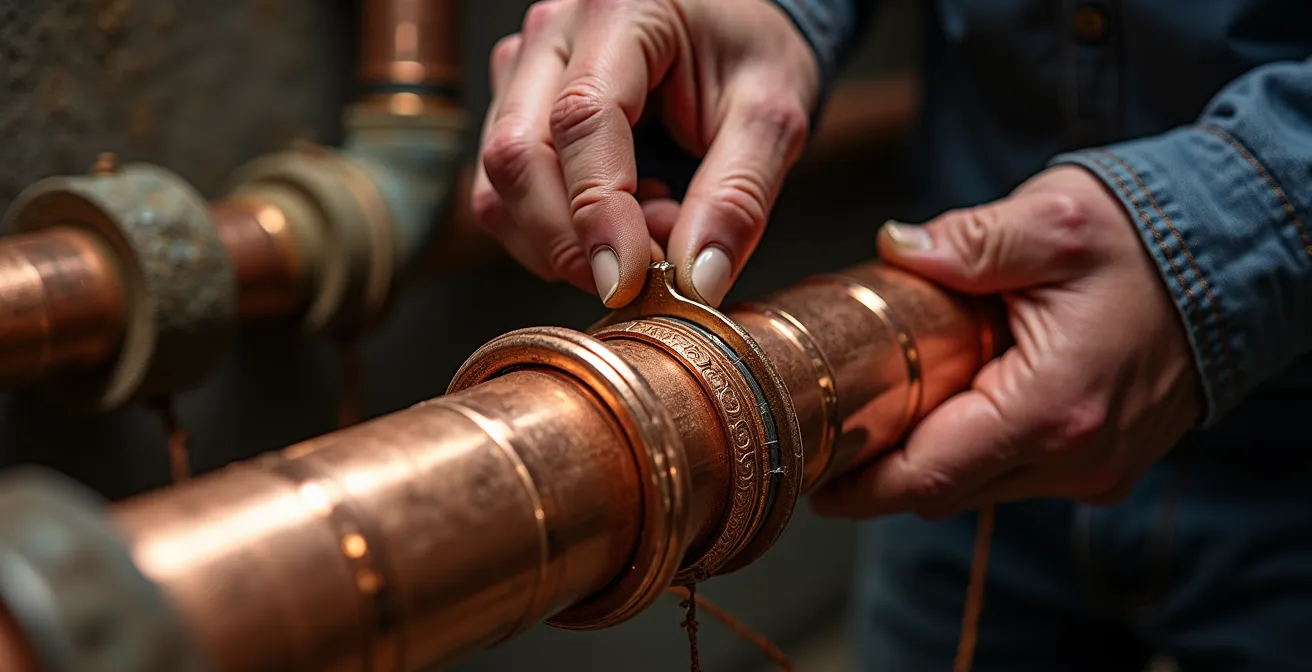
Regardless of the pipe material, the process follows a clear sequence: locate the main vertical drain, measure and cut the required section, install the DWHR unit with appropriate couplings, and finally, connect the cold-water supply line to the unit’s inlet and the outlet to both the water heater’s cold inlet and the cold supply lines for fixtures. This dual connection is key to maximizing energy savings during simultaneous flow.
This table breaks down the key differences when retrofitting on Montreal’s most common drain stack types.
| Stack Type | Cutting Method | Installation Time | Special Considerations |
|---|---|---|---|
| Cast Iron (pre-1970s) | Snap cutter or angle grinder | 2-3 hours | Support brackets required, potential lead joint handling |
| ABS/PVC (modern) | Reciprocating saw | 45-90 minutes | Standard coupling connections, simpler retrofit |
| Copper (rare) | Pipe cutter | 1-2 hours | Direct soldering possible, highest heat transfer |
4-inch vs. 3-inch Diameter: Which Recovery Unit Fits Your Home?
Choosing the correct diameter for your DWHR unit is not a matter of “bigger is better.” It’s an engineering decision based on the existing plumbing of your home and the physics of film flow. The vast majority of modern residential drain stacks for showers and tubs are 3 inches in diameter, while 4-inch pipes are typically reserved for the main building drain or toilets. For DWHR to function at peak efficiency, the falling water must form an even, uninterrupted film on the inside of the pipe. A 3-inch pipe is optimal for this, as the flow from a standard shower is perfectly matched to create a film thickness of approximately 1mm, maximizing the heat transfer rate.
If you install a 3-inch DWHR unit on a 3-inch stack, you get a perfect system. However, if your main stack is 4 inches, installing a 4-inch DWHR unit can actually be less efficient. The same volume of water from a shower, when spread across the larger circumference of a 4-inch pipe, creates a thinner, less stable film. This can lead to “channeling” or “rivulets” of water, reducing the total surface area in contact with the pipe wall and thereby decreasing heat recovery efficiency. The solution in this case is to use a 4×3 reducer coupling to install a 3-inch unit onto the 4-inch stack, forcing the water through the optimal diameter for heat exchange.
Beyond diameter, the length of the unit is the other critical variable. The longer the unit, the more time the incoming cold water spends in contact with the warm drainpipe, and the more heat it absorbs. A highly efficient model like the ThermoDrain TDH3335B, at just 33.5 inches long, can achieve 42.1% efficiency. This unit demonstrates an impressive 1.26% efficiency per inch, showcasing how compact, high-performance designs can deliver significant gains. In a real-world scenario with 10°C (50°F) incoming water, this unit can raise the temperature by nearly 12°C (21°F), delivering 22°C (71°F) preheated water to your fixtures and water heater.
This performance directly translates into financial savings. For homeowners, Hydro-Québec estimates savings between 20% to 40% on water heating costs, depending on the household’s hot water usage patterns and the efficiency of the installed unit. For a tech-savvy renovator, the choice is clear: select the unit with the highest efficiency-per-inch that fits your available vertical space, and always ensure the diameter is optimized (ideally 3 inches) to guarantee the best possible film flow and maximize your perpetual passive savings.
The Error of Installing Recovery Units on Horizontal Drains
The single most critical and non-negotiable rule for DWHR installation is that the unit must be installed vertically. Attempting to install a standard unit on a horizontal or low-slope drain run is not just suboptimal; it renders the device almost completely useless. This common error stems from a fundamental misunderstanding of the heat transfer principle that makes these devices work. The system relies entirely on the thin film of water coating the entire inner surface of the pipe, which only occurs under the influence of gravity in a vertical drop.
In a horizontal pipe, the physics of fluid flow change completely. Water does not create a film; instead, it stratifies, flowing only along the bottom of the pipe. This has several immediate and detrimental effects on heat transfer:
- Reduced Contact Area: Instead of 100% of the pipe’s inner surface being used for heat exchange, only the bottom 20-30% is in contact with the warm water. The top of the pipe is in contact with air, which acts as an insulator.
- Insufficient Contact Time: The velocity of water in a horizontal drain is significantly faster than the slow-moving film in a vertical stack. This drastically reduces the duration of thermal contact, leaving almost no time for meaningful heat transfer to occur.
- Air Pocket Insulation: Air trapped in the upper portion of the horizontal pipe creates an effective insulation barrier, actively preventing heat from reaching the outer coil.
This is not a matter of opinion but a core design constraint. As the technical experts at EcoInnovation Technologies, a leading Canadian manufacturer, state unequivocally in their documentation:
No, the waste water (as it flows down the pipe) forms a film on the inside of the copper drain pipe located in the center of the ThermoDrain.
– EcoInnovation Technologies, ThermoDrain Technical Documentation
This statement confirms that the entire design is predicated on this vertical film flow. Any installation that deviates from this invalidates the engineering. For a renovator in Montreal, this means identifying a suitable vertical drop is the first and most important step. This is often found in the basement, directly below the main bathroom, or within a service wall that runs between floors in a plex. Ignoring this rule is equivalent to investing in a high-performance engine and forgetting to add fuel; the potential is there, but the conditions for operation are not met.
Your Checklist: Why Horizontal Installation Fails
- Verify Flow Type: Confirm the installation location allows for gravity-driven film flow, not stratified horizontal flow. In a horizontal pipe, water flows only along the bottom surface.
- Assess Contact Area: Check that the design enables 100% surface contact. A horizontal setup reduces the heat exchange surface to less than 30% of the pipe’s interior.
- Calculate Contact Time: Ensure the flow velocity is low enough for effective heat transfer. Horizontal flow is 3-5 times faster, offering insufficient time for thermal exchange.
- Inspect for Air Gaps: Ensure no air can be trapped between the water and the pipe wall. Air pockets in horizontal pipes act as insulators, blocking heat transfer.
- Confirm Verticality: The unit must be installed on a true vertical drain stack to meet the fundamental requirements for its designed operation.
When Is a Drain Water Heat Recovery Unit Most Profitable?
A DWHR unit is most profitable under a specific set of conditions that maximize the “film flow delta” and hot water consumption. Profitability isn’t just a function of the device itself, but of its operating environment. The ideal scenario for a rapid return on investment (ROI) involves a confluence of high usage, a significant temperature differential, and simultaneous flows. For a Montreal renovator, this translates into a clear profile: households with multiple occupants, especially those with teenagers, who take frequent, consecutive showers.
The financial case is compelling. The energy savings are direct and perpetual. With no moving parts and no electricity consumption, a DWHR unit has a lifespan equal to that of the copper plumbing itself—effectively permanent. The upfront cost is for the unit and installation, while the savings accrue every time a hot tap is used. Studies from Canadian utilities confirm the viability of this investment; for instance, Manitoba Hydro reports that the typical payback period is under 10 years. In a high-usage household in Quebec, with its higher electricity costs and colder incoming water, this period can be even shorter.
A real-world ROI analysis for a Toronto-based, two-person household provides a conservative but insightful baseline. Even with moderate usage, the calculated energy savings were estimated at $65 per year. While the report noted the ROI was highly dependent on occupancy and usage patterns, it affirmed the financial rationale. For a larger family in a Montreal triplex, this figure could easily double or triple, drastically shortening the payback period and making the investment a clear financial win.
Case Study: ROI Calculation for a Montreal Household
Based on a real-world analysis in a two-person household, estimated energy savings of $65/year were calculated. While modest, this figure was for a low-occupancy scenario. The study concluded that the financial rationality of the investment is directly proportional to water usage, meaning a larger family or a multi-unit dwelling in Montreal would see a much faster and more significant return on investment, solidifying the long-term value of the technology.
Ultimately, a DWHR unit is an investment in systemic efficiency. It reduces the daily operational load on your most energy-intensive appliance after heating: the water heater. This not only cuts energy bills but also extends the life of the heater. The result is more than just savings; it’s about building a resilient, high-performance home where comfort is not at odds with efficiency, a benefit the whole family can enjoy.

When Will Gray Water Recycling Become Mandatory in Quebec?
Currently, there is no province-wide mandate in Quebec requiring the installation of Drain Water Heat Recovery units in all new residential constructions. However, the question is not *if* it will become mandatory, but *when* and under what conditions. The trajectory of building codes across Canada points towards an increasing focus on energy efficiency, and DWHR is one of the most cost-effective passive measures available. It represents a low-hanging fruit for achieving significant energy reductions at the provincial level.
We can look to other provinces for a glimpse of the future. As a precedent, Manitoba amended its building code to mandate the use of DWHR units in new residential builds as of April 1, 2016. This move signaled a clear recognition by a provincial authority that the technology is reliable, effective, and essential for meeting future energy performance targets. This type of regulatory evolution is common; one province sets a new standard, demonstrates its success, and others follow suit over time.
In Quebec, the requirement is currently tied to specific voluntary certification programs rather than the base building code. For instance, under the Novoclimat program, a DWHR unit becomes mandatory for certified homes with three or more bathrooms. This is a form of “soft mandate”—if you want to achieve the higher standard of performance and the associated grants, you must include this technology. This approach encourages adoption among proactive builders and renovators without imposing the cost on every single new build.
For a tech-savvy renovator in Montreal, this context is crucial. Installing a DWHR unit today is an act of future-proofing. As energy efficiency standards inevitably tighten, having this technology already in place will increase your home’s compliance, performance rating, and ultimately, its resale value. You are not just saving money on your current energy bills; you are aligning your property with the next generation of building standards, ensuring it remains a high-value, high-performance asset for years to come.
LEED vs. Novoclimat: Which Standard Should Guide Your Renovation?
For a Montreal renovator committed to an eco-responsible project, choosing the right certification standard is a strategic decision. The two most prominent programs in Quebec are the internationally recognized LEED (Leadership in Energy and Environmental Design) for Homes and the provincially-backed Novoclimat program. While both promote sustainable building, they have different philosophies, costs, and benefits. Your choice should be guided by your project’s specific goals: are you aiming for holistic environmental performance or targeted energy efficiency with strong local recognition?
LEED for Homes is a comprehensive, point-based system that evaluates a home across eight categories, including water efficiency, materials, and innovation. A DWHR system can earn you up to 3 points in the Water Efficiency category. LEED is globally recognized, which can add significant prestige and potentially a higher resale value (6-8% increase internationally). However, the certification process is more complex and expensive, potentially costing around $5,500 including inspections, though grants like the Rénoclimat program can offset some of this.
Novoclimat, on the other hand, is laser-focused on energy efficiency and indoor air quality. It’s a pass/fail system based on meeting specific technical requirements, not accumulating points. The program is heavily subsidized by the Quebec government, making it far more accessible financially. Crucially, Novoclimat certified homes achieve at least a 20% minimum energy performance improvement over standard new construction. Its brand is extremely strong within the Quebec market, immediately signaling a high-performance home to local buyers. As mentioned, it mandates DWHR in homes with 3+ bathrooms, cementing the technology’s importance within this standard.
This table offers a clear comparison for your certification arbitrage:
This comparative data, drawn from a comprehensive guide to green certifications in Quebec, helps clarify the strategic choice.
| Criteria | LEED Homes | Novoclimat |
|---|---|---|
| Focus | Comprehensive environmental performance (8 categories) | Energy efficiency & indoor air quality |
| Point System | 110 points across multiple categories | Pass/fail based on specific requirements |
| DWHR Points | Up to 3 points in Water Efficiency category | Mandatory for homes with 3+ bathrooms |
| Certification Cost | $5,500 including inspections | Subsidized by Quebec government |
| Financial Incentives | $2,500 grant (Renovation Quebec program) | $2,000-4,000 for first-time buyers |
| Resale Value Impact | 6-8% increase internationally recognized | Strong local market recognition in Quebec |
For most tech-savvy renovators in Montreal, Novoclimat often presents the more pragmatic and financially advantageous path. It directly rewards the energy-focused upgrades you are likely already planning, has strong government backing and financial incentives, and boasts powerful local market recognition. LEED remains a premium choice for those seeking a globally recognized stamp of holistic environmental achievement.
Key Takeaways
- DWHR profitability is maximized by Montreal’s cold water supply, which creates a large temperature differential for heat exchange.
- Installation must be on a vertical 3-inch drain stack to ensure the “film flow” effect, which is critical for efficiency. Horizontal installation is a fatal error.
- For Quebec renovators, the Novoclimat program offers a financially pragmatic path to certification that leverages DWHR technology and provides strong local market value.
How to Plan an Eco-Responsible Bathroom Renovation from Start to Finish?
An eco-responsible bathroom renovation is a systems-engineering project, not just an aesthetic upgrade. For the efficiency-obsessed renovator, the goal is to create a high-performance space where comfort, water conservation, and energy savings are integrated from the ground up. This requires an “energy-first” approach, where foundational performance upgrades, like a DWHR system, are planned and executed before any tile is laid or fixtures are chosen.
The starting point for any such project in Quebec should be the Rénoclimat program. Scheduling a pre-retrofit energy evaluation is the critical first step. An advisor will assess your home’s current energy performance, establishing a baseline and providing a list of prioritized recommendations. This expert, third-party advice is invaluable for ensuring your investment targets the areas with the highest potential return. This evaluation also makes you eligible for financial assistance for the work you complete.
With the evaluation in hand, the planning phase should center on the plumbing and mechanical systems. The DWHR unit installation on the main vertical drain stack should be scheduled first. This may influence the layout of your new bathroom, especially if new plumbing runs are required. Once this core energy-saving component is locked in, you can move on to selecting other high-efficiency components. This includes choosing ENERGY STAR certified ventilation fans and WaterSense-labeled low-flow toilets, faucets, and showerheads. Many of these are also eligible for provincial rebates, further strengthening the financial case.
A truly eco-responsible plan also considers the embodied carbon of materials. Prioritizing local Quebec suppliers for cabinetry, countertops, and fixtures reduces transportation emissions and supports the local economy. Finally, ensure the project is executed by qualified professionals. Hiring a CMMTQ-certified plumber who has experience with DWHR installations guarantees that the system is installed correctly to maximize its efficiency and longevity. After the work is done, a post-retrofit evaluation through Rénoclimat will validate the energy savings achieved and unlock the financial assistance you’re entitled to. This can be substantial; for instance, Montreal’s Home Purchase Assistance Program offers up to $15,000 in assistance for eligible buyers, which can include eco-renovations.
Your Energy-First Bathroom Renovation Checklist
- Pre-Retrofit Evaluation: Schedule an energy evaluation through Rénoclimat to establish a baseline and identify renovation priorities.
- Plan DWHR First: Design the installation of the Drain Water Heat Recovery unit on the main vertical stack before finalizing aesthetic upgrades.
- Select Certified Fixtures: Choose ENERGY STAR certified fixtures and ventilation systems that are eligible for Quebec-specific rebates and grants.
- Source Locally: Select local Quebec suppliers for major components like cabinetry and fixtures to minimize your project’s carbon footprint.
- Budget for Expertise: Allocate funds for a CMMTQ-certified plumber with proven experience in DWHR systems to ensure a flawless installation.
- Post-Retrofit Evaluation: Complete the post-renovation evaluation with your Rénoclimat advisor to validate improvements and qualify for all available financial assistance.
By engineering your renovation around these core principles of passive energy recovery, you transform a standard bathroom upgrade into a long-term investment in your home’s performance and value. The next logical step is to contact a Rénoclimat advisor to begin the evaluation process and lay the foundation for a truly efficient home.