In summary:
- The “whooshing” noise from ABS pipes is not a material flaw but a symptom of incorrect installation practices.
- Proper pipe support, correct cement, and avoiding UV damage are more effective at reducing noise than simply adding insulation.
- For renovations, using insulated PVC systems or cast iron provides superior sound dampening.
- Adhering to the Quebec Construction Code is the best strategy for ensuring a quiet and durable drain system.
That “whoosh” sound you hear every time someone flushes a toilet upstairs is a common complaint in many Montreal homes. It’s the sound of water rushing through Acrylonitrile Butadiene Styrene (ABS) drain pipes, a lightweight black plastic used extensively in modern construction. Many homeowners are told the only solutions are to rip open the ceilings to wrap the pipes in insulation or to live with the noise. This advice, however, often misses the point entirely.
While sound dampening materials can help, they are merely a bandage on a problem that usually starts much earlier. The noise isn’t just an inherent property of ABS plastic; it’s often amplified by a series of small, avoidable installation mistakes. From the type of cement used to the spacing of pipe hangers and even how the pipes were stored before installation, every step has an acoustic consequence. True soundproofing for a drainage system is less about muffling noise and more about preventing its creation in the first place.
But what if the issue is a fundamental flaw? Perhaps the problem is a crack caused by sun exposure, or maybe the pipe is sagging and creating a blockage. The real key to solving drain noise is to think like a professional plumber: diagnose the root cause by understanding the principles of a correctly installed system. This guide will move beyond generic insulation tips and delve into the specific installation standards and material choices that make the difference between a noisy house and a peaceful one, with a focus on practices relevant to Montreal’s unique building stock and climate.
This article provides a comprehensive look at the professional standards for drain installation. Below, you will find a detailed table of contents that breaks down each critical aspect, from material selection to local regulations.
Summary: A Specialist’s Guide to Silencing Drain Pipes
- Why Must You Use Yellow Cement for ABS Construction?
- How to Space Hangers to Prevent ABS Sagging and Blockages?
- ABS or PVC: Which Handles Cold Weather Installation Better?
- The Error of Storing ABS Pipes in Direct Sunlight Before Use
- Where to Place Cleanouts for Easy Access to Main Drains?
- Cast Iron or Insulated Plastic: Which Drops Drop Noise Best?
- How to Join New PVC to Old Cast-Iron with Fernco Couplings?
- Who Is Responsible for a Blocked Sewer Lateral: You or the City of Montreal?
Why Must You Use Yellow Cement for ABS Construction?
One of the most fundamental errors in plumbing occurs at the joint. While it may seem like a minor detail, using the correct solvent cement is critical for the structural integrity and quiet operation of a drain system. A common misconception is that all plastic pipe cements are interchangeable. In reality, they are chemically formulated for specific materials. For black ABS pipe, you must use a black ABS cement. This creates a chemical weld that fuses the pipe and fitting into a single, solid piece.
The “yellow cement” is actually a transition cement, specifically designed for the rare cases where you must join ABS to PVC plastic. Using it on an ABS-to-ABS connection can lead to a weak joint that fails over time. According to the Quebec Construction Code, all plumbing products must be certified and used according to manufacturer specifications. This means using CSA B181.1 certified black cement for standard ABS installations.
Why does this matter for noise? A poorly welded joint can create a small interior lip or gap. This disruption causes flow turbulence as water and waste pass over it, creating the gurgling and “whooshing” sounds that travel through the floor structure. While ABS is known for being the most affordable option, its performance relies on flawless installation. Ensuring every joint is perfectly fused with the correct cement is the first step in building a quiet system.
How to Space Hangers to Prevent ABS Sagging and Blockages?
A drainpipe is not a rigid beam; it’s a flexible tube that requires consistent support to maintain its slope and function correctly. Improper hanger spacing is a primary cause of both noise and blockages. When hangers are spaced too far apart (a common shortcut to save time and money), the ABS pipe will sag between supports. This sag creates a “belly” in the line where water and solids can accumulate, leading to slow drains and eventual clogs. Acoustically, this sag also creates a pool of standing water, and subsequent flushes cause significant flow turbulence and noise as water crashes into this pool.
The standard for horizontal ABS pipe is to have a support hanger at least every 4 feet (1.2 meters) and at every fitting. More importantly, the type of hanger matters. Hard plastic clamps or metal straps screwed directly to the floor joists create a direct path for vibrations to travel from the pipe to the building structure. This is known as an acoustic bridge. To prevent this, professional installers use noise-isolating hangers with a rubber or neoprene cushion. These resilient mounts absorb the vibrations before they can turn your floor into a drum.
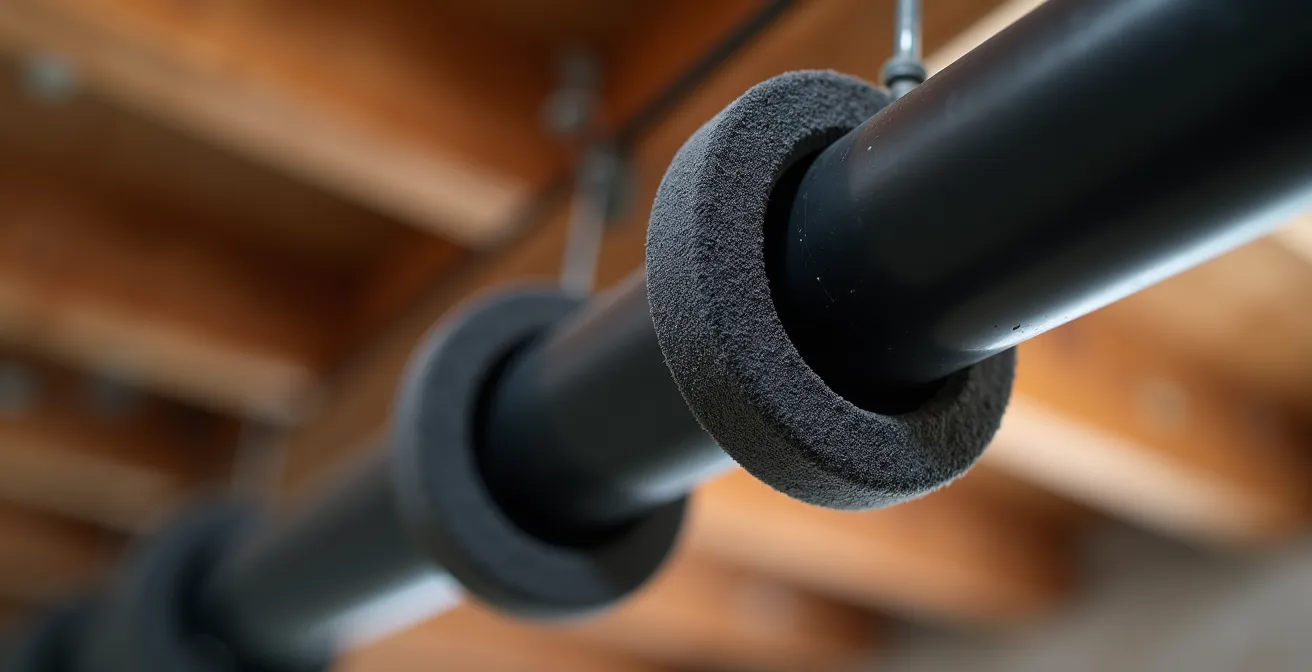
The impact of this simple component is significant. As an expert from the Canadian CNRC noted, noise reductions up to about 15 dBA can be obtained relative to systems where no resilient mounts are used. Proper support isn’t just about preventing blockages; it’s a fundamental technique for decoupling the plumbing system from the living space.
Noise reductions up to about 15 dBA can be obtained relative to systems where no resilient mounts are used for pipes
– Canadian CNRC, InspectAPedia Plumbing Noise Study
ABS or PVC: Which Handles Cold Weather Installation Better?
In a place like Montreal, where temperatures can plummet well below freezing, the properties of building materials in cold weather are a major consideration. Both ABS and PVC (Polyvinyl Chloride) plastics become more brittle as the temperature drops, but their performance is not identical. Generally, PVC has better resistance to cold weather impact than ABS, which can become particularly brittle around -30°C. This makes it more susceptible to cracking if handled roughly or impacted during an unheated winter construction or renovation project.
Both materials have a minimum recommended installation temperature of around 5°C for the solvent cement to cure properly. Attempting to glue pipes in colder conditions can result in weak joints that are prone to leaks and failure. While ABS is often the most affordable material, this cost saving can be negated if pipes are damaged during a winter installation.
For homeowners concerned about noise, a specific type of PVC, known as IPEX System 15, is a popular choice in Quebec. As IPEX points out, System 15 PVC DWV plumbing materials are not only lighter than metal alternatives but also engineered to be quieter than standard ABS or PVC. This offers a middle ground between the low cost of ABS and the superior sound dampening of cast iron.
This table summarizes the key differences for a homeowner in Montreal making a decision during a renovation.
| Feature | ABS | PVC |
|---|---|---|
| Cold Weather Brittleness | More brittle at -30°C | Better cold resistance |
| Installation Temperature | Min. 5°C | Min. 5°C |
| Material Cost | Most affordable | Moderate cost |
| Lifespan | 50 years | 50-75 years |
| Noise Level | High | High (System 15: Lower) |
The Error of Storing ABS Pipes in Direct Sunlight Before Use
One of the most overlooked causes of premature plumbing failure and noise is improper material storage. ABS plastic contains butadiene, which is vulnerable to degradation from ultraviolet (UV) radiation. Leaving black ABS pipes exposed to direct sunlight, even for a short period on a construction site during a Montreal summer, can compromise their material integrity. The UV rays break down the plastic’s polymer chains, causing the surface to become chalky, faded, and brittle.
This degradation has two major consequences. First, it significantly reduces the pipe’s lifespan. As Montreal contractors report, the expected 50-year lifespan of ABS can be severely shortened by UV exposure. A brittle pipe is far more likely to crack under stress, such as from building settlement or the thermal expansion and contraction that occurs with Quebec’s dramatic temperature swings. Second, this change in material properties affects its acoustics. A brittle, compromised pipe can be more prone to “ticking” and “creaking” noises as it expands and contracts with hot and cold water flow.
To identify potential damage, look for a faded, chalky appearance on the pipe’s surface. As a professional precaution, if a pipe has been stored outdoors, it’s wise to cut off and discard the first few inches from any exposed ends before installation. The best practice is simple: always store ABS pipes indoors or under an opaque, UV-protective tarp until the moment they are needed for installation. This simple step preserves the material’s durability and its intended acoustic performance.
Where to Place Cleanouts for Easy Access to Main Drains?
A well-designed plumbing system isn’t just about efficient drainage; it’s also about providing for future maintenance. Cleanouts are the access points that allow a plumber to clear blockages without having to cut open pipes or walls. The Quebec Construction Code has specific requirements for their placement to ensure the entire system is serviceable. Omitting or misplacing cleanouts is a sign of an amateur installation and can turn a simple clog into an expensive and destructive repair job.
Code dictates that a cleanout must be installed at the base of every vertical drain stack, at any change of direction in a horizontal run that is greater than 45 degrees, and at maximum intervals of 100 feet (30 meters) on long horizontal lines. For typical Montreal duplexes and triplexes, one of the most critical cleanouts is the main building drain cleanout, which should be located in the basement near the front foundation wall, just before the pipe exits the building.
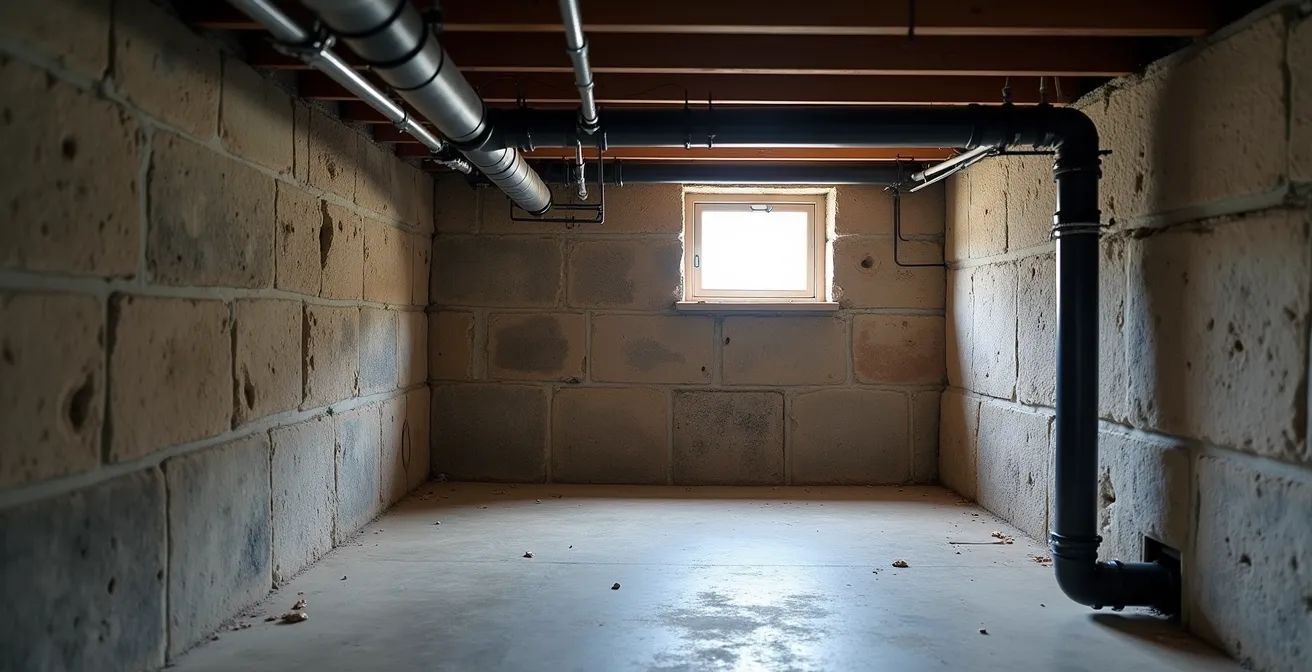
During renovations, it’s an opportune time to add more accessible cleanouts, such as under a bathroom or kitchen sink, to provide easier access to branch lines. A professional plumber will always think ahead, ensuring these access points are not concealed behind permanent fixtures or walls.
Checklist for Code-Compliant Cleanout Placement in Quebec
- Install a cleanout at the base of every drain stack to access vertical runs.
- Place a cleanout at every horizontal direction change greater than 45°.
- Ensure cleanouts are installed at maximum 30m (100ft) intervals on horizontal drain lines.
- For Montreal duplexes, locate the main cleanout near the front foundation wall in the basement.
- Add accessible cleanouts under sinks during renovations for future maintenance access.
Cast Iron or Insulated Plastic: Which Drops Drop Noise Best?
When noise is the primary concern, material selection becomes the most important decision. As acoustic consultant Bonnie Schnitta of SoundSense states, the difference is not subtle.
Water running through a plastic pipe is more than twice as loud as water running through cast iron
– Bonnie Schnitta, SoundSense Acoustic Consulting
Cast iron has long been the gold standard for quiet drainage. Its sheer mass and density are excellent at deadening the sound of rushing water. However, it is heavy, expensive, and difficult to install, often requiring additional structural support, which makes it impractical for many residential renovations in Montreal’s wood-frame duplexes. Fortunately, there are modern alternatives that offer a significant improvement over standard ABS.
The most common approach is to wrap standard ABS pipes with a soundproofing material like Mass Loaded Vinyl (MLV). This dense, flexible barrier adds mass to the pipe and helps to block airborne noise. A more integrated solution is to use an engineered PVC product like IPEX System 15. These systems are designed with sound dampening in mind and have become the professional’s choice for new condos and high-end renovations in Montreal. They offer a good balance of acoustic performance and ease of installation, providing a practical alternative to heavy cast iron.
This comparative table breaks down the options by performance, cost, and installation difficulty.
| Material | Noise Reduction | Cost per Linear Foot | Installation Difficulty |
|---|---|---|---|
| Cast Iron | 10-15 dB reduction | High ($30-50) | Difficult – requires support |
| IPEX System 15 | Moderate reduction | Medium ($15-25) | Easy – lightweight |
| Standard ABS | No reduction | Low ($5-15) | Very easy |
| ABS + MLV Wrap | 10-15 dB reduction | Medium ($20-30) | Moderate |
How to Join New PVC to Old Cast-Iron with Fernco Couplings?
In Montreal, with its vast stock of older homes, renovations frequently involve connecting modern plastic plumbing to an original cast-iron drain stack. This transition is a critical point that, if done improperly, can lead to leaks, blockages, and noise. The original cast iron drain pipes typically last 75-100 years, so while the main stack might still be in good condition, branch lines are often replaced during bathroom or kitchen updates.
The connection is made using a flexible transition coupling, commonly known by the brand name Fernco. However, for a code-compliant and durable connection, it is essential to use a shielded coupling (such as a Proflex or shielded Fernco model). These couplings feature a rubber sleeve surrounded by a stainless steel band clamp. The metal shield provides shear resistance, preventing the heavy cast iron pipe from sagging and creating a lip at the joint, which would cause turbulence and clogs. Quebec plumbing inspectors require these shielded versions for their superior strength and durability.
Proper installation is a multi-step process that ensures a smooth, leak-proof transition:
- Clean and Inspect: The end of the old cast iron pipe must be thoroughly cleaned of all rust and debris to ensure a tight seal.
- Choose the Right Coupling: Select a shielded transition coupling where the size exactly matches the outside diameters of both the cast iron and the new plastic pipe.
- Position and Secure: Slide the coupling into place, ensuring the metal shield is centered over the joint to provide maximum shear resistance.
- Torque to Spec: Tighten the band clamps to the manufacturer’s specified torque using a torque wrench. Over-tightening can damage the coupling, while under-tightening will lead to leaks.
- Verify Smooth Bore: Ensure the interior of the connection is smooth, with no lips or obstructions that could snag waste and create noise.
Key takeaways
- Drain noise is primarily an installation issue, not just a material issue.
- Correct hanger spacing with isolating mounts is more critical for sound than generic insulation.
- Following the Quebec Construction Code for materials and placement is the best path to a quiet system.
Who Is Responsible for a Blocked Sewer Lateral: You or the City of Montreal?
When a serious blockage occurs that affects the entire house, the question of responsibility becomes urgent. The sewer lateral is the pipe that connects your home’s drainage system to the main municipal sewer line under the street. In Montreal, the division of responsibility is very clear. The homeowner is responsible for the sewer lateral from the house’s foundation wall all the way to their property line. The City of Montreal is responsible for the section of pipe from the property line to the main city sewer.
If you suspect a blockage in the main lateral (e.g., drains backing up in the basement), the first step is to determine its location. You can do this by calling a licensed plumber to perform a camera inspection. However, before paying for a private service, you can contact the City of Montreal by calling 311 to request an inspection. The city will often perform this service for free, and if the blockage is determined to be on their side of the property line, they will handle the repair at their expense.
For those living in co-ownership buildings (condos), the situation is different. If the blockage is within a common element, like the main vertical stack or the sewer lateral, the responsibility typically falls to the syndicate of co-ownership (‘syndicat de copropriété’), not the individual unit owner. Ultimately, all plumbing work must adhere to the standards enforced by the Régie du bâtiment du Québec (RBQ). Hiring a contractor with a valid RBQ license ensures they are obligated to follow the Plumbing Code, which is your best protection against faulty installations that could lead to these major issues.
For a quiet and reliable drainage system that lasts for decades, the solution lies not in quick fixes but in a commitment to professional standards from the very beginning. To ensure your renovation or new build meets these critical standards, the next logical step is to consult with a licensed plumbing contractor who understands Montreal’s specific code requirements and building conditions.
Frequently Asked Questions on How to Quiet Down Noisy ABS Drain Pipes in Ceilings?
How quickly does UV damage occur to ABS pipes in Montreal summer?
ABS pipes can show signs of UV degradation after just one week of direct sunlight exposure during Montreal’s July temperatures, appearing chalky or faded.
What are the noise implications of UV-damaged pipes?
Brittle, UV-damaged pipes have altered acoustic properties and are more susceptible to ‘ticking’ noises from thermal expansion, especially during Quebec’s temperature swings.
How can I identify UV-damaged ABS pipe?
Look for a chalky, faded appearance on the pipe surface. As a precaution, cut off the first few inches of any potentially exposed pipe ends before installation.
Where does homeowner responsibility end?
The homeowner is responsible from the house foundation to the property line (‘limite de propriété’). The City of Montreal handles issues from the property line to the main city sewer.
How do I request a City inspection?
Contact the City of Montreal by calling 311 to request a camera inspection. This service is often free if the blockage is on the city’s side.
What about co-ownership buildings?
For blockages in common elements like the main stack, responsibility falls to the syndicate of co-ownership (‘syndicat de copropriété’), not individual owners.