
Meeting Montreal’s water bylaws is not a compromise on luxury; it’s a technical and marketing opportunity to deliver superior, high-efficiency properties.
- Bylaws now mandate low-consumption fixtures (e.g., sub-4.8L toilets) in all major renovations, making older models obsolete and non-compliant.
- The key to user satisfaction lies in “flow engineering”—using aeration and pressure-compensating technology to create a feeling of high pressure while drastically reducing water use.
Recommendation: Focus on WaterSense-certified fixtures with advanced flow technologies to ensure consistent performance, protect warranties, and turn water efficiency into a premium selling point for buyers.
For property developers in Montreal, navigating the city’s evolving water conservation bylaws can feel like walking a tightrope. On one side, there is the absolute requirement for regulatory compliance. On the other, the non-negotiable demand from buyers for a premium living experience, which includes a powerful, satisfying shower. The common assumption is that these two goals are mutually exclusive; that adopting low-flow fixtures inevitably leads to a weak, unsatisfying trickle that diminishes property value. This forces a perceived choice between breaking the law and disappointing customers.
However, this perspective is based on an outdated understanding of plumbing technology. The conversation is no longer about simple water restriction. Modern water efficiency is a matter of sophisticated flow engineering. It’s about mastering the physics of water to shape the flow, infuse it with air, and compensate for pressure fluctuations. This approach creates a “perceived pressure” that feels robust and voluminous, even while using significantly less water. For a developer, this is not a burden but a strategic advantage.
This guide moves beyond the mere listing of regulations. We will explore the technical solutions that allow you to exceed Montreal’s bylaws while delivering a superior water experience that buyers will notice and value. We will cover the specific fixture requirements, the critical mistakes to avoid that can void warranties, and the advanced technologies that turn a regulatory hurdle into a powerful marketing feature. By the end, you will have a clear roadmap for developing properties that are not only compliant and sustainable but also more desirable on the market.
To help you navigate these critical considerations, this article provides a detailed breakdown of the key issues. The following summary outlines the path from mandatory compliance to market-leading innovation.
Summary: A Developer’s Guide to Water Bylaw Compliance and Performance
- Why Are 13-Liter Toilets Now Illegal to Install in Renovations?
- How to Retrofit Aerators to Reduce Consumption by 40%?
- WaterSense vs. Standard: Which Fixtures Qualify for Rebates?
- The Error of Removing Flow Restrictors That Voids Warranties
- When Will Gray Water Recycling Become Mandatory in Quebec?
- Why Does Aerated Water Feel Softer on Hands?
- Why Does the Half-Flush Button Stick on Certain Models?
- How to Choose Low-Flow Faucets That Don’t Feel Weak?
Why Are 13-Liter Toilets Now Illegal to Install in Renovations?
The phasing out of high-capacity toilets is a cornerstone of Montreal’s water conservation strategy. For property developers, understanding this rule is not just about compliance; it’s about recognizing a fundamental shift in building standards. The installation of toilets with a flush volume of 13 liters or more is now prohibited in any major renovation project that requires a permit. This effectively renders a vast inventory of older, water-guzzling fixtures obsolete for any significant remodel. The rationale is clear: toilets are a major source of residential water consumption, and reducing their flush volume offers one of the most impactful ways to conserve this resource on a city-wide scale.
This isn’t merely a local trend. The move toward high-efficiency toilets (HETs) is a global effort with documented success. A comprehensive analysis has shown that transitioning to low-flow fixtures could result in 142.4 trillion liters of water saved globally by 2050. For a developer, this means that specifying compliant fixtures isn’t just about avoiding fines; it’s about future-proofing a property and aligning it with modern sustainability standards that are increasingly valued by discerning buyers. The new benchmark is a maximum of 4.8 liters per flush, a standard met by all WaterSense-certified models.
Navigating this requirement during a renovation demands a systematic approach. From permit acquisition to the final installation, each step must be documented and executed in accordance with municipal and provincial regulations, including those set by the Régie du bâtiment du Québec (RBQ).
Action Plan: Montreal Bylaw Compliance for Toilet Installations
- Verify if your renovation qualifies as “major”—any bathroom remodel requiring a permit falls under this category.
- Get a cutting permit from your borough for any sewer-related work.
- Remove old 13L+ toilets and document with photos for potential rebate programs.
- Purchase a WaterSense-certified toilet with a maximum 4.8L flush capacity.
- Ensure your contractor holds a valid RBQ license and requests an Info-Excavation locate before any digging.
How to Retrofit Aerators to Reduce Consumption by 40%?
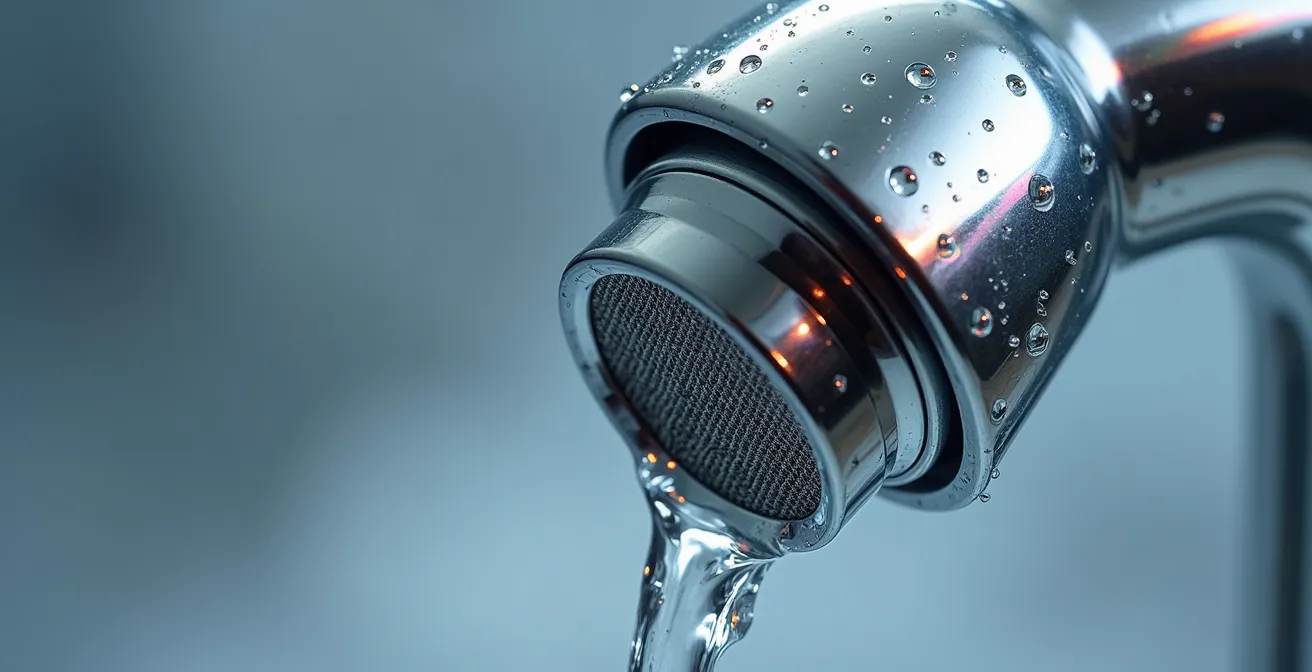
While replacing toilets is a major undertaking, one of the most cost-effective and immediate ways to meet water conservation targets is by retrofitting existing faucets and showerheads with aerators. An aerator is a small, often overlooked component that screws onto the tip of a faucet. Its function is to mix air into the water stream, a simple act of flow engineering that has profound effects. It reduces the volume of water flowing through the fixture without a noticeable drop in what users perceive as pressure. In many cases, this can reduce water consumption by up to 40% or more for a given task, like handwashing.
For a property developer, retrofitting with aerators is a high-ROI move. It addresses compliance requirements with minimal capital outlay and disruption. Instead of replacing entire faucet assemblies, you can upgrade dozens of units in a fraction of the time, immediately bringing them in line with efficiency standards. This is particularly valuable in multi-unit residential buildings where the cumulative savings can be substantial. The technology is simple but effective: as water passes through the aerator’s fine mesh screen, it creates a turbulent flow that draws in air, resulting in a softer, splash-free stream that covers a wider surface area.
The key is selecting the right type of aerator for each application. A bathroom faucet, used for handwashing, can benefit from a very low flow rate, whereas a kitchen faucet may require a slightly higher rate to remain practical for tasks like filling pots. Understanding these nuances allows for a tailored approach that maximizes savings without compromising functionality.
| Fixture Type | Standard Flow Rate | With Aerator | Water Saved |
|---|---|---|---|
| Bathroom Faucet | 2.2 GPM | 1-1.5 GPM | 32-55% |
| Kitchen Faucet | 2.2 GPM | 1.5-2.2 GPM | 0-32% |
| Showerhead | 2.5 GPM | 6-9 L/min (1.6-2.4 GPM) | 4-36% |
WaterSense vs. Standard: Which Fixtures Qualify for Rebates?
For a developer focused on budget and ROI, the WaterSense label is more than a symbol of efficiency—it’s a gateway to financial incentives. WaterSense is a program sponsored by the U.S. Environmental Protection Agency (EPA), but its standards are widely adopted across North America, including Canada, as the benchmark for water-efficient products. To earn the label, fixtures must be at least 20% more water-efficient than their standard counterparts while meeting strict performance criteria. This performance guarantee is crucial; it assures developers and buyers that efficiency does not come at the expense of function.
Crucially, many municipal and provincial rebate programs across Canada are tied directly to the WaterSense label. While programs vary, they typically offer cash back for replacing old, inefficient fixtures with certified models. For a developer undertaking a multi-unit renovation, these rebates can add up to a significant cost offset, directly improving the project’s bottom line. For example, replacing a single inefficient 13L toilet with a WaterSense model can lead to an estimated 13,000 gallons saved annually per household, a powerful metric for both rebate applications and marketing materials.
While Montreal’s specific rebate programs may evolve, the principle remains the same. A prime example from elsewhere in Canada is Winnipeg’s toilet replacement program, where residents replacing old 13L+ toilets with WaterSense models must submit quarterly water meter readings to track savings and qualify for credits. This demonstrates a common framework: prove the upgrade, document the purchase of a certified product, and receive a financial benefit. For developers, this means that specifying WaterSense is not an added cost but a strategic investment that pays dividends through both utility savings and direct rebates.
The Error of Removing Flow Restrictors That Voids Warranties
In a misguided attempt to “improve” water pressure, some contractors or homeowners are tempted to tamper with low-flow fixtures by removing the built-in flow restrictor. This small plastic component is engineered to regulate the amount of water passing through a showerhead or faucet to meet WaterSense and bylaw requirements. While removing it may temporarily increase the flow rate, it is a critical error with serious consequences for a property developer. First and foremost, it instantly voids the manufacturer’s warranty on the fixture. Should any issue arise, from a leak to a finish defect, the manufacturer will be under no obligation to provide a repair or replacement.
Beyond the warranty, this modification fundamentally undermines the entire purpose of installing a high-efficiency fixture. It negates the water savings, pushes the property out of compliance with municipal bylaws, and eliminates eligibility for any associated rebates. It is a shortsighted “fix” that creates significant financial and legal liability. For a developer, the reputational damage can be severe if new homeowners discover their “eco-friendly” property is equipped with illegally modified fixtures that fail prematurely.
The message from local authorities and service providers is unequivocal. Any unauthorized modification to plumbing systems carries risk. As Montreal-based Trans Canada Drain clearly states, this type of action can have costly repercussions.
Performing work without the required permits or failing to follow regulations may lead to fines and additional remediation costs charged by the City.
– Trans Canada Drain, Montreal Drainage Services Provider
The correct approach is not to fight the technology but to choose the right technology from the start—fixtures that are engineered to provide a satisfying experience at a compliant flow rate.
When Will Gray Water Recycling Become Mandatory in Quebec?
For a forward-thinking property developer, compliance isn’t just about meeting today’s rules; it’s about anticipating tomorrow’s. The next frontier in urban water management is gray water recycling, and it’s already on the legislative horizon in Quebec. Gray water is the relatively clean wastewater from showers, bathtubs, and washing machines. Instead of being sent directly to the sewer, it can be collected, minimally treated, and reused for non-potable applications like toilet flushing and landscape irrigation. This practice can reduce a household’s fresh water demand by 30-50%, easing the strain on municipal treatment plants and water sources.
While not yet universally mandatory for residential projects, the regulatory framework is tightening. The Quebec Ministry of Environment is pushing for significant reductions in wastewater discharges, particularly into sensitive ecosystems like the St. Lawrence River. As part of this push, a key deadline is looming. The ministry requires municipalities to take concrete steps to reduce their wastewater impact, with a compliance timeline that points towards stricter on-site water management policies. A report on the subject highlights the January 1, 2030 deadline for municipalities to implement measures reducing wastewater overflows.
What does this mean for developers? It signals that buildings designed today will likely operate under a much stricter water reuse regime in the near future. Incorporating gray water-ready plumbing (known as “dual plumbing”) into new constructions now is a savvy, future-proofing investment. While the upfront cost is higher, it positions a property as a leader in sustainable design and avoids a far more expensive and disruptive retrofit down the line. For premium, eco-conscious developments, showcasing a gray water recycling system can be a powerful and unique selling proposition.
Why Does Aerated Water Feel Softer on Hands?
The success of low-flow fixtures hinges on a crucial piece of user psychology: perceived pressure. A well-designed aerated faucet delivers a stream that feels robust and cleansing, even though it uses a fraction of the water. The secret lies in the physics of how air is introduced into the water stream. The sensation of “softness” and “volume” is a direct result of the millions of tiny air bubbles that are mixed in. This process does two things: it increases the diameter of the water stream and it cushions the impact of the water on the skin.
Instead of a solid, “hard” column of water hitting your hands, an aerated stream is a composite of water and air. This makes the flow feel lighter and more distributed, covering a larger surface area with less splashing. This is a masterful illusion of flow engineering. As one expert source explains, the aerator creates a balanced flow that feels just as powerful as its water-guzzling counterparts. The goal is to make every drop feel like it’s doing more work, providing the sensory feedback of high volume without the actual high consumption.
For a developer, this concept is the key to selling water efficiency. You are not selling a restriction; you are selling a superior sensory experience. When buyers turn on a faucet and feel a soft, full, splash-free stream, they don’t perceive a lack of water. They perceive a modern, high-quality fixture. This completely reframes the conversation from one of sacrifice to one of smart, luxurious design. This is how you satisfy both the building inspector and the discerning home buyer.
Why Does the Half-Flush Button Stick on Certain Models?
A common and frustrating maintenance issue with dual-flush toilets, especially in regions like Montreal, is a sticking half-flush (low-volume) button. While it may seem like a minor annoyance, for a property developer it represents a recurring maintenance cost and a point of dissatisfaction for residents. The primary culprit is often the local water quality. Montreal’s water is classified as moderately hard, meaning it contains a higher concentration of dissolved minerals like calcium and magnesium. Over time, these minerals precipitate out of the water and form limescale deposits on the internal components of the toilet’s flush mechanism.
In many dual-flush toilets, particularly gravity-fed models with push-rod systems, these mineral deposits build up on the button assembly and prevent it from returning smoothly after being pressed. The half-flush button, often used more frequently, can be the first to show symptoms. While the issue can sometimes be temporarily fixed with a descaling agent like CLR or vinegar, it’s a reactive solution to a design problem. For a developer aiming for long-term quality and low maintenance, the proactive solution is to select fixtures that are more resilient to these conditions.
Certain toilet technologies are inherently more resistant to such problems. For instance, pressure-assist toilets, which use compressed air to force water into the bowl, often have more robust mechanical flushing systems that are less prone to the delicate issues caused by scale buildup. Choosing such a model may involve a slightly higher upfront cost, but it can prevent years of resident complaints and plumber call-outs, which can range from $300-$800 for a professional installation or major repair. It is a classic example of how considering the total lifecycle cost, not just the purchase price, leads to a better investment.
Key Takeaways
- Compliance is mandatory, not optional, for any major Montreal renovation; older 13L+ toilets are now illegal to install.
- Modern flow engineering, particularly aeration, creates a high “perceived pressure,” successfully decoupling user satisfaction from actual water volume (GPM).
- Choosing the right technology from the start, such as pressure-compensating fixtures, is critical for delivering consistent performance, preventing future maintenance, and protecting manufacturer warranties.
How to Choose Low-Flow Faucets That Don’t Feel Weak?
The ultimate challenge for a developer is selecting the specific low-flow fixtures that will deliver on the promise of performance. The fear of a “weak” stream is the single biggest objection from buyers. The solution lies in moving beyond the GPM (gallons per minute) rating and understanding the technology that shapes the water flow. Not all low-flow faucets are created equal. The key is to match the flow technology to the application to ensure the user experience is enhanced, not compromised.
Three primary technologies dominate the high-performance, low-flow market. Laminar flow devices produce a clear, non-aerated, splash-free stream that looks like a solid rod of glass. This is ideal for applications like kitchen sinks where a clean, fast fill is needed. Aerated flow, as discussed, is perfect for bathroom sinks, creating a soft, voluminous stream for handwashing. The most advanced option for ensuring user satisfaction across an entire building is pressure-compensating technology. These devices have flexible orifices that automatically adjust to maintain a consistent flow rate, regardless of fluctuations in the building’s water pressure. This is a critical feature in multi-story developments, ensuring the penthouse shower feels just as powerful as the one on the ground floor.
By specifying fixtures with these advanced technologies, a developer can confidently market their properties as having a premium, water-efficient plumbing package. You are no longer just selling a faucet; you are selling a consistent, high-quality experience backed by smart engineering. This is the definitive answer to meeting Montreal’s bylaws without sacrificing an ounce of performance or buyer satisfaction.
| Technology Type | Flow Rate | Best Application | User Experience |
|---|---|---|---|
| Laminar Flow | 1.5 GPM or less | Kitchen – pot filling | Clear, splash-free stream |
| Aerated Flow | 1.2-1.5 GPM | Bathroom sinks | Soft, voluminous feel |
| Pressure-Compensating | 1.0-1.5 GPM | Variable pressure buildings | Consistent flow regardless of pressure |
To ensure your next project not only complies with regulations but sets a new standard for desirable, eco-luxe living, a strategic review of your fixture specifications based on flow engineering principles is the essential next step.
Frequently Asked Questions on Low-Flow Fixtures in Montreal
What causes dual-flush buttons to stick in Montreal’s hard water?
Montreal’s moderately hard water causes mineral buildup on button mechanisms, particularly in push-rod systems. Scale formation prevents the smooth return of the button after being pressed.
Can I fix a sticking button without calling a plumber?
Yes, for minor issues, you can apply CLR or white vinegar directly to the button mechanism. Let it sit for 30 minutes, then work the button repeatedly to help break up the mineral deposits and restore movement.
Which toilet mechanism types resist sticking better?
Pressure Assist Toilets are generally more resilient to this issue. They use compressed air in the tank to forcefully push water into the bowl, which relies on a more robust flushing mechanism compared to the more delicate components found in many gravity-fed, dual-flush models.