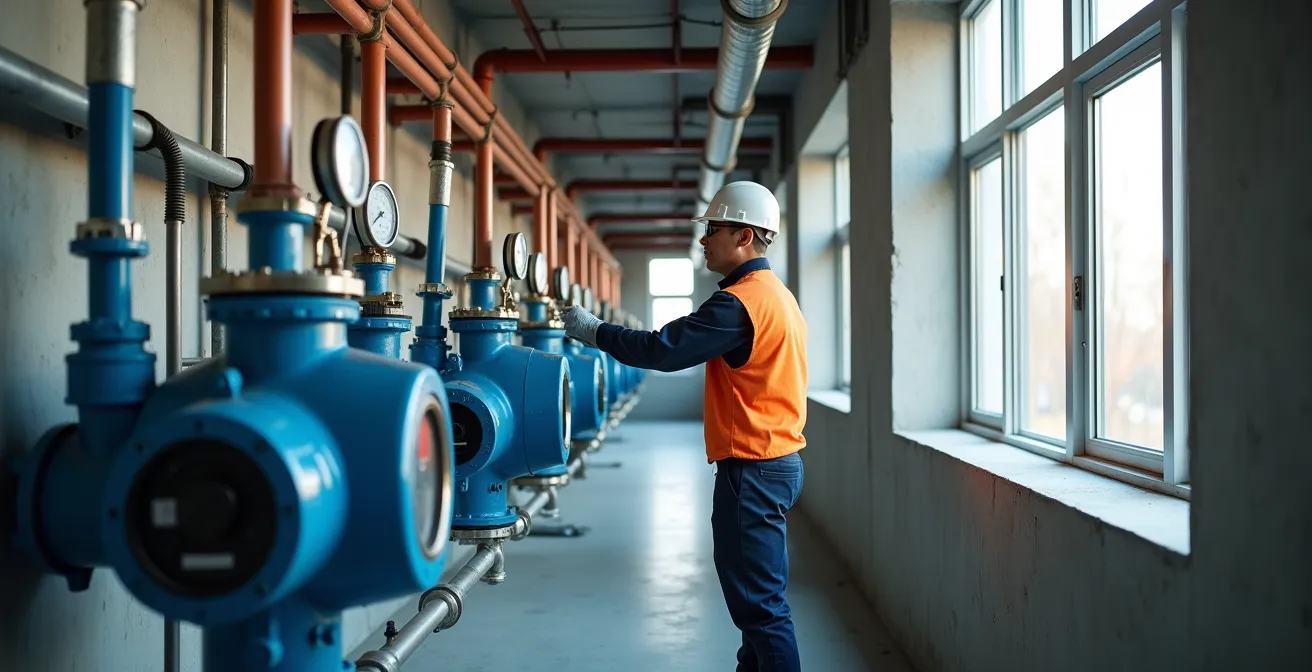
Managing water damage in a high-rise isn’t just about fixing leaks; it’s about governing a complex vertical plumbing ecosystem where standard homeowner logic fails.
- The responsibility for a pipe is not based on visibility but on its function within the building’s shared infrastructure, as defined by Quebec’s Civil Code.
- Minor issues like slow drains or small stains are often symptoms of systemic “infrastructure fatigue” that can lead to catastrophic, building-wide failures.
Recommendation: Shift from a reactive, unit-by-unit repair mindset to proactive “plumbing governance” by establishing clear bylaws and a building-wide preventive maintenance schedule.
Living in a Montreal high-rise condo offers undeniable advantages, but it introduces a set of shared risks that a single-family homeowner never confronts. When it comes to water damage, the most pervasive and costly of these risks, the instinct is often to think in terms of individual appliances or personal negligence. We hear about burst washing machine hoses or overflowing bathtubs, and the advice is typically to check your insurance and report the leak immediately. While correct, this view is dangerously incomplete.
This approach misses the fundamental truth of high-rise living: your unit is not an island. It is a single node in a complex, interconnected vertical ecosystem of plumbing. The pipes in your walls are part of a shared circulatory system that runs from the basement pumps to the penthouse suite. A problem on the 3rd floor can manifest on the 1st, and a decision made on the 20th can impact everyone below. The true challenge isn’t just reacting to leaks; it’s understanding the physics, legal frameworks, and systemic fatigue of this shared infrastructure.
But what if the key to mitigating water damage wasn’t just better insurance or faster reactions, but a radical shift in perspective? What if we treated the building’s plumbing not as a collection of individual parts, but as a single, shared asset that requires collective governance? This guide moves beyond the generic advice. We will explore the specific plumbing dynamics of Montreal condos, from the legal nuances of pipe ownership to the technical realities of maintaining consistent water pressure and flow across dozens of floors. It’s time to move from simply owning a unit to responsibly co-managing a building.
This article provides a framework for syndicate members and proactive owners to understand the unique plumbing challenges in multi-story buildings. By breaking down the core issues into manageable sections, you will gain the necessary knowledge to implement effective risk management strategies.
Summary: A Complete Guide to Plumbing Governance in Montreal Condominiums
- Why Is the Wall Pipe the Syndicate’s Problem but the Faucet Yours?
- How to Soundproof Drains to Maintain Good Neighbor Relations?
- Washing Machines in Condos: Which Hoses Are Mandatory for Insurance?
- The Error of Dismissing Minor Ceiling Spots That Rot Structural Wood
- When to Clean Kitchen Stacks in a 20-Story Building?
- Contractor or In-House Team: Which Is Best for a 50-Unit Building?
- Variable Frequency Drive (VFD) vs. Constant Speed: Which Saves Energy?
- How to Guarantee Consistent Hot Water in a Penthouse Suite?
Why Is the Wall Pipe the Syndicate’s Problem but the Faucet Yours?
This is the most fundamental and frequently misunderstood aspect of condo living. The responsibility for a pipe is not determined by its location within your unit’s walls but by its function. A pipe that serves only your unit—like the one connecting your faucet to the shut-off valve under the sink—is typically your private responsibility. However, the main vertical stack that carries wastewater from your unit and your neighbors’ is a common portion, managed by the syndicate, even if a section of it passes through your wall cavity. This distinction is not arbitrary; it’s enshrined in law.
The legal framework in Quebec provides a clear, if sometimes complex, definition. The key principle is “common use.” According to Quebec Civil Code Article 1043, common portions are “owned by all the co-owners and serve for their common use.” This includes structural elements, main plumbing and electrical systems, and anything deemed essential to the building’s integrity. Your declaration of co-ownership will further specify these definitions, sometimes creating a third category: “common portions for restricted use,” like a balcony or a section of pipe that serves only your unit but is located in a common wall.
As a condo manager, my role is to enforce this distinction firmly but fairly. A leak from a shared vertical stack is a syndicate issue, and repairs are funded through condo fees or the reserve fund. A leak from your personal faucet or toilet supply line is your financial responsibility and falls under your personal condo insurance. Understanding this division is not just a legal technicality; it’s the foundation of effective plumbing governance and financial planning for the entire building. Ignoring it leads to disputes, delayed repairs, and escalating damage.
Action Plan: Pinpointing Pipe Responsibility in Your Co-ownership
- Review the Declaration: Start by examining your Declaration of Co-ownership. It should contain specific definitions of what constitutes private versus common portions for your building.
- Consult the Civil Code: Cross-reference your declaration with Articles 1043, 1044, and 1064 of the Quebec Civil Code for the overarching legal distinctions.
- Identify the Pipe’s Function: Determine if the pipe in question serves multiple units (making it common) or exclusively your unit (making it likely private).
- Verify Location vs. Use: Check if the pipe is located within a common wall but serves only your unit. This may classify it as a “common portion for restricted use,” with specific maintenance rules.
- Request Clarification: If any ambiguity remains, formally consult with the syndicate manager. Request a written clarification to establish a clear record of responsibility before any work begins.
How to Soundproof Drains to Maintain Good Neighbor Relations?
In a high-rise, you don’t just share pipes; you share the sounds they make. The gurgling of a drain or the rush of a flushing toilet from the unit above can be a constant source of irritation, eroding the quality of life and straining neighborly relations. This isn’t a sign of defective plumbing but a byproduct of the vertical ecosystem. Sound travels easily through the rigid structures and shared cavities that house the building’s plumbing stacks. While older buildings with thick plaster walls and cast-iron pipes are often naturally quieter, modern constructions using lighter materials like PVC or ABS pipes and drywall can be significantly noisier.
Effective soundproofing is therefore not a luxury but a critical component of considerate high-rise living. The solution lies in isolating the pipes from the building structure to stop vibrations from propagating. This is typically achieved by wrapping the drainpipes (stacks) with specialized acoustic insulation. This material, often a dense, mass-loaded vinyl or fibrous wrap, adds mass to the pipe, which dampens the sound energy produced by flowing water. Furthermore, using isolation clips or mounts where the pipe is secured to studs prevents the direct transfer of vibrations into the walls and floors.
This is a detail that must be addressed during construction or major renovations. For a syndicate, mandating minimum soundproofing standards in the declaration of co-ownership for any plumbing work is a proactive measure. While a plumber’s primary job is to ensure a leak-free system, effective building management involves looking at the system’s holistic impact, as even perfectly functioning pipes can become a nuisance. A preventative maintenance program should not only focus on leak detection but also on quality-of-life elements like noise. Addressing sound transmission is an investment in community harmony.

Washing Machines in Condos: Which Hoses Are Mandatory for Insurance?
A washing machine is one of the most common sources of in-unit water damage, but in a condo, its failure is a threat to the entire vertical stack of units below. A simple burst hose can flood your apartment, damage the unit below, and continue down several floors, causing exponential destruction. Insurers are acutely aware of this risk. Water damage is the leading cause of home insurance claims in Canada, and according to the Insurance Bureau of Canada (IBC), water damage contributed to over $1 billion in losses in 2024 alone. Consequently, most insurers and, by extension, condo syndicates in Quebec have implemented strict, non-negotiable rules regarding washing machine installations.
The most critical requirement is the use of braided stainless steel hoses. Standard black rubber hoses degrade over time, becoming brittle and prone to bursting under the constant water pressure. Braided steel hoses encase a durable rubber tube in a stainless steel mesh, providing a vital layer of protection against ruptures. For most insurers in Quebec, their use is not a suggestion; it’s a mandatory condition for coverage. A claim for water damage originating from a washing machine with non-compliant hoses is likely to be denied, leaving the owner personally liable for all damages to their own unit and to others’.
Effective plumbing governance goes further. Syndicates must enforce these rules through clear bylaws, which often include:
- Mandatory replacement of all hoses every five years, regardless of their apparent condition.
- Installation of an automatic shut-off valve, a device that detects leaks and immediately cuts the water supply.
- A requirement for owners to provide proof of professional installation and periodic inspection.
These measures are not about penalizing owners. They are essential risk-management protocols designed to protect the collective financial health of the co-ownership and ensure the insurability of the entire building. As a manager, enforcing these rules is a primary duty.
The Error of Dismissing Minor Ceiling Spots That Rot Structural Wood
One of the most dangerous forms of complacency in a condo is ignoring a small, faint water spot on a ceiling. The temptation is to dismiss it as an old stain or a minor, one-time issue. This is a grave mistake. A ceiling spot is not the problem; it is the final symptom of a hidden, ongoing problem. By the time water has saturated drywall or plaster to the point of visible discoloration, a significant amount of moisture has already been accumulating in the ceiling cavity. This hidden moisture is a silent destroyer, promoting the growth of mold and, more critically, causing slow rot in the building’s structural elements like wooden joists or subflooring.
The source is often not a major flood but an insidious, slow leak. These can originate from a faulty wax seal on a toilet upstairs, a cracked tile in a shower, or, most deceptively, from what are known as pinhole leaks. As explained by plumbing experts, these are tiny perforations that develop in copper pipes over years due to internal corrosion. They don’t gush water; they seep it, drop by drop, often for months or years before any evidence becomes visible. This slow, steady drip creates a permanently damp environment perfect for rot and mold, compromising the structural integrity of the floor assembly between units.
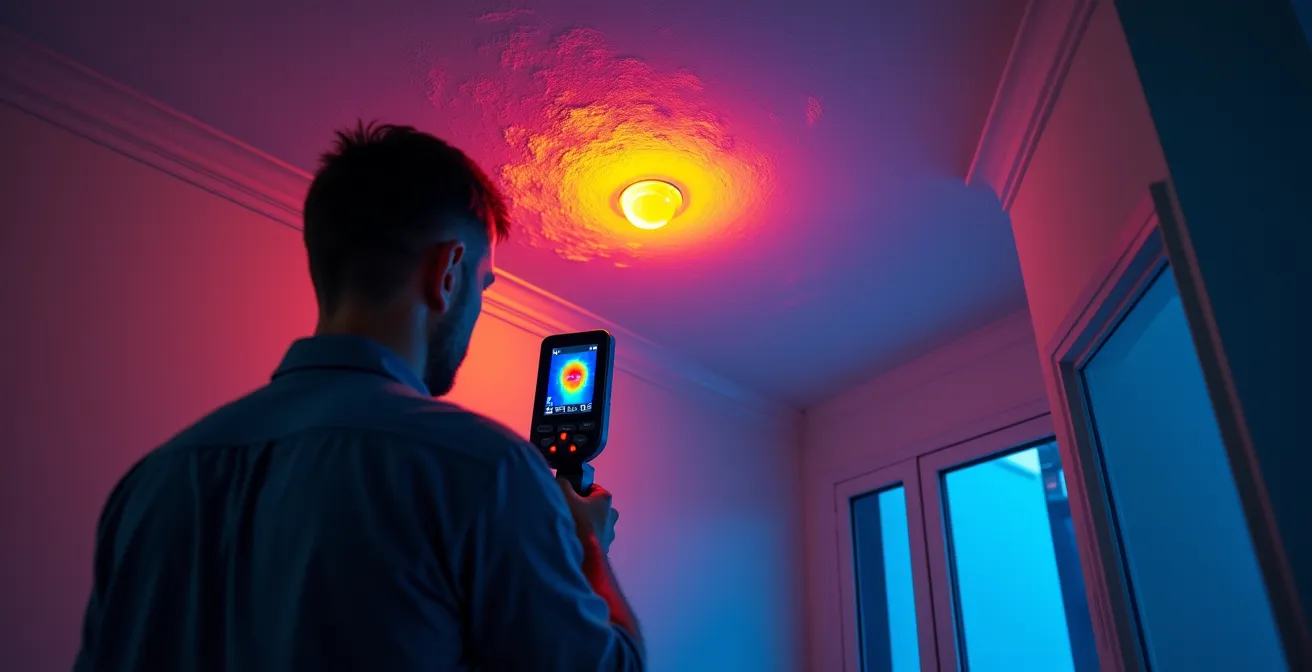
Upon noticing any new or changing spot, an immediate and formal protocol must be initiated. The first step is to document the spot with dated photos and notify both the upstairs neighbor and the syndicate manager in writing. This creates a crucial paper trail. The syndicate should then authorize a professional inspection using tools like a thermal imaging camera and a moisture meter. Thermal imaging can reveal the full extent of the hidden moisture plume, while a moisture meter provides quantifiable data for insurance claims. Ignoring a small spot is a gamble against the building’s structural health—a gamble that, as a manager, I will never permit.
When to Clean Kitchen Stacks in a 20-Story Building?
While a bathroom clog is a personal inconvenience, a blockage in a main kitchen stack of a 20-story building is a systemic failure waiting to happen. Over years, the accumulation of grease, food debris, and soap scum coats the inside of the vertical drainpipes. This buildup, known as FOG (Fats, Oils, and Grease), hardens and narrows the pipe’s diameter, particularly on lower floors where the flow from all upper units converges. The first sign of trouble isn’t a complete blockage, but slow draining in multiple units on lower levels. When this symptom is ignored, the result is an inevitable and unpleasant backup, forcing wastewater from upper floors back up through the drains of the lowest units.
This is a clear example of infrastructure fatigue. The cleaning frequency for these stacks is not one-size-fits-all; it depends heavily on the age of the building and the material of the pipes. Montreal’s condo landscape includes buildings from various eras, each with its own plumbing profile. Proactive syndicates must have a maintenance schedule based on this profile, rather than waiting for a crisis. It’s an essential part of the preventive maintenance plan now strongly encouraged by Quebec law. As noted by security and risk management experts, “Since 2018, Quebec has adopted laws (Bills 141 and 16) and made changes to the Civil Code, providing stricter regulation of condominium insurance and maintenance.” This legal shift emphasizes the syndicate’s duty to maintain common portions, and drain stacks are a prime example.
Since 2018, Quebec has adopted laws (Bills 141 and 16) and made changes to the Civil Code, providing stricter regulation of condominium insurance and maintenance.
– GardaWorld Security Systems, Quebec Condo Water Damage Crisis Report
As a manager, I insist on a scheduled, preventative drain cleaning program, funded by the reserve fund. Waiting for a backup to occur is a reactive and far more expensive strategy. It not only causes property damage but also creates significant distress for residents. A well-managed building anticipates problems, not just responds to them. The following table provides a general guideline for Montreal buildings.
| Stack Type | Building Era | Cleaning Frequency | Signs of Blockage |
|---|---|---|---|
| Cast Iron | 1960s-1980s | Every 7-10 years | Gurgling drains, foul smells |
| ABS/PVC | 1990s-Present | Every 15-20 years | Slow draining in lower units |
| Copper | Pre-1960s | Every 5-7 years | Multiple floor backups |
Contractor or In-House Team: Which Is Best for a 50-Unit Building?
Once a syndicate commits to a proactive maintenance strategy, the next question is execution: who performs the work? For a mid-sized building of around 50 units, the choice between hiring external contractors on a case-by-case basis or employing an in-house maintenance team (or a hybrid model) is a critical strategic decision. There is no single right answer; the best choice depends on the building’s age, complexity, and budget. An in-house team can offer faster response times for minor issues and a deeper familiarity with the building’s specific quirks. However, this model comes with the overhead of salaries, benefits, and the need for ongoing training and supervision.
Hiring external, specialized contractors offers flexibility and access to a broad range of expertise without the fixed costs of an employee. For specialized tasks like VFD maintenance, drain camera inspections, or major repiping projects, a certified contractor is non-negotiable. It is crucial to remember that plumbing is a regulated trade. In Quebec, any person performing plumbing work must meet strict requirements, including being a member of the CMMTQ (Corporation des maîtres mécaniciens en tuyauterie du Québec) and holding a valid RBQ (Régie du bâtiment du Québec) license. Using unlicensed handymen for anything beyond changing a faucet washer is a legal and insurance liability the syndicate must never assume.
A hybrid model often presents the best balance for a 50-unit building. This involves having an on-site superintendent for immediate, minor repairs (like a running toilet or a simple clog) while establishing long-term service contracts with vetted, licensed plumbing contractors for all major work and preventative maintenance. This approach optimizes the reserve fund by ensuring that routine tasks are handled cost-effectively, while complex, high-risk work is performed by qualified experts. This strategic allocation of resources is the core of efficient building management, ensuring the longevity of the plumbing system and avoiding costly emergency repairs.
Variable Frequency Drive (VFD) vs. Constant Speed: Which Saves Energy?
In any high-rise, delivering water to the upper floors requires a booster pump system located in the mechanical room. Traditionally, these systems used constant speed pumps that run at 100% capacity whenever they are activated, regardless of the building’s actual water demand. This is like driving a car with only two modes: parked or full throttle. It’s simple but incredibly inefficient, wasting a significant amount of electricity and causing mechanical stress on the entire plumbing infrastructure through abrupt pressure changes known as “water hammer.”
The modern, and vastly superior, solution is a Variable Frequency Drive (VFD) pump system. A VFD acts like a sophisticated throttle for the pump’s electric motor. It constantly adjusts the motor’s speed to precisely match the building’s real-time water demand. During periods of low use (e.g., overnight), the pump runs at a much lower speed, consuming a fraction of the energy. When demand peaks in the morning, the VFD seamlessly ramps up the speed to maintain consistent pressure. This intelligent modulation results in massive energy savings, often between 30% and 50% on the pump’s electricity consumption.
For a syndicate, investing in a VFD retrofit is one of the smartest long-term financial decisions. The benefits extend beyond energy savings. By eliminating water hammer, VFDs reduce mechanical stress on pipes, joints, and valves, prolonging the life of the building’s entire plumbing ecosystem and reducing the frequency of repairs. Furthermore, programs like Hydro-Québec’s “Energy Efficiency for Businesses” may offer grants or incentives to help offset the initial installation cost. Evaluating the potential for a VFD upgrade should be a standard part of any syndicate’s long-term capital planning and is a clear indicator of a proactively managed building.

Key Takeaways
- Responsibility Follows Function: A pipe’s owner (you or the syndicate) is determined by who it serves, not where it is located. This is a core legal principle in Quebec co-ownership.
- Small Signs, Big Problems: Minor issues like ceiling spots or slow drains are often early warnings of systemic failures. Proactive investigation is non-negotiable.
- Governance Over Repairs: Effective management focuses on proactive rules and preventive maintenance (e.g., mandatory hoses, scheduled drain cleaning) rather than reactive repairs.
How to Guarantee Consistent Hot Water in a Penthouse Suite?
The penthouse hot water problem is the ultimate litmus test for a high-rise’s plumbing health. A resident on the top floor complains that it takes minutes to get hot water at their tap. This isn’t a problem with their water heater, because in most condos, hot water is generated centrally and circulated throughout the building in a continuous loop. The issue is a failure in this circulation, a classic symptom of poor pressure dynamics and infrastructure fatigue in the vertical ecosystem. Hot water from the boiler is pumped up a supply line to the top floor and then travels back down a return line, allowing for “instant” hot water at every tap. When this loop is compromised, the water in the pipes cools, and the resident must run the tap until fresh hot water travels all the way from the basement.
Several factors can cause this failure. The most common is mineral scale buildup (calcification) inside the recirculation loop, especially in older buildings with copper or galvanized pipes. This narrows the pipe and restricts flow. An aging or undersized circulation pump can also be the culprit, lacking the power to push water effectively to the highest floors. Finally, inadequate pipe insulation allows the water to lose too much heat on its journey, defeating the purpose of the loop. This problem is more than an inconvenience; it’s a sign that the building’s circulatory system is failing and requires a strategic intervention.
Resolving this requires a systematic approach, not a quick fix. As a manager, my first step is to authorize a diagnostic to pinpoint the cause. Depending on the findings, the solutions can range in complexity and cost. Sometimes, a simple de-scaling of the recirculation loop is sufficient. In other cases, the best solution is to upgrade to a “smart” recirculation pump equipped with an aquastat, which monitors water temperature and runs only when needed, saving energy while ensuring performance. For persistent issues, installing a small, point-of-use electric heater in the penthouse unit may be the most effective, albeit more costly, solution. The choice depends on a cost-benefit analysis for the syndicate.
The following table outlines the most common solutions and their implications for a syndicate board to consider.
| Solution | Cost Level | Installation Impact | Effectiveness |
|---|---|---|---|
| De-scaling recirculation loop | Low | Minimal | Moderate |
| Smart recirculation pump with aquastat | Medium | Moderate | High |
| Point-of-use electric heater | High | Requires approval | Very High |
| Pipe insulation upgrade | Low | Minimal | Moderate |
Ultimately, safeguarding a high-rise building from water damage requires a paradigm shift. It demands that syndicate members and owners move beyond the mindset of individual homeownership and embrace their role as co-stewards of a complex, shared asset. Proactive plumbing governance, backed by clear rules, a robust preventative maintenance schedule, and strategic capital investments, is not an expense—it is the single most effective insurance policy you can have. To put these principles into practice, the logical next step is to commission a comprehensive audit of your building’s plumbing system to identify risks and establish a long-term maintenance plan.