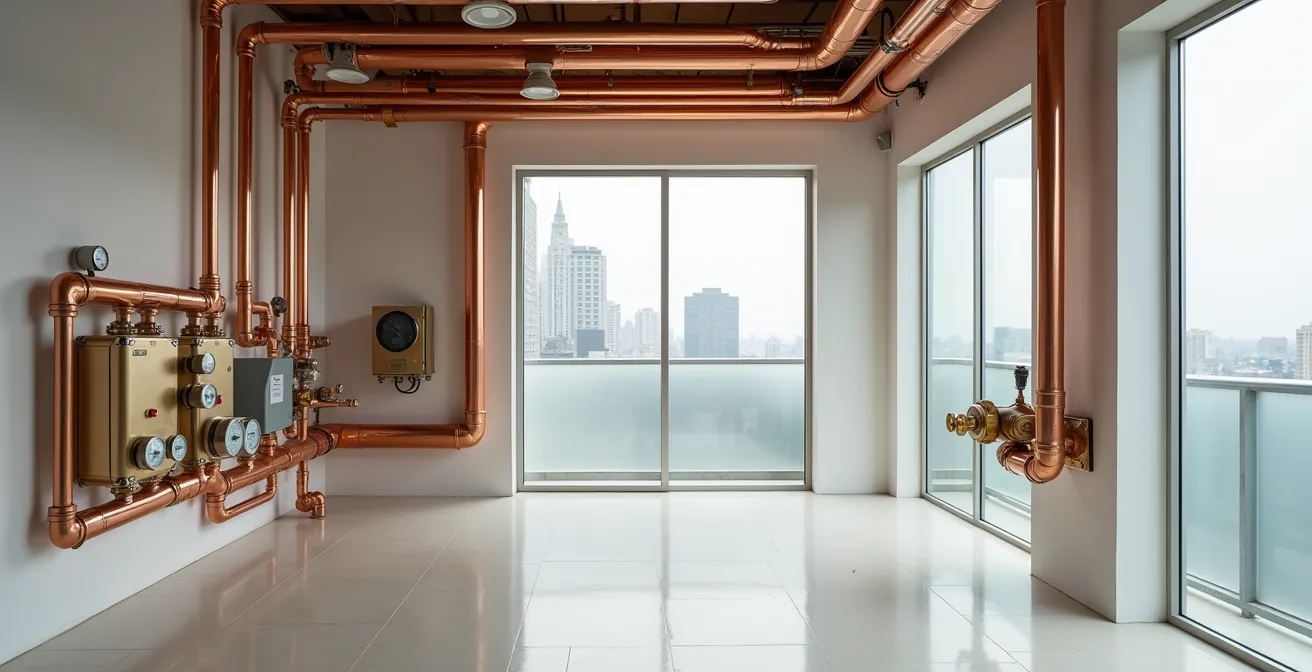
The frustrating wait for hot water in a luxury penthouse isn’t a sign of a faulty fixture; it’s a symptom of a compromised plumbing architecture that overlooks the physics of high-rise buildings.
- Gravity and distance create significant thermal latency and pressure drop, which standard plumbing cannot overcome.
- True performance requires a holistic system: pressure zoning, centralized heating analysis, and most critically, a dedicated recirculation loop.
Recommendation: Shift focus from replacing individual components to auditing the building’s core hydronic design to eliminate the performance delta between expectation and reality.
Owning a penthouse in a city like Montreal is a statement of success. It promises panoramic views, exclusive amenities, and an unparalleled standard of living. Yet, for many, this luxury experience is undermined daily by a simple, persistent frustration: turning on a high-end shower only to wait minutes for lukewarm water to finally turn hot. You’ve invested in premium fixtures and finishes, so why does the most fundamental comfort—consistent hot water—feel so elusive?
The common response is to blame the water heater or the distance the water must travel. While not entirely wrong, these explanations are dangerously simplistic. They miss the core issue, which is rarely about a single faulty component. The inconsistency you experience is a direct result of a plumbing system that was likely designed for cost-efficiency, not for the uncompromising performance that a luxury residence demands. The problem isn’t a part; it’s a gap in the architectural philosophy.
This is where we must shift the conversation from basic plumbing to that of holistic system architecture. True comfort in a high-rise environment is not an accident; it is engineered. It involves a precise understanding of hydronic principles, pressure stratification, and the unique challenges posed by a vertical structure, especially in a climate like Montreal’s. This article will deconstruct the engineering failures that lead to poor performance and outline the architectural strategies required to deliver the instant, reliable hot water you rightfully expect.
We will explore the underlying physics of water delivery in tall buildings and then detail the specific design solutions that separate a standard condominium from a true luxury residence. This guide provides the framework to understand and address the root cause of your hot water inconsistency.
Summary: A Systemic Approach to Penthouse Hot Water Performance
- Why Does It Take 5 Minutes for Hot Water to Reach the 20th Floor?
- How to Zone High-Rise Plumbing to Balance Pressure on Upper Floors?
- Central Boiler vs. In-Suite Tankless: Which Is Better for Penthouses?
- The Error of Oversizing Tanks That leads to Legionella Risk
- When to Install Pressure Reducing Valves to Protect High-End Fixtures?
- How to Get Hot Water Instantly on Top Floors Without Wasting Liters?
- How to Calculate the GPM Required for Peak Morning Usage?
- How to Design a Plumbing System for a Custom Luxury Home?
Why Does It Take 5 Minutes for Hot Water to Reach the 20th Floor?
The delay you experience, often called thermal latency, is a direct consequence of two physical forces working against your comfort: distance and gravity. Hot water leaving a central boiler in the basement must travel hundreds of feet, pushing out the cold, stagnant water sitting in the pipes. This “dead leg” of pipe is a reservoir of cold water you must purge every time you need hot water. The longer the pipe run, the longer the wait and the more water and energy are wasted.
Simultaneously, gravity impacts water pressure. For every floor water is lifted, pressure decreases. Plumbing engineering experts confirm a general rule of a 5 PSI pressure loss per floor ascended. In a 20-story building, this can result in a 100 PSI loss from the base to the penthouse, before accounting for friction loss from pipes and fittings. Without a properly engineered system of booster pumps, the water flow on upper floors can be drastically lower than on lower floors, further extending the time it takes to get hot water to the tap.
This combination of thermal latency and pressure drop is the fundamental reason for your frustration. It’s not a defect in your faucet; it’s the predictable outcome of a system not designed with top-floor performance as a primary objective. Quantifying this waste can be a powerful first step in understanding the scale of the problem.
Action plan: Calculate your personal cost of thermal latency
- Measure the flow rate of your faucet in liters per minute (L/min) using a measuring container and a stopwatch.
- Time how long it takes for acceptably hot water to arrive at the fixture (this can be 3-5 minutes on an upper floor).
- Multiply the flow rate (L/min) by the wait time (min) to calculate the total volume of wasted water per use.
- Calculate the annual financial cost of this wasted water based on current Montreal water rates.
- Estimate the additional energy costs for needlessly heating this wasted water, using your latest Hydro-Québec bill as a reference.
How to Zone High-Rise Plumbing to Balance Pressure on Upper Floors?
The immense pressure required to serve the top floor of a high-rise would be destructive to fixtures on the lower floors. A standard plumbing system simply cannot accommodate this massive pressure differential. The architectural solution is pressure stratification, or zoning. Instead of a single, high-pressure system, the building’s plumbing is divided into vertical zones, each serving a specific number of floors and operating within a safe and effective pressure range.
Each zone is typically managed by a dedicated set of booster pumps and controls. For instance, a system might be divided into low-rise, mid-rise, and high-rise zones. The low-rise zone may run directly off municipal street pressure, while the mid-rise and high-rise zones use booster pumps to achieve the necessary head pressure for their respective heights. This ensures that a faucet on the 5th floor and a shower in the penthouse receive consistent and safe water pressure.

As an engineering case in point, consider the demands of a 50-story building. To serve the top floor, the system might require over 300 PSI at its base. According to an analysis of high-rise construction needs, a common design strategy is to limit each pressure zone to a maximum of six floors. This maintains a manageable pressure differential within each zone, preventing extreme fluctuations between the first and last floor of that zone and protecting the plumbing infrastructure.
Central Boiler vs. In-Suite Tankless: Which Is Better for Penthouses?
A core architectural decision in any multi-family building is whether to generate hot water centrally or within each unit. For a penthouse owner, the implications of this choice are significant. A central boiler system, typically a large, high-capacity unit in the basement, generates all hot water for the building. Its main advantage is simplified maintenance (managed by the building), but it is the primary cause of thermal latency for upper floors. Even with a well-zoned system, the distance remains a problem.
Conversely, an in-suite tankless heater provides hot water on demand, generated instantaneously within your unit. This completely eliminates the wait time caused by long pipe runs from a central boiler. It is also generally more energy-efficient, as it only heats water when needed. However, it requires space, individual installation, and places the responsibility for maintenance directly on the owner. Furthermore, its capacity must be precisely calculated to handle the peak demand of a luxury suite with multiple bathrooms.
For a Montreal penthouse, the choice involves a trade-off between the convenience of a managed central system and the superior on-demand performance of an in-suite unit. The operating costs, influenced by Hydro-Québec rates, are also a critical factor in the decision-making process.
| Feature | Central Boiler System | In-Suite Tankless |
|---|---|---|
| Installation Cost | $15,000-25,000 (shared) | $8,000-12,000 (individual) |
| Operating Cost (Hydro-Québec) | $800-1200/year | $600-900/year |
| Space Required | Central mechanical room | Wall-mounted unit (4 sq ft) |
| Hot Water Availability | Depends on circulation | Instant on-demand |
| Condo Board Approval | Required for upgrades | Required for installation |
| Maintenance | Building managed | Owner responsibility |
The Error of Oversizing Tanks That leads to Legionella Risk
In an attempt to solve hot water shortages, a common but dangerous mistake is to install an oversized hot water tank. The logic seems sound: more storage means more available hot water. However, this approach introduces a significant health risk: the growth of Legionella bacteria. This bacterium thrives in warm, stagnant water, typically between 20°C and 45°C. An oversized tank that is not regularly and fully depleted of its stored water creates the perfect breeding ground.
When the volume of the tank far exceeds daily usage, large amounts of water can sit for extended periods, allowing the temperature to drop into the danger zone. When a tap is finally opened, aerosolized droplets containing the bacteria can be inhaled, potentially causing Legionnaires’ disease, a severe form of pneumonia. This risk is not merely theoretical; it is a serious public health concern addressed by stringent building codes.
To mitigate this, regulations dictate minimum storage temperatures. For instance, Régie du bâtiment du Québec (RBQ) guidelines mandate a minimum tank temperature of 60°C to kill Legionella bacteria. While essential for safety, this high temperature increases standby heat loss and energy consumption, further highlighting the inefficiency of an improperly sized system. The solution is not a bigger tank, but a correctly sized one, or a tankless system that eliminates storage altogether.
An older water heater can also inflate your electricity bill significantly!
– Confort Expert Inc., Montreal Water Heater Installation Guide
When to Install Pressure Reducing Valves to Protect High-End Fixtures?
While low pressure is a common complaint on upper floors, excessively high pressure on lower floors is equally problematic. As discussed, booster pumps are necessary to serve a high-rise, but the pressure they generate can be destructive to plumbing fixtures and appliances not designed to handle it. Your high-end rain shower head, thermostatic valves, and custom faucets have maximum pressure ratings. Exceeding them can cause leaks, malfunctions, and premature failure—a costly and frustrating outcome.
This is where a Pressure Reducing Valve (PRV) becomes an essential component of the system’s architecture. A PRV is a valve installed on the water line that automatically reduces the pressure from the main supply to a lower, safer, and more consistent level downstream. It acts as a gatekeeper, protecting every fixture in your suite from the damaging effects of pressure surges and the high static pressure required by the building’s overall system.

The installation of a PRV is not just a suggestion; it’s often a requirement. The plumbing code generally requires that water pressure at any fixture does not exceed an 80 PSI maximum. If the building’s supply pressure to your unit surpasses this limit, a PRV is mandatory to ensure the longevity of your investment and prevent water damage. It is a critical element of precision control in a luxury plumbing system.
How to Get Hot Water Instantly on Top Floors Without Wasting Liters?
We have established that the wait for hot water is caused by the “dead leg” of cold water in the pipes. While an in-suite tankless heater solves this, it’s not always feasible in buildings with central systems. The definitive architectural solution for this problem, applicable to both central and in-suite systems with long pipe runs, is a hot water recirculation system. This is the single most effective technology for delivering a true luxury experience.
A recirculation system creates a dedicated loop that constantly and slowly circulates hot water from the heater to the furthest fixtures and back again. This is achieved by installing a small, low-power circulation pump and a dedicated return line. Because the hot water is always circulating through the pipes, it is available almost instantly when you turn on the tap. There is no cold “dead leg” to purge, eliminating both the wait and the associated water and energy waste.
Modern systems are highly intelligent. They can be activated by a timer set to your peak usage hours (e.g., mornings and evenings), by a motion sensor in the bathroom, or even by a smart-home-integrated button you press a minute before you intend to shower. As explained by engineers specializing in high-rise plumbing solutions, this on-demand approach provides the best of both worlds: instant hot water without the energy cost of circulating it 24/7. It is the hallmark of a truly performance-oriented hydronic design.
How to Calculate the GPM Required for Peak Morning Usage?
Designing a system that can deliver a luxurious experience requires a precise understanding of demand. This is measured in Gallons Per Minute (GPM), or the total flow rate of water the system must supply at any given moment. For a penthouse, peak demand often occurs in the morning, when multiple fixtures may be running simultaneously—a rain shower, a tub filler, and a kitchen sink, for example. The system must be able to meet this combined load without a drop in pressure or temperature.
Calculating this peak demand involves summing the GPM ratings of all fixtures and applying a simultaneous use factor. For example, a 10 GPM rain shower running at the same time as a 2.2 GPM kitchen sink and a 1.5 GPM bathroom faucet creates a significant load. The challenge is compounded in Montreal’s climate. With Montreal’s 4°C winter inlet water temperature, the water heater must be powerful enough to produce a 38°C temperature rise just to reach a standard 42°C shower temperature, all while meeting the high GPM demand.
Under-sizing the heating capacity will result in lukewarm water during peak use, completely undermining the luxury experience. A proper calculation is essential for selecting a water heater—whether central or tankless—that has the power (measured in BTUs or kW) to handle the absolute worst-case scenario on a cold February morning.
| Fixture Type | Flow Rate (GPM) | Simultaneous Use Factor |
|---|---|---|
| Rain Shower Head | 10 GPM | 100% |
| Bathroom Sink (each) | 1.5 GPM | 50% |
| Tub Filler | 12 GPM | 25% |
| Kitchen Sink | 2.2 GPM | 75% |
| Total Peak Demand | 16.7 GPM | – |
Key takeaways
- Inconsistent hot water is a system design failure, not a fixture problem.
- High-rise physics require active management through pressure zoning and recirculation systems.
- True luxury performance is achieved when heating capacity (GPM) is precisely matched to peak demand and local climate conditions.
How to Design a Plumbing System for a Custom Luxury Home?
Achieving flawless hot water performance in a custom luxury residence is the culmination of every principle discussed. It is not about buying expensive parts; it is about commissioning a holistic and bespoke system architecture. This process moves beyond standard plumbing practices and enters the realm of specialized mechanical engineering, where every component is selected and integrated to serve a single goal: uncompromising comfort and reliability.
This level of design accounts for everything: the specific GPM demand of your chosen fixtures, the extreme temperature differentials of the Montreal climate, the building’s existing pressure zones, and your personal usage patterns. It integrates booster pumps, PRVs, and a recirculation system into a single, intelligent network. It involves local experts, like those certified by Énergir for complex natural gas installations, who understand the nuances of high-performance systems in the regional context.
Ultimately, a truly luxurious system is invisible. The complex engineering of pumps, valves, and controls operates silently in the background, delivering a perfect experience every time. This is not a DIY project or a standard plumbing job. As one industry expert wisely notes, it requires a unified vision from a team of specialists.
A project of this scope requires a collaborative team: an architect, an interior designer, a mechanical engineer specializing in residential hydronics, and a master plumber.
– Karl Caouette, CPD, Plumbing Technical Director at Henderson Engineers
To guarantee the level of performance you expect, the next logical step is to commission a professional audit of your existing system by a mechanical engineer specializing in residential hydronics. They can provide a data-driven plan to transform your daily frustration into the seamless luxury you paid for.