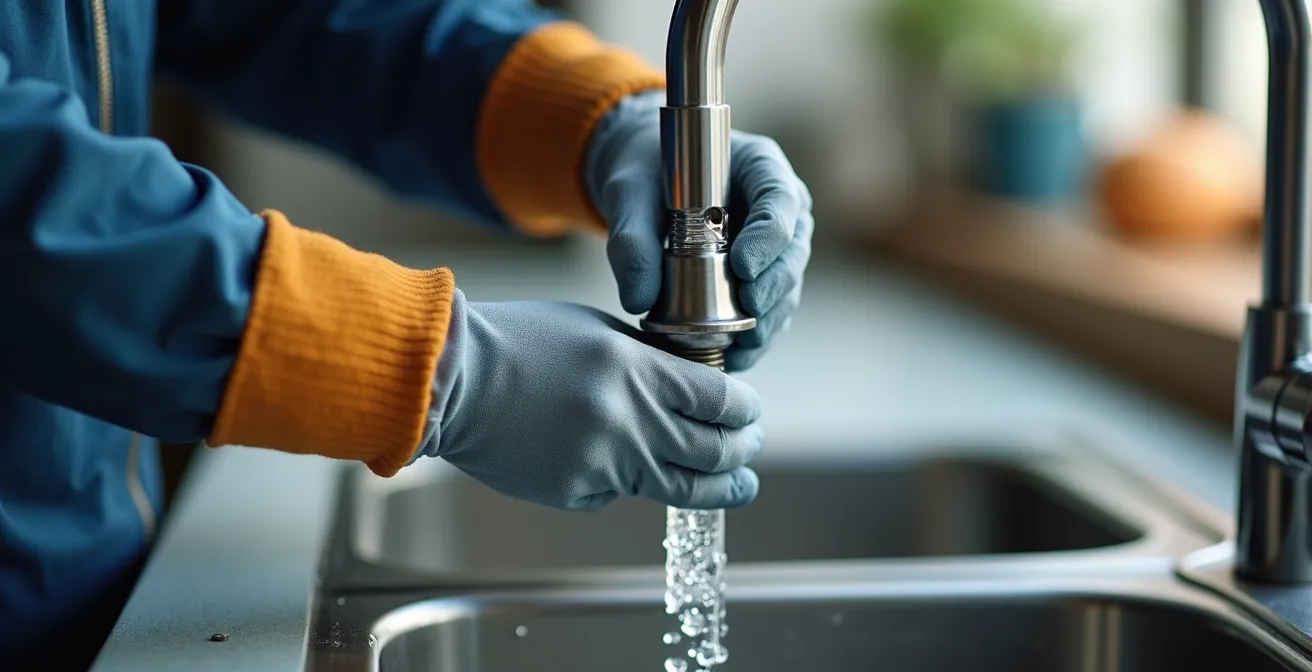
The feeling of a powerful faucet isn’t about water volume (GPM), but how technology uses velocity and aeration to trick your senses.
- Aeration mixes air into the stream, making it feel softer and fuller while using significantly less water.
- Laminar flow creates a clear, high-velocity stream that feels strong and loses less heat—ideal for Montreal winters.
Recommendation: Choose a faucet based on your home’s actual plumbing (especially in older Plateau/Mile End buildings) and regularly maintain the aerator to combat Montreal’s hard water.
The number one complaint about low-flow faucets is the dreaded “drizzle.” You turn the handle, expecting a satisfying gush of water, and instead get a weak, unsatisfying trickle. It’s a common frustration for the eco-conscious Montrealer who wants to save water but refuses to sacrifice comfort. Many people believe this is an unavoidable trade-off: to save on your water tax and Hydro-Québec bill, you must endure a subpar hand-washing or shower experience. This leads many to illegally remove the flow restrictors, defeating the entire purpose.
The conventional wisdom is to simply look for a WaterSense label and hope for the best. But what if the key to a powerful-feeling stream isn’t the volume of water at all? What if it’s a clever feat of engineering designed to manipulate your perception? The secret lies not in how much water is used, but in how that water is delivered. It’s about velocity, aeration, and stream integrity—the physics of how water hits your skin. High-velocity jets, aerated streams, and even laminar flow can create the sensation of high pressure while using a fraction of the water.
This guide demystifies the technology behind modern low-flow fixtures. We will explore the science of “perceived pressure” and how to harness it. We’ll provide a data-driven framework for choosing the right flow rate for your Montreal home, from a Griffintown condo to a West Island family house. Most importantly, we’ll arm you with the knowledge to select a low-flow faucet that feels generous and powerful, proving that you can have both sustainability and satisfaction.
To help you navigate these choices, this article breaks down the science, the local context, and the practical steps for achieving water-efficient comfort. The following sections will guide you from understanding the basic principles to making an informed purchase that works with your home’s unique plumbing.
Summary: How to Choose a Low-Flow Faucet in Montreal That Actually Feels Powerful
- Why Does Aerated Water Feel Softer on Hands?
- Why Does High Velocity Make Low Flow Feel Like More Water?
- 1.2 GPM or 1.5 GPM: Which Is Best for Bathroom Sinks?
- How to Retrofit Aerators to Reduce Consumption by 40%?
- How to Unclog Aerators Caused by Hard Water Deposits?
- The Mistake of Installing Low-Flow Heads on Old Gravity Systems
- When to Install Point-of-Use Heaters for Low-Flow Sinks?
- How to Reduce Water Usage Without Sacrificing Shower Comfort?
Why Does Aerated Water Feel Softer on Hands?
The magic of a good low-flow faucet begins with a tiny, brilliant component: the aerator. This small, screw-on piece at the tip of the faucet is responsible for a remarkable sensory illusion. Its primary job is to mix air into the water stream as it passes through. Instead of a single, solid column of water, the aerator creates a spray of countless tiny, water-coated air bubbles. This process has a profound effect on how the water feels on your skin. The stream becomes wider, whiter, and feels significantly softer and more voluminous than it actually is.
This happens because the aerated stream covers a larger surface area of your hands, tricking your nerve endings into perceiving a fuller flow. As explained by plumbing experts in Canada, this transforms how water is delivered. As water passes through the faucet, the aerator introduces air into the stream, creating a well-balanced and controlled flow that feels robust. For Montreal residents dealing with the St. Lawrence River’s moderately hard water (around 115-165 ppm), this aeration creates a perception of a softer texture without chemically altering the mineral content.
The efficiency gains are substantial. By replacing water volume with air, a quality aerator can maintain a satisfying sense of pressure while drastically cutting water usage. In fact, well-designed aerators can cut water flow by up to half, a significant reduction that translates directly into savings on both your municipal water tax and your Hydro-Québec bill for heating that water. It’s not magic; it’s the smart application of fluid dynamics to deliver comfort with less consumption.
Why Does High Velocity Make Low Flow Feel Like More Water?
While aeration is the most common method for enhancing low-flow performance, it’s not the only one. Another powerful technique relies on a different principle of physics: velocity. The idea is simple: by forcing the same low volume of water through smaller, more focused openings, the faucet increases the speed of the individual streams. This high-velocity water hits your skin with more force, creating a sensation of higher pressure. Your brain interprets this kinetic energy as a stronger, more abundant flow, even though the gallons per minute (GPM) remain low.
A sophisticated application of this concept is laminar flow technology. Unlike aerated streams that are cloudy with air bubbles, a laminar stream is a perfectly clear, non-splashing column of water. It achieves its power by producing a vortex-free flow that appears crystal clear and natural. This technology, found in select faucets from brands like Delta and Moen, is particularly well-suited for Montreal’s climate. Aerated streams have a high surface area, which causes them to cool down quickly as they mix with the air—a noticeable drawback during cold winter months. A solid laminar stream, by contrast, has less surface area and maintains its temperature far more effectively from the faucet to your hands, delivering enhanced thermal comfort.
Before purchasing, it’s wise to do some research. You can often search YouTube for a flow test of the specific model you’re considering to see the actual stream pattern. Better yet, visit a local Montreal showroom like Taps Bath Centre or Bain Dépôt to test display models yourself. Pay attention to the spray pattern; a “needle” spray will feel much stronger than a wide spray at the same GPM, demonstrating the powerful effect of velocity on perceived pressure.
1.2 GPM or 1.5 GPM: Which Is Best for Bathroom Sinks?
Once you understand the technologies that make low-flow faucets feel powerful, the practical question becomes: which flow rate is right for you? For private bathroom faucets, federal standards and the WaterSense program provide a clear ceiling. According to the U.S. Department of Energy, WaterSense-labeled faucets must not exceed 1.5 GPM, a significant reduction from older faucets that could use 2.2 GPM or more. In the market, you’ll primarily find options at 1.5 GPM and the even more efficient 1.2 GPM.
For most Montreal households, a 1.5 GPM faucet offers the best balance between water conservation and user comfort. It provides a flow that feels ample for tasks like washing your face and brushing your teeth, especially when paired with a good aerator. A 1.2 GPM faucet, while maximizing savings, may feel noticeably weaker to some users, making it better suited for specific situations. For instance, a low-traffic powder room in a Griffintown condo could be a perfect spot for a 1.2 GPM model, maximizing efficiency where a high-volume flow is unnecessary. However, for a busy family bathroom in a West Island home, the added comfort of a 1.5 GPM model is likely the better choice.
The financial incentive is compelling, with savings on both the Montreal water tax and your Hydro-Québec bill. The following table, based on typical usage data and local rates, illustrates the potential annual savings for a family of four compared to an old 2.2 GPM faucet.
| Flow Rate | Annual Water Use (4-person family) | Montreal Water Tax Savings | Hydro-Québec Hot Water Savings | Total Annual Savings |
|---|---|---|---|---|
| Old 2.2 GPM | 8,800 gallons | Baseline | Baseline | $0 |
| 1.5 GPM | 6,000 gallons | $35 | $45 | $80 |
| 1.2 GPM | 4,800 gallons | $50 | $60 | $110 |
While a $30 difference per year between the 1.2 and 1.5 GPM models may seem small, the cumulative savings over the faucet’s lifetime add up. The decision ultimately hinges on your household’s priorities: maximum savings or maximum comfort.
How to Retrofit Aerators to Reduce Consumption by 40%?
You don’t necessarily need to buy a brand-new faucet to reap the benefits of low-flow technology. One of the most cost-effective water conservation measures you can take is to simply retrofit your existing bathroom and kitchen faucets with modern, water-saving aerators. This simple upgrade often takes less than a minute to install and can make a significant impact on your water consumption. Simply unscrew the old aerator and screw in the new one. This small change can reduce a faucet’s water flow by 30% or more without a noticeable drop in performance.
Finding the right aerator in Montreal is easy. Major hardware stores stock a wide variety of options. You can find Neoperl dual-thread aerators at Rona, Danco water-saving kits (often including a removal key) at Patrick Morin, and a wide selection of WaterSense certified models at Home Depot. For professional-grade options or unusual thread sizes, a specialized plumbing supplier like Deschenes is your best bet. While you’re there, pick up a bottle of CLR or Lime-A-Way; you’ll need it for maintenance, especially with Montreal’s water.
For Montreal renters, this is an especially attractive option. Under the rules of the Tribunal administratif du logement (TAL), installing a new aerator is considered a minor and easily reversible modification that does not require your landlord’s permission. Since you are improving the efficiency of the dwelling and can easily reinstall the original part when you move out, you are well within your rights. For tenants who pay their own Hydro-Québec bill, the savings on hot water are immediate and go directly into your pocket.
How to Unclog Aerators Caused by Hard Water Deposits?
The primary adversary of any faucet aerator in Montreal is the city’s water. While not excessively hard, it contains enough calcium and magnesium (115-165 ppm) to cause mineral buildup, or limescale, over time. This buildup clogs the fine mesh screen inside the aerator, obstructing water flow and turning your once-vigorous stream into a weak, sputtering trickle. Before you blame the faucet, you should always check the aerator. In most cases, a simple cleaning is all that’s needed to restore full performance.
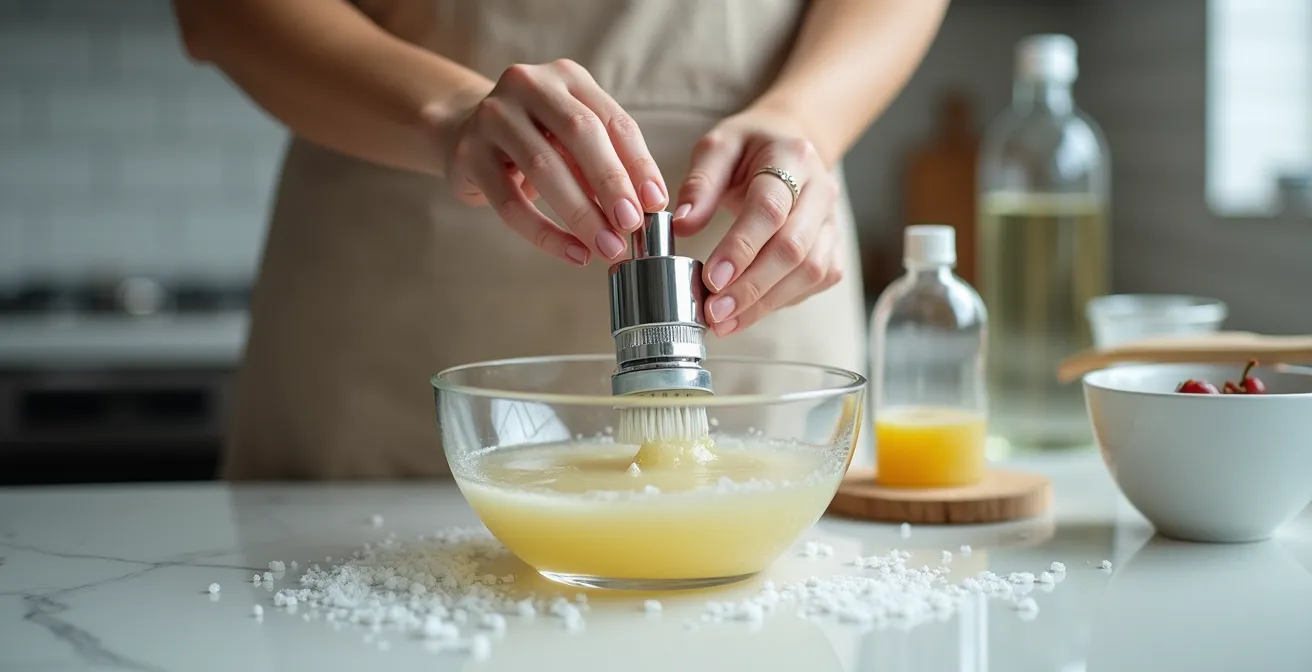
Fortunately, cleaning an aerator is a straightforward DIY task. You’ll need white vinegar, a small bowl, and a soft brush like an old toothbrush. This simple maintenance should be part of your regular home care routine to ensure your low-flow faucets continue to perform as designed, delivering that satisfying pressure you expect while keeping your water bills in check.
Your Action Plan: Montreal-Specific Aerator Maintenance Schedule
- Remove Aerator: Use an aerator key or adjustable pliers (with a cloth to prevent scratching) to unscrew the aerator from the faucet tip, turning it counter-clockwise.
- Soak to Dissolve: Submerge the aerator in a 50/50 solution of white vinegar and warm water. Let it soak for at least 2-4 hours, or overnight for heavy buildup, to dissolve Montreal’s specific mineral deposits.
- Scrub and Rinse: Use a soft brush or toothbrush to gently scrub away any remaining debris from the mesh screen and the threads. Rinse it thoroughly under running water.
- Schedule a Reminder: Given Montreal’s water hardness, plan to repeat this cleaning every 4-6 months. In areas with older plumbing like Rosemont or Villeray, you may need to do it quarterly.
- Know When to Replace: If a vinegar soak no longer restores the flow after two or three attempts, it’s time to replace the aerator. They are inexpensive and widely available.
For more stubborn blockages, commercial descaling products can be more effective. The table below, based on products readily available at local stores, provides a guide to what to use and when.
This comparative analysis, based on offerings at popular Montreal retailers like Rona and Canadian Tire, helps in choosing the right product for your needs.
| Product | Price Range | Available At | Best For |
|---|---|---|---|
| White Vinegar | $2-4 | All stores | Light deposits, monthly maintenance |
| CLR (Calcium Lime Rust) | $8-12 | Canadian Tire, Rona | Heavy buildup, quarterly deep clean |
| Lime-A-Way | $6-10 | Réno-Dépôt, Home Depot | Moderate deposits, bi-monthly use |
| Bio-Clean | $15-20 | Specialized plumbing stores | Eco-friendly option, safe for septic |
The Mistake of Installing Low-Flow Heads on Old Gravity Systems
There is one critical scenario where a standard low-flow faucet will always fail: when installed on a home with inherently low water pressure. This is a common and costly mistake in Montreal, particularly in older neighbourhoods like the Plateau and Mile End. Many of these beautiful heritage buildings and plexes still have original galvanized steel or narrow-gauge copper pipes. Over decades, these pipes corrode and accumulate scale, reducing their internal diameter and restricting the overall water pressure available to the entire building *before* it even reaches your faucet.
A standard low-flow aerator is designed to work with typical municipal pressure (around 40-80 PSI). It creates a pressure drop to function correctly. If your system’s baseline pressure is already low, adding a restrictive aerator on top of it will result in an unusable trickle. In these situations, you need a different solution. Specialized manufacturers like Neoperl offer “stream shapers” specifically designed for low-pressure faucets. These devices shape the water into a cohesive stream without creating the high back-pressure of a conventional aerator, making them suitable for non-pressurized or gravity-fed water heaters.
Before investing in new faucets for an older home, it’s essential to test your baseline pressure. A Montreal plumber suggests a simple “bucket test”: grab a standard 4-litre Canadian milk jug and time how long it takes to fill 3 litres with the faucet on full blast (with the aerator removed). If it takes more than 45 seconds, you likely have a low-pressure system. In this case, you should either avoid flow restriction or seek out these specialized low-pressure stream shapers to maintain a usable flow.
When to Install Point-of-Use Heaters for Low-Flow Sinks?
Low-flow faucets introduce a secondary, often overlooked issue: an increased wait time for hot water. Since less water is flowing through the pipes per minute, it takes longer for the hot water from your main water tank—often located in the basement—to travel to a distant faucet, such as a second-floor bathroom. This extended wait means more cold water is wasted down the drain, partially offsetting the savings you’re trying to achieve. It’s also a major source of daily frustration, especially during a frigid Montreal winter morning.
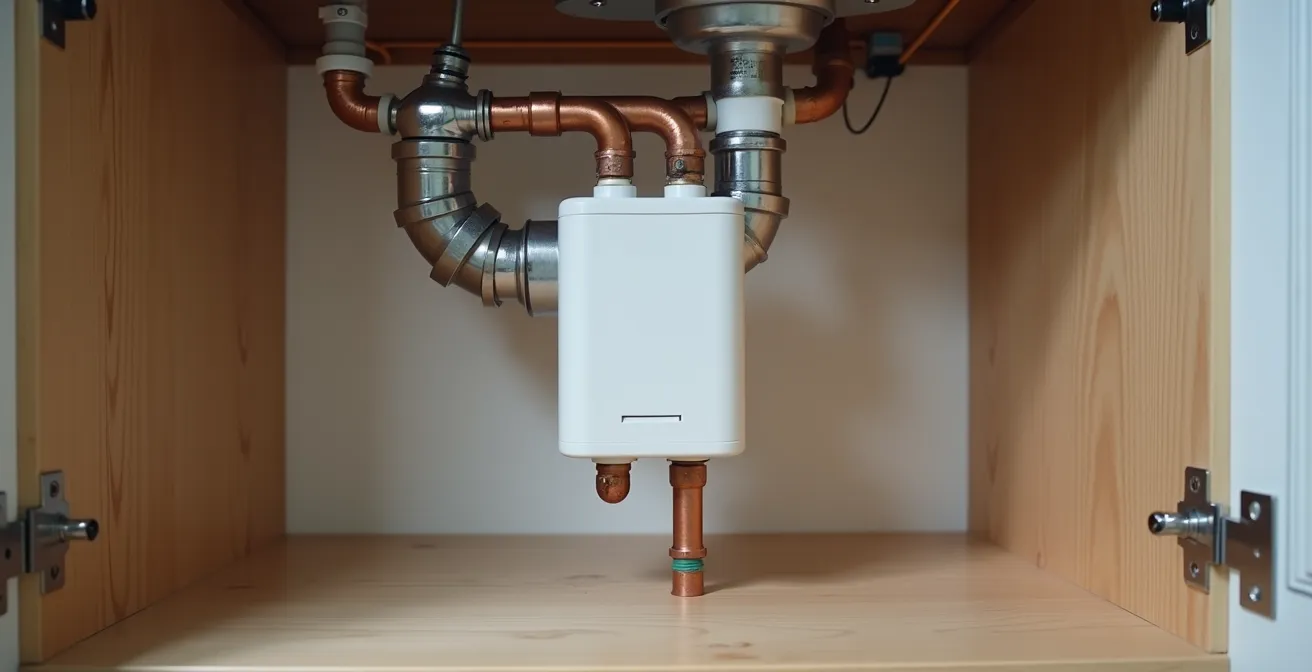
For sinks where this wait time is significant, a point-of-use (POU) water heater can be an excellent solution. These are small, compact electric heaters that are installed directly under the sink. They hold a small amount of water (typically 1-4 gallons) and keep it constantly hot, delivering it instantly when you turn on the tap. This eliminates both the water waste and the frustrating wait. While the main water heater takes over for longer uses, the POU heater bridges the initial gap.
The decision to install one comes down to a cost-benefit analysis. A POU heater has an upfront cost for the unit and installation, plus a small ongoing electricity cost for keeping the water hot. You must weigh this against the cost of the water you’re currently wasting. For a basement bathroom or kitchen island sink in a large Montreal home with a 30-45 second wait for hot water, a POU heater can pay for itself in 3-5 years through water and energy savings. However, for a main floor powder room that’s close to the main tank with only a 15-second wait, the investment is likely not worth it.
Key takeaways
- The sensation of pressure is created by technology (aeration, velocity) not just water volume (GPM).
- In Montreal, regular cleaning of aerators with vinegar is essential to combat hard water buildup and maintain flow.
- For older buildings (Plateau, Mile End), test your home’s baseline pressure before installing standard low-flow fixtures to avoid an unusable “trickle.”
How to Reduce Water Usage Without Sacrificing Shower Comfort?
The same principles of perceived pressure apply just as forcefully to the shower, which is the single largest source of hot water consumption in most homes. The goal is to find a low-flow showerhead that doesn’t feel like a sacrifice. Modern WaterSense-labeled showerheads, which are mandated to have a maximum flow rate of no more than 2.0 GPM, rely on advanced engineering to deliver a satisfying experience. They use a combination of aeration and high-velocity nozzles to create a powerful, invigorating spray.
An aerating showerhead works by forcing water through a screen, mixing it with air to produce what many describe as a vigorous spray of tiny “needles” of water. This creates an especially steamy shower and a feeling of being enveloped in water, despite the reduced volume. This is highly effective at tricking your senses into feeling a drenching flow. For Montreal’s many multi-unit buildings and condos, where water pressure can fluctuate when a neighbor starts their dishwasher, pairing an aerating showerhead with a thermostatic mixing valve is the ultimate comfort solution. This valve automatically adjusts to pressure changes to keep the water temperature perfectly constant, eliminating any sudden bursts of hot or cold.
Ultimately, achieving comfort with a low-flow fixture—whether a faucet or a showerhead—is about choosing the right technology for your specific situation. It requires looking beyond the GPM number and understanding how aeration, velocity, and stream design work together to create a satisfying sensory experience. By making an informed choice, you can significantly reduce your environmental impact and lower your utility bills without ever feeling like you’re compromising.
Now that you are equipped with the knowledge to select the right hardware, the next step is to assess your own home’s needs and start planning your upgrade for a more comfortable and sustainable water experience.