
Contrary to popular belief, cutting your hot water costs isn’t about taking shorter showers; it’s about strategically managing when and how you heat water to work with Hydro-Québec’s grid, not against it.
- Your water heater’s operation during peak hours (6-9 AM, 4-8 PM) can drastically inflate costs under new rate plans.
- Montreal’s hard water creates limescale buildup, forcing your heater to run up to 20% longer and silently adding a “limescale tax” to every bill.
Recommendation: Shift your mindset from simply ‘using less’ to ‘managing demand’. Run high-consumption appliances like dishwashers and washing machines during off-peak hours or when your dual-energy system is on fuel.
If you’re a Montreal resident, you know the feeling. The winter Hydro-Québec bill arrives, and the number is high enough to make you reconsider the very concept of warmth. Your immediate reaction is to blame the heating, turn down the thermostat, and layer up. Common advice tells you to take shorter showers and wash clothes in cold water. While these tips aren’t wrong, they miss the bigger picture. They treat the symptom—high energy use—without diagnosing the underlying cause, which is often a complete mismatch between your habits and the way Quebec’s energy grid actually functions.
The truth is, your hot water tank is more than just an appliance; it’s a massive energy reservoir, a kind of “thermal battery” in your basement. But most of us use it inefficiently, heating water at the most expensive times and fighting against hidden local factors that silently inflate costs. The key to unlocking real savings isn’t just about reducing consumption, but about mastering the timing and technology of water heating within the unique context of Hydro-Québec’s rate structures and Montreal’s specific environmental conditions.
This is where a shift in perspective becomes crucial. Instead of just trying to use less hot water, what if you learned to manage your home’s energy demand like a grid operator? This article will deconstruct the portion of your Hydro bill dedicated to water heating. We will move beyond generic advice to give you a strategic playbook, showing you how to leverage rate structures, understand hidden costs, and make informed technology choices to turn one of your biggest energy expenses into a managed, predictable cost.
This guide breaks down every aspect of water heating costs in the specific context of Montreal and Hydro-Québec. From peak hour rates to the chemistry of our local water, you will gain a complete understanding of the forces driving your bill and the strategies to control them.
Summary: Decoding the Hot Water Component of Your Hydro Bill
- Why Does Heating Water During Peak Hours Cost More (Future Rates)?
- How to Calculate the Cost of a 20-Minute Shower in Dollars?
- On-Demand vs. Storage Tank: Which Is Cheaper at current kWh Rates?
- The Error of Washing Clothes in Hot Water That Doubles Cost
- When to Run the Dishwasher to Optimize Hot Water Availability?
- Why Does Your Furnace Turn On Automatically at -12°C?
- Gas vs. Electric Tankless: Which Is More Efficient for Large Families?
- How Does the Hydro-Quebec Dual-Energy Rate Actually Work?
Why does heating water during peak hours cost more (future rates)?
Heating water during peak hours costs more because you are using electricity when demand on the entire Hydro-Québec grid is at its highest. To manage this demand, Hydro-Québec has introduced dynamic pricing like the optional Rate Flex D, which charges a much higher price per kilowatt-hour (kWh) during morning (6-9 AM) and evening (4-8 PM) peaks. Since water heating is a home’s second biggest use of electricity, running your water heater during these periods directly exposes you to the highest possible rates.
Think of it as energy rush hour. When everyone is waking up, making coffee, and showering, the grid is under immense strain. By charging more during these times, Hydro-Québec incentivizes customers to shift their consumption to off-peak periods when there is surplus generating capacity. Your standard 60-gallon water heater doesn’t know what time it is; it simply turns on to reheat water after you’ve used it. A morning shower can trigger a reheating cycle that runs squarely within the expensive 6-9 AM window.
Adopting a grid management mindset is the first step to avoiding these costs. Instead of letting your water heater run on autopilot, you can take control. By preventing it from operating during peak hours, you are essentially performing “cost arbitrage”—ensuring the energy you use to heat water is always purchased at the lowest available price. This is especially critical as dynamic rates become more common, turning timing into one of the most significant factors in your total energy bill.
To avoid these high costs, you can implement several smart strategies:
- Install a timer on your water heater to prevent it from operating during the 6-9 AM and 4-8 PM peak periods.
- Shift your showers to after 8 PM, allowing the water heater to do its work during off-peak hours.
- Consider pre-heating your water tank by a few degrees in the hours leading up to a peak event to ensure you have enough hot water without running the elements during the expensive window.
- During peak hours, default to using cold water for tasks like rinsing dishes or washing hands whenever possible.
This strategic timing is the foundation of effective energy management in a home governed by Hydro-Québec’s rate structure.
How to calculate the cost of a 20-minute shower in dollars?
Calculating the exact cost of a single 20-minute shower is complex, as it depends on your water heater’s efficiency, the incoming water temperature, and your electricity rate. However, for Montreal residents, there’s a hidden variable that significantly increases this cost: a silent “limescale tax.” Montreal’s water, sourced from the St. Lawrence River and Lac Saint-Louis, has a moderate hardness that leads to mineral buildup—limescale—on your water heater’s heating elements. This crust acts as an insulator, forcing the appliance to work harder and longer to heat the same amount of water.
This mineral buildup means that over time, your water heater’s efficiency degrades significantly. A unit that was efficient when new may now need to run 15-20% longer to bring the water up to temperature, directly increasing the electricity cost of every single shower. While the average Quebec household uses 186 litres of hot water per day, a home with a limescale-affected heater pays a premium on every one of those litres.
Case Study: The Hidden Cost Impact of Montreal’s Moderately Hard Water
Montreal’s water hardness is a perfect example of a hidden cost factor. The mineral deposits from the St. Lawrence River create a layer of limescale on heating elements. This forces the water heater to overcome this insulation, consuming more electricity to achieve the set temperature. For a typical family, this inefficiency can add up to a noticeable increase on the monthly Hydro bill, turning a seemingly small geological fact into a tangible financial burden.
The visual evidence of this “limescale tax” is stark. The once-smooth heating element becomes caked in a crusty, white deposit, reducing its ability to transfer heat to the water efficiently.
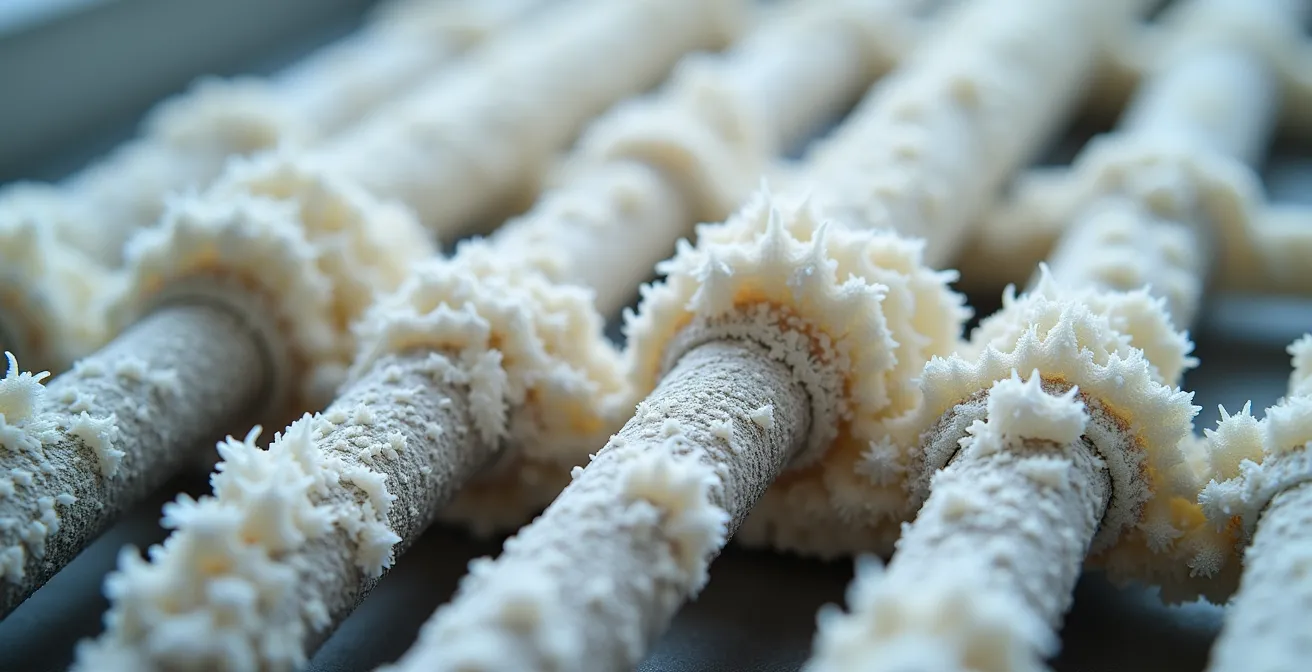
As you can see in this close-up, the limescale forms a thick, insulating barrier. Every kilowatt-hour of energy must first fight its way through this mineral layer before it can even begin to heat the water. To mitigate this, periodic maintenance, such as flushing the tank and inspecting the elements (if accessible), is not just a best practice—it’s a direct cost-saving measure for any Montreal homeowner.
Therefore, when you calculate the cost of that 20-minute shower, you must account not only for the price of electricity but also for the invisible tax levied by our local water chemistry.
On-demand vs. storage tank: Which is cheaper at current kWh rates?
When comparing on-demand (tankless) water heaters to traditional storage tanks in Montreal, the cheaper option over the long term is often not the one with the highest upfront efficiency. While electric on-demand heaters eliminate standby heat loss, their high purchase price, significant installation costs, and demanding electrical requirements frequently make them the more expensive choice over a 10-year period for the average Montreal home.
A standard storage tank has standby losses because it must constantly keep 40 to 60 gallons of water hot, 24/7. An on-demand unit heats water only when you turn on a tap, making it more energy-efficient in theory. However, the financial reality in Montreal is more complex. The high amperage draw of these units is a major barrier, as noted by local experts.
The high amperage draw of on-demand heaters, often exceeding 100A, is incompatible with the older 100A electrical panels common in many Montreal duplexes and triplexes.
– Quebec plumbing contractors, Hot Water Tank Quotes Montreal
This electrical incompatibility often necessitates a costly panel upgrade, adding thousands to the installation cost and erasing potential energy savings. A 10-year cost analysis, which includes purchase, installation, and energy, reveals that even an ENERGY STAR rated storage tank or a rental unit from a provider like HydroSolution can be more economical.
The following table provides a clear breakdown of the total cost of ownership for different water heater types in the Montreal market. It highlights that the high initial investment for an electric on-demand system can make it the most expensive option over a decade, according to recent market analysis.
| Water Heater Type | Purchase Price | Installation Cost (Montreal) | Annual Energy Cost | 10-Year Total |
|---|---|---|---|---|
| Standard 60-gallon tank | $400 | $600 | $350 | $4,500 |
| ENERGY STAR 60-gallon tank | $700 | $600 | $280 | $4,100 |
| Electric on-demand | $1,500 | $1,200* | $250 | $5,200 |
| HydroSolution rental | $0 | $0 | $420 (rental included) | $4,200 |
Ultimately, for many Montreal homeowners, the familiar storage tank, especially a modern high-efficiency or rental model, offers a more predictable and often lower total cost, avoiding the significant upfront investment and potential electrical upgrades required for on-demand systems.
The error of washing clothes in hot water that doubles cost
The habit of washing clothes in hot water is one of the most significant and unnecessary energy expenditures in a household. The reality is that the vast majority of the energy consumed by your washing machine isn’t used to power the motor, but to heat the water. In fact, Hydro-Quebec reports that 80 to 90% of the energy used to wash clothes goes to heating water. Opting for a hot or warm cycle is akin to running a small, inefficient water heater for an hour straight.
This practice is largely a holdover from a time when detergents were less effective. Modern detergents are formulated with enzymes and surfactants that are designed to work just as effectively, if not more so, in cold water. Stains from proteins (like grass or blood) can even be “set” by hot water, making them harder to remove. By switching to cold water, you are not sacrificing cleaning power; you are simply eliminating a massive and pointless energy draw.
Making the switch from hot to cold water for laundry is the single most impactful change you can make to reduce your hot water consumption without affecting your lifestyle. It requires no sacrifice, no expensive upgrades—just a simple change in habit. The savings are immediate and substantial, directly reducing the workload on your water heater and, consequently, your Hydro bill. To maximize these savings and ensure cleaning performance, a few best practices should be followed.
Your Action Plan: Cold Water Washing Best Practices
- Switch Detergents: Opt for cold water detergents specifically formulated with enzymes that activate at low temperatures for maximum cleaning power.
- Use Presoak Cycles: For heavily soiled items, use your machine’s presoak function instead of resorting to a hot water wash.
- Run Full Loads: Washers operate most efficiently when fully loaded. Avoid running small loads to maximize both water and energy savings.
- Check Proximity: If possible, ensure your washer is installed near the water heater to minimize heat loss through long connecting pipes.
- Select Water Levels: If your machine allows, select the appropriate water level setting for each load to avoid heating unnecessary volumes of water.
By abandoning the hot water washing habit, you are not just saving a few cents; you are effectively cutting the energy cost of doing laundry by up to 90%, a significant saving that accumulates with every load.
When to run the dishwasher to optimize hot water availability?
The optimal time to run your dishwasher is not when you finish dinner, but late at night, well after peak electricity hours have ended. By using your dishwasher’s delay start feature to begin its cycle after 9 PM, you align its significant energy and hot water consumption with the period when electricity is cheapest and grid demand is lowest. This simple act of scheduling is a core tenet of the “grid management mindset.”
Many people assume the dishwasher draws a large amount of hot water directly from the main tank. However, modern dishwashers, particularly ENERGY STAR models, are incredibly efficient. They have internal booster heaters that take in a small amount of water (either hot or cold) and raise it to the optimal temperature for sanitation. This design means you don’t need to deplete your main “thermal battery”—the hot water tank—to wash your dishes. You can let the dishwasher’s own efficient internal heater do the work during cheap, off-peak hours.
Optimizing Dishwasher Use with Hydro-Quebec’s Rate Structure
For Montreal residents on a flexible rate plan, using the delay start feature is a powerful tool for cost arbitrage. By setting the dishwasher to run after 9 PM, you ensure that its internal heater—which is a significant electrical load—operates during the off-peak period. This strategy avoids drawing from the main hot water tank during the expensive 4-8 PM peak, preserving that hot water for evening showers while minimizing the electricity cost of the cleaning cycle itself.
Furthermore, choosing an efficient model amplifies these savings. According to Hydro-Québec, efficiency data shows that ENERGY STAR certified dishwashers use 15% less hot water than standard models, reducing the demand on your system regardless of when you run them. Coupling an efficient appliance with smart scheduling is the key to minimizing both energy and water costs.

Setting your dishwasher timer is a small, two-second action that has a real impact on your bill. It preserves your main supply of hot water for personal use during the evening and shifts the appliance’s energy consumption to the most cost-effective time of day, perfectly embodying the strategy of managing demand rather than just reducing it.
By treating your dishwasher as a schedulable load, you turn a daily chore into a daily opportunity for savings.
Why does your furnace turn on automatically at -12°C?
If you have a dual-energy heating system, your furnace automatically switches from electricity to its secondary fuel source (like natural gas or oil) when the outdoor temperature drops to -12°C (or -15°C in some regions). This is not a malfunction; it is the core feature of Hydro-Québec’s dual-energy rate (Rate DT). This switch is mandated by Hydro-Québec to reduce strain on the electrical grid during periods of extreme cold and peak demand.
This automatic switchover is a critical component of Quebec’s overall energy management strategy. During a cold snap, residential electric heating creates an enormous demand on the grid. The “-12°C trigger” is a system-wide signal to offload a portion of that demand onto alternative fuels, ensuring grid stability for everyone. As the energy authority explains, this is a planned and essential function.
At -12°C, Hydro-Quebec’s dual-energy system mandates switching from electricity to secondary fuel sources like gas or oil to relieve grid pressure during extreme cold.
– Hydro-Quebec, Dual Energy Rate Documentation
For the savvy homeowner, this mandatory switch creates a unique window of opportunity for cost arbitrage. When your main heating system is running on fuel, your home’s electrical consumption plummets. This frees up significant capacity on your electrical panel and means the grid is less stressed. This is the absolute best time to run other high-consumption electric appliances.
Instead of avoiding energy use during these cold snaps, you should strategically shift it. The period when your furnace is burning fuel is the ideal time to run the electric clothes dryer, operate the dishwasher, and, most importantly, allow your electric water heater to run its reheating cycles. You are effectively taking advantage of the “space” on the grid created by your furnace switching off electricity. This is a perfect illustration of the grid management mindset: using system rules to your financial advantage.
- When the furnace switches to fuel at -12°C, run your dishwasher and washing machine.
- This is the ideal time for your electric water heater to recharge, as it won’t be competing with your heating system for electricity.
- Monitor the outdoor temperature to anticipate the switchover and plan your high-consumption activities accordingly.
- Remember that your water heater is not part of the dual-energy system; it always runs on electricity at the standard rate, so using it during this low-demand period is purely opportunistic.
By recognizing the -12°C switch not as a constraint but as a signal, you can turn the coldest days of winter into the most electrically efficient ones.
Gas vs. electric tankless: Which is more efficient for large families?
For large families in Montreal weighing the efficiency of gas versus electric tankless water heaters, the decision extends beyond the appliance’s fuel source. It involves considering Quebec’s long-term energy policy and provincial incentives. While natural gas heaters can offer high flow rates, Quebec’s strategic push towards electrification, coupled with its low electricity rates, makes electric tankless units a more forward-thinking and often more economical long-term choice.
A large family’s primary concern is the ability to supply continuous hot water for multiple simultaneous uses, like running a shower and a dishwasher at the same time. Both gas and electric tankless models excel at providing endless hot water. However, the context of Quebec’s energy landscape, where typical Montreal electricity bills range from $80-$150 for larger homes, makes leveraging cheap electricity a powerful financial strategy. Natural gas prices can be more volatile and are not subject to the same level of provincial control as hydro-electricity.
The most compelling argument for electric systems in Quebec is the government’s clear policy direction. This long-term strategic view is a crucial factor that a simple efficiency rating doesn’t capture.
Case Study: Quebec’s Electrification Push Impacts Water Heater Choices
With provincial programs like ‘Chauffez vert’ heavily incentivizing the switch to electric solutions, the financial case for electric appliances is strong. These programs, combined with Hydro-Québec’s consistently low electricity rates, mean that electric tankless units can provide better long-term value than gas alternatives for Montreal families. Furthermore, the province’s commitment to electrification suggests that natural gas appliances may face increasing regulatory restrictions or reduced incentives in the coming years, making an electric choice a safer bet for the future.
While a gas unit might seem appealing, investing in an appliance that runs counter to the provincial energy strategy could be a short-sighted decision. For a large family, an electric tankless water heater—provided the home’s electrical panel can support its high amperage draw—aligns perfectly with the economic and political realities of living in Quebec. It leverages the province’s most abundant and affordable energy source while future-proofing the home against potential shifts away from fossil fuels.
Therefore, for large Montreal families planning for the next decade, the “most efficient” choice is not just about the unit’s thermal efficiency, but its alignment with Quebec’s electrified future.
Key Takeaways
- Your hot water tank acts as a “thermal battery”; charge it during cheap off-peak hours to use during expensive peak hours.
- Montreal’s hard water creates a “limescale tax,” reducing efficiency by up to 20%. Regular maintenance is a direct cost-saving measure.
- The -12°C dual-energy switch is an opportunity. Run electric appliances like your dryer and dishwasher when your furnace is using fuel to take advantage of freed-up electrical capacity.
How does the Hydro-Quebec dual-energy rate actually work?
The Hydro-Québec dual-energy rate (Rate DT) is a specialized pricing plan designed for homes with a two-source heating system, typically combining electricity with a fuel like oil or natural gas. Its purpose is to reduce strain on the power grid during winter’s coldest days. The system works by automatically switching your home’s primary heating from electricity to the secondary fuel source whenever the outdoor temperature drops to a set point, usually -12°C. In exchange for allowing Hydro-Québec to manage your heating load this way, you receive a lower electricity rate for the rest of the year.
It is a common and costly misconception that this rate applies to all electricity use in the home. In reality, the dual-energy system and its special rate apply only to your heating system. All other electrical uses in your home—including your lights, appliances, and, most importantly, your electric water heater—are always billed at the standard Rate D. This is a critical distinction. While your furnace may be running on oil during a cold snap, your water heater is still drawing electricity from the grid.
Understanding this separation is key to optimizing your energy bill. The fact that your water heater is not part of the dual-energy system is precisely what creates the strategic opportunity discussed earlier. When the -12°C trigger is hit and your furnace switches to fuel, your home’s overall electrical demand drops sharply. This is the ideal moment to run your electric water heater, dryer, or dishwasher, as you are not “competing” with your own heating system for power. Overall, Hydro-Quebec confirms that water heating accounts for approximately 20% of your electricity bill, making its management a crucial part of any savings strategy.
By mastering these rules, you can transform the dual-energy rate from a passive setting into an active tool for financial savings, aligning your consumption habits with the grid’s operational logic.
Frequently asked questions about water heating and your Hydro bill
Does the dual-energy rate apply to my water heater?
No. Your hot water tank, electric stove, and lighting always remain on standard Rate D, regardless of your dual-energy heating system.
When should I use high-consumption appliances with dual-energy?
When outdoor temperature drops below -12°C and your system switches to fuel, your home’s electrical load decreases. This is the ideal time to run dishwashers, dryers, and heat water.
How much can I save with Rate DT compared to Rate D?
For a typical 1,700 sq ft Montreal home with four occupants, Rate DT can provide annual savings when using the right energy source at the right time, though savings depend on your consumption habits during peak periods.