Hydro-Quebec’s Rate DT transforms your heating system from a simple expense into a strategic financial asset that pays you for helping to stabilize the provincial power grid.
- Your system automatically switches from your electric heat pump to an auxiliary fuel source (like a furnace) when the temperature drops below -12°C.
- This switch reduces strain on the grid during peak winter demand, and in return, you receive a significantly lower electricity rate the rest of the time.
- Enrolling requires a compliant system certified by a master electrician, but potential annual savings can be substantial, often between $300 and $500.
Recommendation: Before investing, perform a detailed heat loss calculation for your specific Montreal home to ensure your system is properly sized for maximum efficiency and savings.
Facing a Montreal winter often means bracing for formidable heating bills. Many homeowners invest in a high-efficiency heat pump, hoping it will be the silver bullet for energy costs. While heat pumps are remarkably effective, they represent only half of a truly optimized strategy. The common approach is to simply use the new equipment, but this overlooks a powerful financial tool available specifically to Quebecers: the dual-energy rate. Most people think of it as a simple discount, but they miss the underlying mechanics that unlock its full potential.
The key to mastering your energy costs isn’t just about having efficient hardware; it’s about understanding and leveraging the grid’s own economics. What if your heating system wasn’t just a utility expense, but a smart asset actively participating in a grid-level partnership? This is the core principle of Hydro-Quebec’s Rate DT. It’s designed as a collaborative effort where homeowners are rewarded financially for alleviating electricity demand during the coldest moments of winter. This shifts the perspective from passively consuming energy to actively managing it for profit.
This guide will deconstruct the Rate DT program from the perspective of a tariff optimization specialist. We will explore the automatic temperature switch, the precise steps for enrollment, how to choose the right equipment for unique Montreal housing like plexes, and the critical maintenance that protects your investment. By understanding the ‘why’ behind the ‘how’, you can transform your heating strategy into a source of significant and predictable annual savings.
To help you navigate this powerful program, this article breaks down every critical component. Below is a summary of the key topics we will cover to turn you into a savvy manager of your home’s energy costs.
Summary: Your Guide to Mastering the Dual-Energy Rate
- Why Does Your Furnace Turn On Automatically at -12°C?
- How to Enroll in the Dual-Energy Program After Installation?
- Central Heat Pump vs. Mini-Splits: Which is Better for Old Plexes?
- The Error of Letting Snow Block the Outdoor Unit Airflow
- When Will the LogisVert Grants for Heat Pumps End?
- How to Calculate Your Home’s Heat Loss Before Buying a System?
- Why Does Heating Water During Peak Hours Cost More (Future Rates)?
- How to Update Old Electric Baseboards to Modern Convectors?
Why Does Your Furnace Turn On Automatically at -12°C?
The automatic switchover at a specific cold temperature is the very heart of the dual-energy program. It’s not an arbitrary number but a carefully calculated threshold designed to protect Quebec’s electrical grid during periods of extreme demand. When the outdoor temperature plummets, millions of electric heating systems turn on simultaneously, creating immense strain on power generation and distribution. The dual-energy system acts as a province-wide relief valve.
The mechanism is elegant in its simplicity. A temperature sensor is built directly into your Hydro-Quebec meter. When it detects an ambient temperature drop to -12°C or -15°C depending on your region, it sends a signal to your home’s control system. This signal automatically deactivates your electric heat pump and engages your auxiliary heating system, which must be powered by a non-electric source like oil, propane, or natural gas. At the same time, your electricity consumption is billed at a much higher rate to discourage the use of other high-draw appliances.
This automated switch is the core of your “grid partnership.” By agreeing to use a fossil fuel for a few hundred hours during the coldest days of the year, you are helping Hydro-Quebec avoid the massive expense and environmental impact of firing up peak-demand power plants. In exchange for this crucial service, you are rewarded with a significantly lower electricity rate for the thousands of other hours when your heat pump operates. An optional indicator light inside your home confirms when you are in this high-rate period, helping you manage consumption even further.
How to Enroll in the Dual-Energy Program After Installation?
Simply having a qualifying heat pump and furnace is not enough to benefit from Rate DT; you must formally enroll your system with Hydro-Quebec. Delaying this process is a common and costly error, as homeowners can miss out on potential annual savings of $300 to $500, depending on their home and consumption patterns. The enrollment process is a formal procedure that ensures your system is safe, compliant, and correctly integrated with Hydro-Quebec’s grid management technology.
The most critical player in this process is a certified master electrician. They are responsible for inspecting your entire dual-energy setup to confirm it meets the strict technical requirements of the program. This is not a step that can be skipped or performed by a general contractor; it is a legal and safety requirement. The electrician will verify that the control system correctly prioritizes the heat pump and only activates the auxiliary system when it receives the signal from the Hydro-Quebec meter.
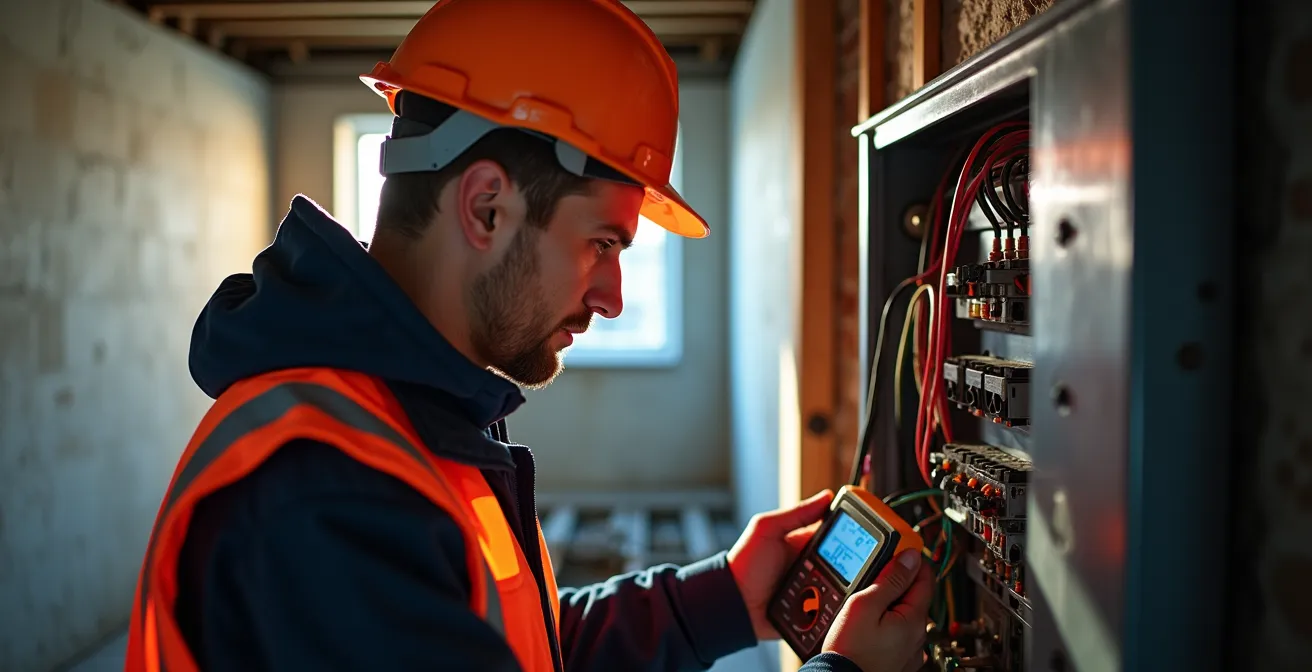
Following a successful inspection, the electrician provides an official attestation of conformity. This document is your key to enrollment. With it in hand, you can contact Hydro-Quebec to finalize your switch to Rate DT. While the inspection itself is a paid service, the program is designed so that the long-term savings far outweigh this initial investment. It’s a crucial piece of due diligence in transforming your heating system into a true financial asset.
Your Action Plan: Step-by-Step Enrollment for Rate DT
- System Inspection: Hire a master electrician to inspect your dual-energy system and ensure it complies with all Rate DT requirements.
- Compliance Modifications: Pay for any necessary modifications your electrician identifies to meet the program’s technical specifications.
- Request Indicator Light: Ask your HVAC contractor to install the free indicator light, which helps you monitor when the high-rate period is active. They can obtain it from Hydro-Quebec.
- Contact Hydro-Quebec: Call customer service for Montreal at 514-385-7252 to initiate your enrollment request.
- Submit Attestation: Provide Hydro-Quebec with the master electrician’s attestation of conformity, proving your system is compliant.
- Await Confirmation: Wait for official written confirmation from Hydro-Quebec that your enrollment in Rate DT has been accepted and activated.
Central Heat Pump vs. Mini-Splits: Which Is Better for Old Plexes?
Choosing the right type of heat pump system is especially complex in Montreal’s iconic multi-unit buildings, such as duplexes and triplexes. These older “plexes” present unique challenges, including a lack of existing ductwork, the need for separate tenant billing, and the preservation of heritage features. The decision between a single central heat pump and multiple mini-split systems is therefore not just technical, but also financial and logistical.
A central system, while powerful, often requires the installation of extensive and invasive ductwork, which can be destructive and costly in an old brick-and-plaster building. Furthermore, it complicates billing, as one system serves multiple units, necessitating complex sub-metering or including heating costs in the rent. In contrast, installing individual mini-split systems for each apartment offers far greater flexibility. It avoids the need for ducts, allows each tenant to control their own heating, and enables separate, direct billing from Hydro-Quebec. This also means each tenant can individually enroll in Rate DT, maximizing savings across the building.
The following table breaks down the key considerations for a typical Montreal plex, highlighting why mini-splits are often the more strategic choice for these specific buildings.
| Feature | Central Heat Pump | Mini-Split System |
|---|---|---|
| Installation in old plexes | Requires extensive ductwork | No ducts needed, preserves walls |
| Multi-tenant billing | Complex shared metering | Individual units per tenant |
| Rate DT eligibility | Single enrollment for building | Each tenant can enroll separately |
| Installation cost (triplex) | $15,000-$25,000 | $12,000-$18,000 (3 systems) |
| Heritage building impact | Destructive to original features | Minimal structural changes |
Hydro-Quebec’s Approach to Multi-Unit Buildings
For apartment buildings that use bulk metering for the entire building, Hydro-Quebec’s Rate DT billing includes a special consideration. A multiplier equal to the number of dwellings is applied when calculating charges. This structure makes individual mini-split systems, which allow for separate tenant billing and control, a more financially advantageous solution for landlords and tenants alike, avoiding the complexity of the multiplier.
The Error of Letting Snow Block the Outdoor Unit Airflow
Using your dual-energy heating system lowers the demand for electricity during peak periods, which are generally during winter cold spells.
– Hydro-Quebec, Rate DT Information Guide
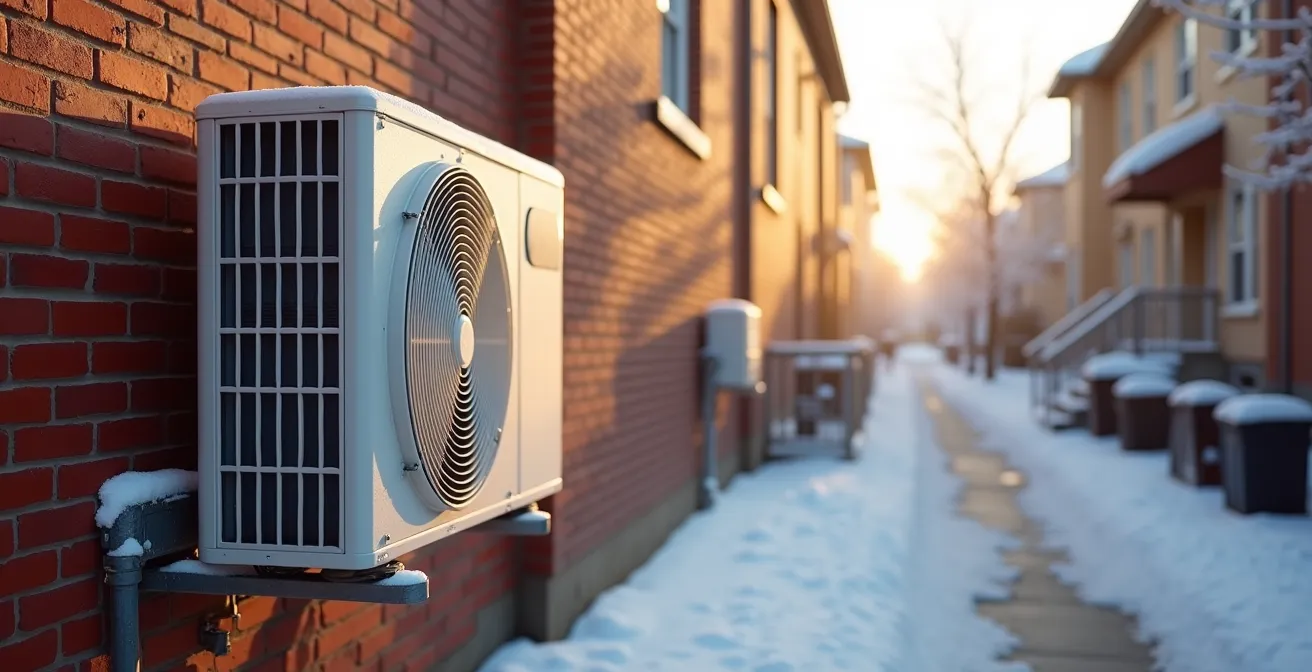
Your heat pump is the engine of your savings, and in a Montreal winter, its biggest enemy is snow and ice. A common and costly mistake is neglecting the outdoor unit, allowing it to become buried in snow or encased in ice. A heat pump works by exchanging thermal energy with the surrounding air. If airflow is obstructed, the unit cannot “breathe.” It has to work much harder to extract heat, causing its efficiency to plummet and your electricity consumption to spike. In severe cases, it can lead to system strain and premature failure.
Protecting this vital component of your energy asset is a matter of simple but consistent winter maintenance. The outdoor unit should ideally be installed on wall brackets or a stand, elevating it at least 18-24 inches above the ground to keep it clear of average snow accumulation. However, after heavy snowfalls, you must manually clear the area around it, ensuring a clearance of at least two to three feet on all sides. It is also critical to monitor the unit for ice buildup, especially at its base, during the freeze-thaw cycles common in Quebec winters.
An obstructed unit may also enter its defrost cycle more frequently. While this cycle is a normal function, excessive use is a red flag indicating an airflow problem that is costing you money. Keeping the unit clear is not just about preventing damage; it is about ensuring your heat pump operates at the peak efficiency required to generate the savings that justify its installation.
- Install the outdoor unit on wall brackets or stands 18-24 inches above ground level.
- Clear snow after each snowfall, maintaining 2-3 feet of clearance on all sides.
- Check for ice buildup at the base of the unit weekly during freeze-thaw cycles.
- Ensure the drainage area beneath the unit is clear to prevent ice dams from forming.
- Monitor the frequency of defrost cycles; excessive cycling often points to an airflow obstruction.
When Will the LogisVert Grants for Heat Pumps End?
A key part of optimizing the finances of a dual-energy system is taking full advantage of available government grants. In Quebec, the primary program is LogisVert, a partnership between the government, Hydro-Quebec, and energy distributors like Energir. These programs provide substantial financial assistance that can cover a significant portion of the purchase and installation costs, dramatically improving the return on investment. For systems using natural gas as the auxiliary fuel, the grant from Energir can be particularly attractive.
For instance, under current programs, homeowners may be eligible for financial aid of up to $5,800 from Energir for a qualifying dual-energy system. This funding significantly lowers the upfront financial barrier. Eligibility for these grants extends to a wide range of housing types, including detached homes, semi-detached houses, row houses, and even multi-unit buildings like duplexes and triplexes, making it a broadly accessible incentive for Montreal homeowners.
However, it is crucial to understand that these grant programs are not permanent. They are funded for specific periods and are subject to change or termination based on government budgets and policy priorities. The history of energy efficiency programs in Quebec shows that they evolve, and funding can be exhausted. Therefore, homeowners considering a switch to dual-energy should act decisively to ensure they can secure the available grants. Waiting could mean missing out on thousands of dollars in assistance, fundamentally altering the financial calculation of the project.
How to Calculate Your Home’s Heat Loss Before Buying a System?
Perhaps the most critical step before purchasing any heating equipment is to perform a heat loss calculation, also known as a “Manual J” calculation. This analysis determines exactly how much heat your home loses to the outdoors during the coldest days of the year. Buying a system without this data is like investing without due diligence. An undersized system will struggle to keep your home warm, running constantly and inefficiently. An oversized system will cycle on and off too frequently, which is also inefficient, increases wear and tear, and does a poor job of dehumidifying in the summer.
In Montreal, this calculation is particularly important due to the age and variety of the housing stock. A 1920s brick duplex in the Plateau with 10-foot ceilings and original single-pane windows has a dramatically different heat loss profile than a 1960s bungalow in the West Island or a modern 2010s condo in Griffintown. A professional HVAC contractor will perform a detailed assessment, but you can do a preliminary check yourself.
A proper assessment, like the one used in Hydro-Quebec’s analysis of a typical 1,700 sq.ft. home, is the foundation for correctly sizing both your heat pump and your auxiliary system. The goal is to size the heat pump to handle the majority of the heating load (down to -12°C) and the auxiliary system to handle only the peak demand during extreme cold snaps. This ensures each component operates in its most efficient range, maximizing your savings under Rate DT.
Checklist for a Preliminary Heat Loss Assessment
- Identify Home Type: Note the age and style (e.g., 1940s plex, 1970s split-level), as construction methods dictate heat loss.
- Measure Square Footage: Calculate the total heated floor area, including a heated basement.
- Assess Windows: Count all windows and note their type. Single-pane windows can be a major source of heat loss.
- Check Insulation: Evaluate insulation levels in the attic and walls. Uninsulated brick walls are common in older Montreal homes.
- Factor in Ceiling Height: Taller ceilings (9-10 feet in many older homes) increase the volume of air to be heated.
- Add a Buffer: For Montreal’s climate, it’s wise to add a 25% capacity buffer to handle extreme cold snaps below -20°C.
Why Does Heating Water During Peak Hours Cost More (Future Rates)?
The principle behind Rate DT—charging more for electricity during periods of high demand—is a core tenet of modern grid management. While Rate DT focuses on the switch to an auxiliary fuel source at a specific temperature, other dynamic rates from Hydro-Quebec, like Rate Flex D, apply this principle to time of day. Understanding this concept is key to mastering your overall energy finances, as this philosophy is likely to become more widespread.
Hydro-Quebec defines winter peak demand periods as the hours when provincial electricity usage is at its highest. These are typically the morning hours when people wake up and the evening hours when they return from work. Specifically, these events often occur between 6:00-10:00 and 16:00-20:00 on weekdays. During these windows, the cost to generate and supply electricity is highest for Hydro-Quebec. Dynamic rates pass this cost on to consumers to incentivize them to shift their consumption to off-peak hours.
As Hydro-Quebec states regarding its flexible rates, the goal is to empower customers to ” save money in winter by shifting their nonessential electricity consumption to outside peak demand events.” This is the strategy of “peak demand arbitrage.” By running your dishwasher, laundry, or even scheduling your electric water heater to operate overnight (outside of peak hours), you can significantly reduce your bill on these types of rates. While Rate DT’s trigger is temperature, not time, the financial logic is identical: avoid consuming electricity when it is most expensive and in highest demand. Mastering this habit prepares you for the future of energy pricing.
Key Takeaways
- Financial Partnership: Rate DT is a financial agreement where you are paid with lower rates for helping stabilize Quebec’s power grid during extreme cold.
- Compliance is Mandatory: You must formally enroll through a process involving a master electrician’s certification to access the savings; simply owning the equipment is not enough.
- Maintenance Protects ROI: Keeping your outdoor heat pump unit clear of snow and ice is not just about preventing damage—it’s about ensuring the peak efficiency needed to maximize your return on investment.
How to Update Old Electric Baseboards to Modern Convectors?
A common misconception about the dual-energy program is that the auxiliary heating system must be fossil fuel-based. While furnaces are traditional, it is entirely possible to create a compliant dual-energy system using only electricity, provided it is configured correctly. This is an excellent strategy for apartments or homes without access to natural gas lines, allowing them to replace inefficient old baseboards with a modern, Rate DT-compatible system.
The solution involves pairing a high-efficiency mini-split heat pump with a network of modern, smart electric convectors. The key to making this setup eligible for Rate DT lies in the wiring. A master electrician must wire the convectors to act as the official auxiliary source, ensuring they are automatically activated by the signal from the Hydro-Quebec meter when the temperature drops below -12°C. At the same time, the mini-split heat pump must be automatically shut off.
This all-electric approach offers a clean, modern alternative to a furnace. While installation costs are significant, the potential for long-term operational savings under Rate DT is substantial compared to relying solely on old, inefficient baseboard heaters. The table below illustrates the financial landscape for a typical Montreal 4½ apartment, showing how a modern dual-energy setup offers a compelling path to lower annual costs.
| System Type | Installation Cost | Annual Operating Cost | Rate DT Compatible |
|---|---|---|---|
| Old baseboards only | $0 (existing) | $1,800-$2,200 | No |
| Mini-split + furnace | $6,000-$8,000 | $900-$1,200 | Yes |
| Mini-split + smart convectors | $5,000-$7,000 | $1,000-1,300 | Yes (with proper wiring) |
To fully leverage these strategies and transform your heating from an expense into an asset, the logical next step is to get a precise understanding of your home’s unique energy profile. Contact a certified HVAC professional to perform a detailed heat loss calculation and discuss a compliant dual-energy system tailored to your needs.