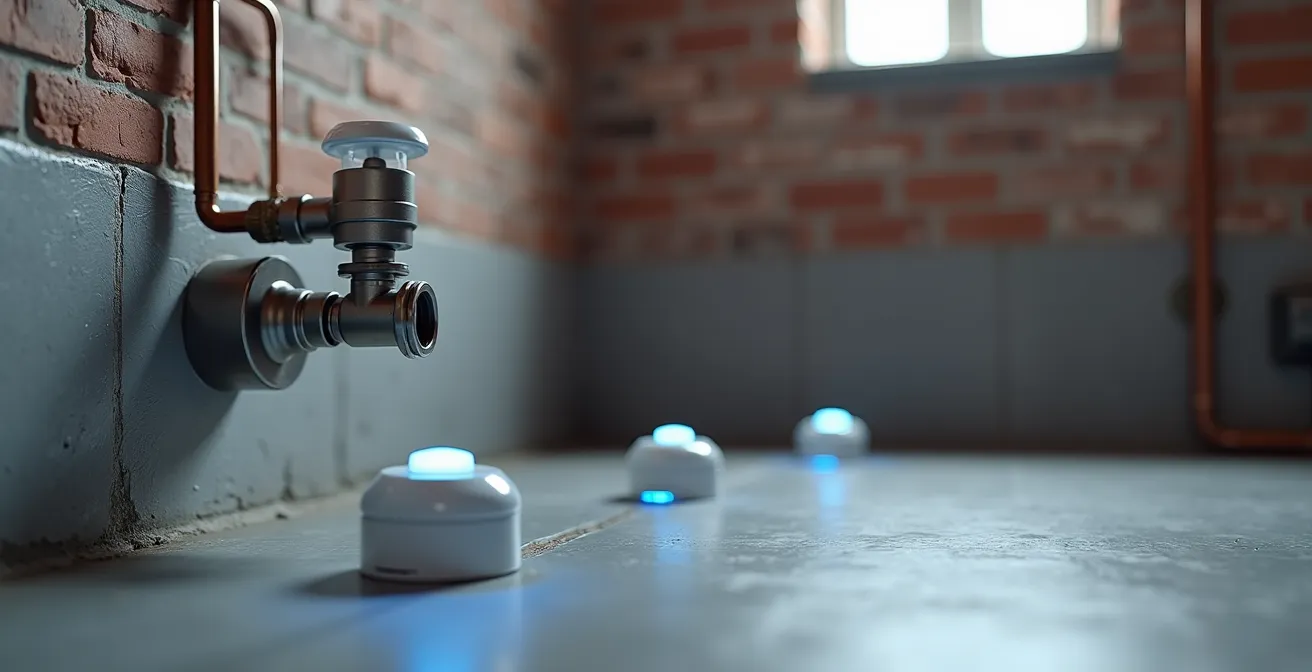
A smart water detector lowers your insurance premium not by its mere presence, but by providing verifiable proof that you have fundamentally reduced your property’s risk profile.
- Installing a system with an automatic water shut-off valve can yield a discount up to four times greater than a simple leak alarm.
- For Montreal homes, a Z-Wave network offers superior reliability in basements, and monthly, documented system tests are non-negotiable for proving due diligence to insurers.
Recommendation: For maximum financial and protective ROI, invest in a professionally monitored, Z-Wave-based system with an auto-shutoff valve tailored to your home’s specific layout.
As a tech-savvy Montreal homeowner, you’ve invested significantly in your property. The thought of a sudden pipe burst or a slow, hidden leak causing catastrophic water damage to your newly renovated basement is a primary concern. You’ve likely heard the buzz around smart leak detectors and the promise of home insurance discounts. However, the common advice to simply “place sensors near water sources” barely scratches the surface and often leads to a negligible premium reduction.
The conversation needs to shift. From a financial and risk management perspective, the goal isn’t just to install a gadget; it’s to engineer a complete, verifiable risk mitigation system. It’s about demonstrating to your insurer, with data and diligence, that your home is a fundamentally safer asset to underwrite. This approach moves beyond the sticker on the box and focuses on the strategic deployment that unlocks significant savings and provides true peace of mind.
This guide will deconstruct the process. We will analyze why certain technologies provide a greater return, how to position them for maximum effect within typical Montreal housing, which connectivity choices are most reliable, and the crucial maintenance steps that transform your setup from a simple alert into an insurable, automated protection system.
Summary: A Strategic Guide to Reducing Insurance Costs with Smart Water Monitoring
- Why Wi-Fi Shut-Off Valves Are Safer Than Simple Alarms?
- How to Position Sensors Near Dishwashers for Instant Detection?
- Wi-Fi vs. Z-Wave: Which Connection Is More Reliable for Basements?
- The Mistake of Not Testing the Auto-Shutoff Feature Monthly
- When to Link Your Water Monitor to Your Security System?
- Tracer Gas vs. Water Dye: Which Finds Micro-Leaks Faster?
- Why Does Your Smart Monitor Think the Toilet Is a Shower?
- How to Track Your Water Usage in Real-Time to Detect Hidden Leaks?
Why Wi-Fi Shut-Off Valves Are Safer Than Simple Alarms?
The single most important distinction an insurer makes is between passive and active water damage mitigation. A simple alarm, which only sends an alert to your phone, is a passive system. It relies on you to be available, see the notification, and take manual action. From an underwriter’s perspective, this still involves significant human-dependent risk. An active system, such as a smart water shut-off valve, physically stops the flow of water automatically the moment a leak is detected, eliminating the risk of human delay or unavailability.
This difference is directly reflected in insurance premiums. A recent analysis of Canadian insurance offerings shows that installing an active shut-off valve can lead to a home insurance discount of up to 20%, whereas a basic alarm system may only yield a 5% discount. The four-fold difference in potential savings underscores the value insurers place on automated intervention. An active valve transforms the scenario from damage control into proactive prevention, drastically reducing the potential claim amount.
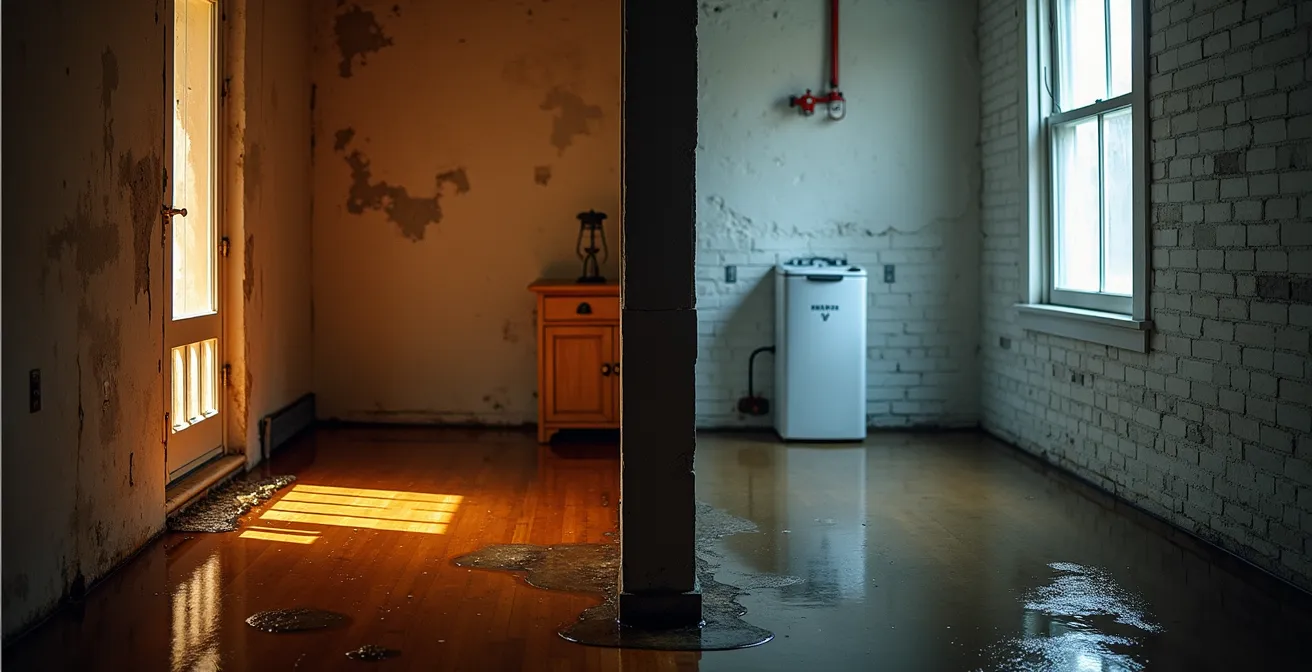
This visual comparison highlights the starkly different outcomes. On one side, a passive alert results in significant damage. On the other, an active shut-off system maintains the integrity of your property and investment.
Ultimately, choosing an automatic shut-off valve is not just a safety upgrade; it’s a calculated financial decision. It communicates to your insurer that you have installed a robust system that minimizes their exposure to a major claim, justifying a more substantial reduction in your premium. It’s the cornerstone of an effective, insurable risk mitigation strategy.
How to Position Sensors Near Dishwashers for Instant Detection?
Strategic sensor placement is about thinking like an insurer: identifying and covering every high-risk failure point, not just the obvious ones. While placing a sensor under the kitchen sink is standard practice, the specific architecture of Montreal homes demands a more nuanced approach. Dishwashers, washing machines, toilets, and water heaters are all critical, but their connection points and the materials around them dictate the best type of sensor to use.
For example, the tight cabinetry common in Plateau apartments or Griffintown condos often makes placing a standard “puck” sensor difficult. Here, an ultra-slim rope sensor run along the water inlet hose is far more effective. For a Rosemont duplex with a known history of hard water, placing a sensor directly at the hot water heater’s inlet valve is critical, as mineral buildup is a common cause of failure in this specific area.
The objective is to create a comprehensive detection network that accounts for the unique risks of your property type, from protecting original hardwood floors in an older apartment to preventing liability issues from leaks into a neighbour’s unit below.
| Housing Type | Recommended Sensor | Key Placement | Special Consideration |
|---|---|---|---|
| Plateau Apartment | Ultra-slim rope sensor | Along inlet hose | Tight cabinetry, original flooring protection |
| Griffintown Condo | Contact point sensor | Under unit base | Liability to neighbors below |
| Rosemont Duplex | Standard puck sensor | Hot water valve area | Hard water mineral buildup zones |
By tailoring your sensor choice and placement to your home’s specific construction, you demonstrate a higher level of diligence. You’re not just checking a box; you’re building a customized system designed for the fastest possible detection, which is a powerful argument when negotiating your insurance premium.
Wi-Fi vs. Z-Wave: Which Connection Is More Reliable for Basements?
The effectiveness of your smart water detection system is entirely dependent on its ability to communicate. A sensor that can’t send a signal is useless. While Wi-Fi is ubiquitous, it is often not the most reliable choice for a whole-home leak detection system, especially in the context of typical Montreal basements. The thick concrete foundations and brick walls found in Villeray or Verdun duplexes are notorious for blocking or weakening standard Wi-Fi signals.
This is where Z-Wave technology presents a superior alternative. Unlike Wi-Fi, where each device connects individually to a router, Z-Wave devices create a mesh network. Each mains-powered Z-Wave device acts as a repeater, relaying signals from other devices. This creates multiple redundant pathways for the signal to travel, making it far more robust at penetrating the thick construction materials common in Montreal homes. An analysis of smart home protocols confirms that mesh networks are more effective for reaching sensors in challenging locations like basements and sub-floors.
Furthermore, systemic reliability is paramount during a crisis. Many Z-Wave hubs come with battery backup. This is a critical feature in Quebec, where Hydro-Québec service interruptions during ice storms or high winds are a reality. A Wi-Fi-only system will fail during a power outage, leaving you unprotected. A Z-Wave system with battery backup will maintain full functionality, ensuring your shut-off valve can still trigger even when the power is out. This level of resilience is a key component of a truly “insurable” system.
The Mistake of Not Testing the Auto-Shutoff Feature Monthly
Installing an advanced leak detection system is only the first step. The single biggest mistake a homeowner can make is assuming the system will work perfectly forever without maintenance. From an insurer’s perspective, a system’s value is tied to its proven functionality. This is where “verifiable diligence” comes into play: regularly testing your system and documenting the results provides concrete proof that your risk mitigation measures are active and effective.
In Montreal, this is doubly important. The region’s hard water can lead to mineral buildup on valve mechanisms, potentially causing them to seize over time if not exercised. Seasonal changes also introduce risks; the ground shift during the spring thaw can stress plumbing, while the first deep frost can lead to frozen pipes. A scheduled testing protocol addresses these local challenges directly.
A proactive testing schedule demonstrates to your insurer that you are actively managing your property’s risk, which can be a powerful factor during a claim review. Water damage consistently ranks as one of the top sources of insurance claims in Quebec, making this diligence even more critical.
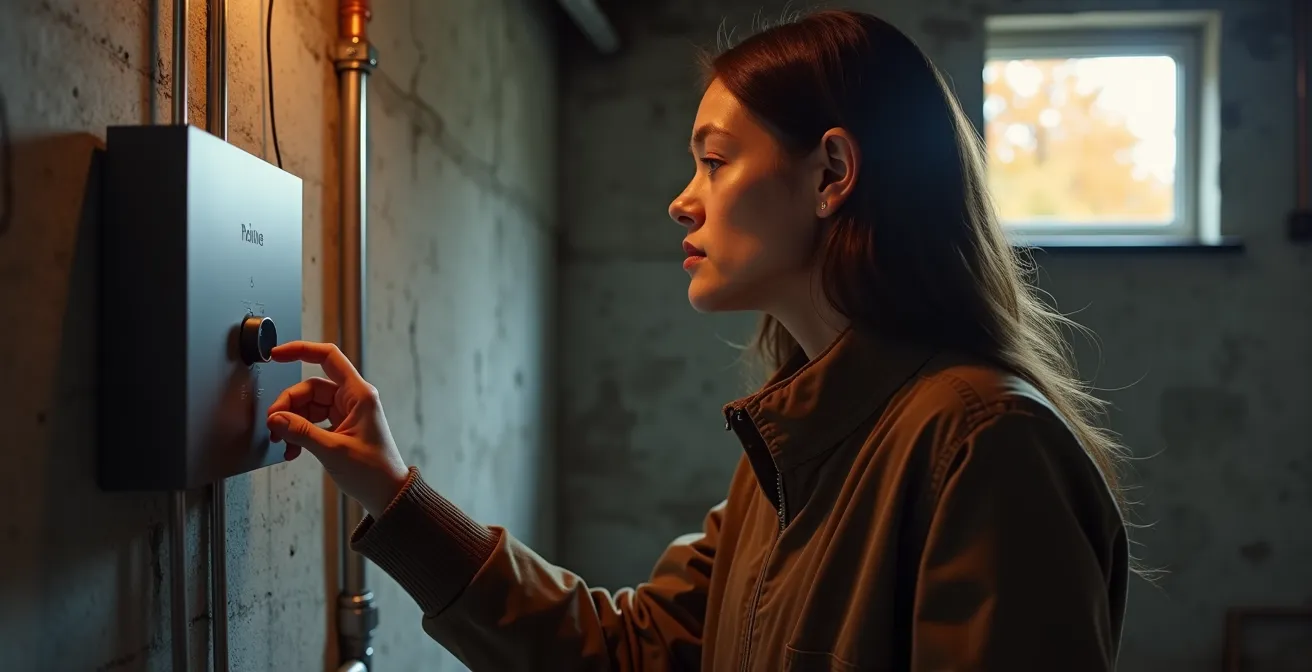
Implementing a simple, documented testing routine is non-negotiable for maintaining both your system’s integrity and its value in the eyes of your insurer. It is the final link in proving your home is a lower-risk asset.
Your Action Plan: Montreal Seasonal Testing Schedule
- October Pre-Frost Check: Test the system before the first major frost to ensure it’s ready to prevent damage from frozen pipes.
- March Spring Thaw Check: Test again in late March as the ground thaws, a period known for putting stress on plumbing foundations.
- Monthly Valve Exercise: Briefly operate the shut-off valve via the app once a month to prevent seizure from Montreal’s hard water mineral buildup. This is critical, as water damage tops Quebec insurance claims.
- Document Every Test: Keep a simple log in a spreadsheet or notebook with the date and result (e.g., “March 25, 2024 – Valve closed/opened successfully”). This log is your proof of due diligence.
- Annual Function Verification: Once a year, verify that both the automatic (by triggering a sensor with a wet cloth) and manual shut-off functions work correctly.
When to Link Your Water Monitor to Your Security System?
For the homeowner focused on maximizing both protection and financial return, the final upgrade is integrating the water detection system with a professionally monitored security service. A self-monitored system is good, but a professionally monitored one provides an additional layer of guaranteed response that insurers value highly.
When a leak is detected, a monitored system doesn’t just alert you; it also alerts a 24/7 central station. This station can then follow a pre-determined protocol, such as attempting to contact you, dispatching an emergency contact, or even sending a plumber if required. This guaranteed response protocol is the key. It removes the “human-in-the-loop” variable that insurers see as a primary risk. Even if you are on a plane, in a meeting, or have your phone turned off, a response is initiated.
This enhanced reliability translates directly into greater savings. Data from the insurance industry shows that monitored water alarms yield higher insurance discounts than self-monitored systems. The logic is simple: professional monitoring significantly reduces the likelihood of a small leak turning into a catastrophic claim, which in turn reduces the insurer’s potential payout. By investing in monitoring, you are aligning your interests with your insurer’s, creating a clear business case for a larger premium discount.
The decision to link your water monitor to a security system should be made when your priority shifts from basic notification to guaranteed intervention. It is the definitive step in creating a fully-managed, insurable risk mitigation system for your property.
Tracer Gas vs. Water Dye: Which Finds Micro-Leaks Faster?
While a smart system prevents future disasters, what about existing, hidden micro-leaks that are too small to trigger an immediate alert but can cause long-term damage and high water bills? For the truly diligent homeowner, understanding professional leak detection methods is the next level of property management. When you suspect a slow leak behind a wall or under a slab, knowing which technology to request can save time and money.
The two primary methods used by professionals are tracer gas and fluorescent dye. Water dye is effective and straightforward for visible drain systems, like a suspected leak in a multi-unit building’s toilet assembly. The dye is added to the system and will visually appear at the leak point within 15 to 30 minutes.
However, for more insidious leaks, such as those under the concrete slab of a post-war bungalow’s finished basement, tracer gas is vastly superior. A safe, inert gas mixture (typically helium or hydrogen/nitrogen) is injected into the empty pipe. Being much lighter than water, the gas escapes through the tiniest fissure and rises through the concrete and flooring, where a highly sensitive “sniffer” can detect it on the surface within minutes. This non-invasive method pinpoints the exact location of the leak without any destructive exploratory work, a service that experts like Canadian Leak Detection specialize in.
| Method | Best Use Case | Montreal Application | Detection Speed |
|---|---|---|---|
| Tracer Gas (Helium/Hydrogen) | Under-slab leaks | Post-war bungalows with finished basements | Within minutes |
| Water Dye | Visible drain systems | Multi-unit building toilet/drain assemblies | 15-30 minutes |
| Acoustic Detection | Behind walls | NDG semi-detached homes with hidden pipes | Real-time |
Knowing these options allows you to have an informed conversation with a plumbing professional, ensuring the fastest and most cost-effective method is used for your specific situation. It’s another facet of transforming from a reactive homeowner into a proactive property manager.
Why Does Your Smart Monitor Think the Toilet Is a Shower?
A common point of frustration for new users of smart water monitors is seeing bizarre classifications in the app, such as a toilet flush being labeled as a 15-minute shower. This isn’t a system flaw, but a misunderstanding of how these devices work. Your smart monitor is in an AI learning phase for the first week or two. It’s not just measuring water flow; it’s building a unique “hydrological signature” for your home.
During this calibration period, the system’s algorithm analyzes the flow rate, duration, and pressure changes associated with every water event. It then tries to match these patterns to fixture types. An initial misclassification is normal. The key is to use your system’s app to correctly categorize each event. By telling the app “No, that was the toilet, not the shower,” you are actively training the AI, making it progressively more accurate. Over time, it will learn to distinguish the sharp, brief signature of a toilet from the long, steady signature of a shower.
In Montreal, two local factors can complicate this learning process. First, “phantom flushes” caused by old or worn toilet flappers create a continuous, low-level flow that the system can misinterpret as a long-running fixture. This is actually a benefit, as it helps you identify a wasteful leak you didn’t know you had. Second, many older Montreal homes still have water-guzzling fixtures with flow patterns very different from modern, high-efficiency models, which can extend the AI’s learning period. Patience and diligent categorization in the app are essential to achieving high accuracy.
Key Takeaways
- An automatic shut-off valve is the most critical component for maximizing your home insurance discount.
- Z-Wave mesh networks provide more reliable connectivity than standard Wi-Fi in Montreal homes with thick concrete or brick walls.
- Documenting monthly system tests provides your insurer with concrete proof of due diligence, strengthening your position in a claim scenario.
How to Track Your Water Usage in Real-Time to Detect Hidden Leaks?
The ultimate function of a smart water monitoring system—and the one that provides long-term value beyond a single event—is its ability to give you a real-time, granular view of your home’s water consumption. This data is your most powerful tool for detecting the small, hidden leaks that don’t trigger an immediate shut-off but can lead to staggering waste and slow, structural damage. With 27.6% of home insurance claims stemming from water damage, proactive monitoring is a financial necessity.
The key is to establish a “zero-usage” baseline. This is done by checking your system’s app during a time when you know no water should be running, for instance, late at night or when the family is out for the day. The flow rate should read 0.0 L/min. If it shows a constant, non-zero flow—even a tiny one—you have a hidden leak somewhere in your system. This data allowed one Beaconsfield family to discover a slow leak in their underground sprinkler system that would have otherwise gone unnoticed for months.
This real-time tracking transforms you from a passive victim of potential water damage into an active manager of your home’s infrastructure. It allows you to identify issues before they become claims, cross-reference your consumption with the City of Montreal’s smart meter data to challenge billing errors, and prevent the kind of slow, steady leaks that can compromise your foundation over time. This continuous, data-driven oversight is the ultimate expression of a proactive risk mitigation system.
The next logical step is to assess your property’s specific vulnerabilities and select a system that not only protects your home but actively enhances its insurable profile for maximum savings and security.