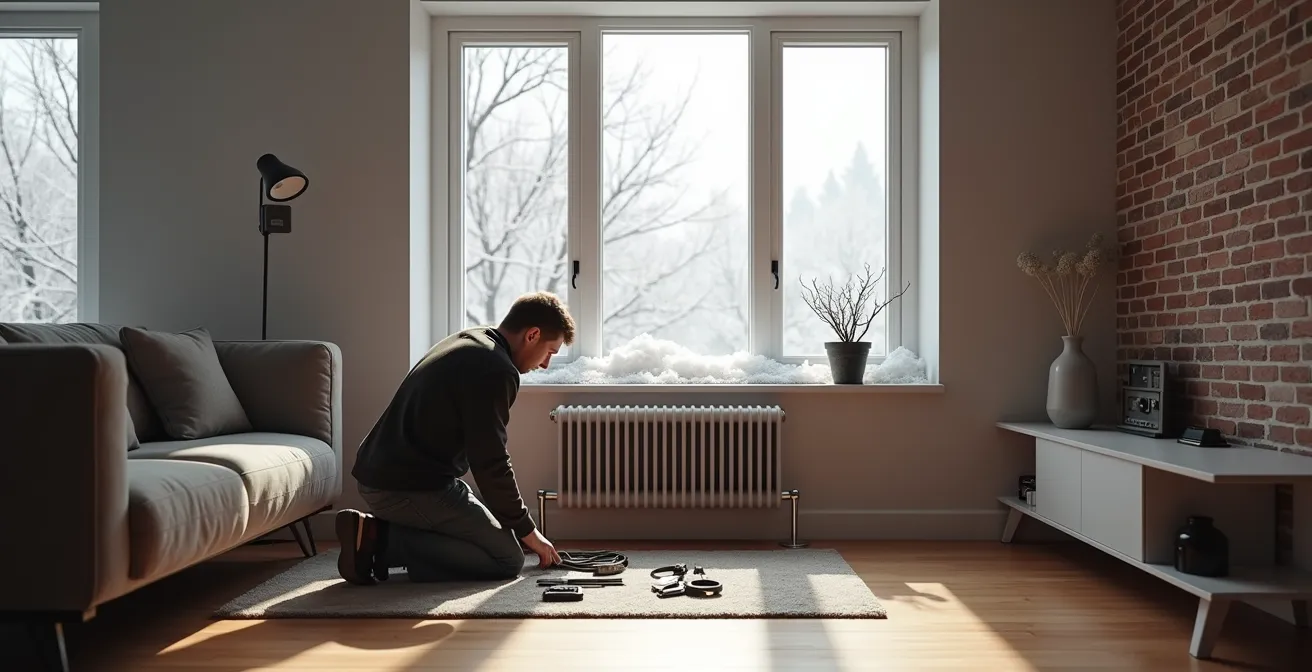
Upgrading from old electric baseboards to modern convectors is a design-forward move that enhances both your Montreal condo’s aesthetic and its heating efficiency.
- Modern convectors provide faster, more even heating while consuming less energy and opening up valuable floor space.
- Strategic placement of new electronic thermostats and smart home integration (like Hilo) maximizes comfort and savings.
Recommendation: Begin by assessing your room layout and electrical capacity to create a heating plan that prioritizes both functionality and interior design.
For any Montreal condo owner, the familiar click and hum of an old electric baseboard heater is a winter staple. But so are the frustrations that come with them: the bulky, off-white enclosures that dictate furniture placement, the dusty smells, and the nagging feeling that your Hydro-Québec bill could be lower. For decades, these units have been the default, but their time is passing. The conversation around home heating has shifted from mere functionality to a blend of efficiency, control, and, crucially, aesthetics.
Many articles will tell you that new heaters are more efficient or that you should install a smart thermostat. While true, this advice often misses the bigger picture for a design-conscious urban dweller. The real opportunity isn’t just a technical swap; it’s a chance for spatial reclamation. It’s about transforming a heating system from a necessary evil into an integrated, intelligent part of your home’s design. This isn’t about simply replacing a heater; it’s about rethinking how you experience comfort and style in your living space.
But what if the key to this upgrade wasn’t just in the hardware, but in understanding the principles behind it? This guide moves beyond the basics. We will explore the science of modern convection, the art of thermostat placement, the strategic use of smart technology, and how to make choices that are perfectly tailored to the realities of Montreal living—from a Plateau apartment to a larger West Island home. This is your blueprint for turning an outdated heating system into a sophisticated, cost-effective, and beautiful asset.
To guide you through this transformation, this article is structured to answer your most pressing questions. From the core principles of modern heating to the smart integrations that complete the ecosystem, here is a clear path to upgrading your condo’s comfort and style.
Summary: A Montrealer’s Guide to Upgrading Electric Baseboards
- Why Do Modern Convectors Heat Faster Than Old Baseboards?
- How to Move a Thermostat to Avoid False Temperature Readings?
- 120V vs. 240V Heaters: Which Is More Efficient for Bedrooms?
- The Error of Placing Furniture Directly in Front of Heaters
- When to Upgrade to Smart Thermostats for Electric Baseboards?
- Why Does a Tankless Unit Require a 60-Amp Electrical Upgrade?
- When to Add Smart Blinds to Assist Your Heating System?
- How to Start a Smart Home Ecosystem Without Overwhelming Complexity?
Why Do Modern Convectors Heat Faster Than Old Baseboards?
The difference in heating speed between old baseboards and modern convectors lies in their fundamental approach to warming a room. Traditional baseboards operate primarily on radiant heat; they warm the objects and people directly in front of them. This process is slow and creates uneven temperature zones. In contrast, a modern convector is designed for air circulation. It pulls cool air from the floor, passes it over a heated element, and then naturally releases the warmed air from the top. This creates a continuous convection cycle that circulates and heats the air in the entire room much more quickly and uniformly.
This efficiency isn’t just about speed; it’s about energy. The convection process ensures that the thermostat gets an accurate reading of the room’s ambient temperature sooner, allowing the heater to shut off and save power. In fact, due to their advanced design, modern convectors use approximately 10% less energy than their older baseboard counterparts for the same heat output. For a Montreal condo, this translates directly into lower winter Hydro bills.
Furthermore, the design of the heating element itself has evolved. New convectors often feature finned, monolithic elements with a large surface area, allowing for a more efficient transfer of heat to the air. This engineering focus on airflow and heat exchange is the core reason you feel the warmth faster and more consistently throughout your space, transforming a cold room into a comfortable one in a fraction of the time.
How to Move a Thermostat to Avoid False Temperature Readings?
A heating system is only as smart as its sensor, and the thermostat is your system’s brain. Placing it in the wrong spot is a common mistake that leads to “ghost readings,” where the thermostat thinks the room is warmer or colder than it actually is. This results in an uncomfortable space and wasted energy. The golden rule is to place the thermostat on an interior wall, away from any sources that could skew its perception of the room’s temperature.
Common culprits for false readings include placing thermostats directly above a heater, near a drafty window or door, in direct sunlight, or near heat-generating appliances like lamps or televisions. In a typical Montreal triplex or condo, this means finding a central location in the room, usually at a standard light-switch height (around 48-52 inches from the floor), where airflow is representative of the entire space. This ensures it measures the true ambient temperature, not a localized hot or cold spot.
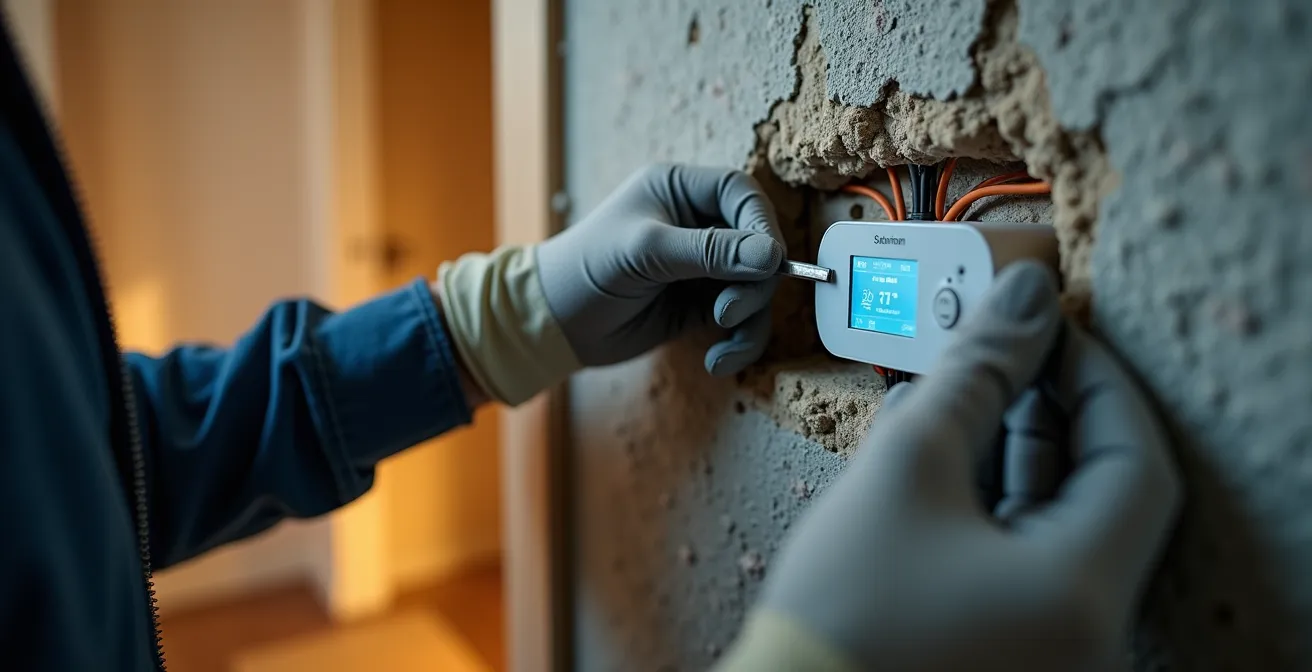
When upgrading, it’s the perfect time to replace outdated bimetal (mechanical) thermostats with modern electronic or smart models. As noted by Montreal electricians, these upgrades are crucial for accuracy and efficiency. In fact, you can often benefit from programs like rebates offered by Hydro-Québec for switching to electronic thermostats. A certified electrician can ensure the new placement complies with the Quebec Construction Code and that the wiring is handled safely, especially when fishing new wires through older lath-and-plaster walls common in the city.
120V vs. 240V Heaters: Which Is More Efficient for Bedrooms?
When choosing a new convector, especially for a bedroom, the voltage question—120V versus 240V—inevitably comes up. It’s a common misconception that one is inherently more energy-efficient than the other. In reality, a 1500-watt heater will use 1500 watts of power and produce the same amount of heat regardless of whether it’s a 120V or 240V model. The real difference lies in installation cost, electrical capacity, and the heater’s maximum power output, which dictates the size of the room it can effectively heat.
A 120V heater can often be plugged into an existing standard outlet, making installation simpler and cheaper. However, these circuits are typically limited to 15 amps, meaning the heater’s maximum output is usually capped around 1,500 watts. This is generally sufficient for small bedrooms or offices up to 150 square feet. For larger rooms, a 120V heater may struggle to keep up, running constantly without ever reaching the target temperature. For proper sizing in our climate, Montreal homes with regular insulation require about 10 watts per square foot.
A 240V heater, on the other hand, requires a dedicated circuit run directly from your electrical panel by a certified electrician. While the initial installation cost is higher, 240V circuits can handle much higher wattages. This allows for more powerful convectors (2,000W, 2,500W, or more) capable of quickly and efficiently heating larger master bedrooms or open-concept spaces common in newer condos.
This table breaks down the key decision factors for a typical Montreal residence.
| Feature | 120V Heaters | 240V Heaters |
|---|---|---|
| Installation Cost | Lower – uses existing circuits | Higher – requires dedicated circuit |
| Maximum Wattage | 1,500W typical | 2,500W+ available |
| Room Size Capacity | Up to 150 sq ft | 250+ sq ft |
| Panel Requirements | Standard 100A panel sufficient | May require panel upgrade |
| Best For | Small bedrooms in Rosemont apartments | Large master bedrooms in West Island homes |
The Error of Placing Furniture Directly in Front of Heaters
From an interior design perspective, one of the biggest limitations of old baseboard heaters is the dead space they create. Pushing a sofa, bookshelf, or credenza against them isn’t just an aesthetic compromise; it’s a significant functional and safety error. Obstructing a heater, whether it’s a baseboard or a modern convector, cripples its ability to circulate air. The heat becomes trapped behind the furniture, and the unit works overtime trying to warm a room that never gets comfortable. This simple placement mistake can be surprisingly costly.
The impact on performance is not trivial. According to CAA-Quebec, blocked electric heaters can experience up to a 40% reduction in heating efficiency. That trapped heat also fools the thermostat into thinking the job is done, shutting the unit off prematurely while the rest of the room remains chilly. Beyond inefficiency, it’s a serious safety hazard. The *Service de sécurité incendie de Montréal* regularly flags blocked heaters as a fire risk, as heat buildup can damage furniture and, in worst-case scenarios, ignite nearby flammable materials like curtains or upholstery.
Upgrading to slim, wall-mounted convectors already helps with spatial reclamation, but respecting clearance is still paramount. The goal is to integrate heating into your design, not hide it. This means choosing furniture with legs to allow airflow underneath, using wall-mounted consoles, and ensuring drapes or curtains end well above the heating unit. Adhering to proper clearances allows your heating system to function as designed, ensuring both safety and efficiency.
Your Action Plan: Safe and Stylish Furniture Placement
- Verify Clearances: Maintain a minimum of 10 inches of clear space above electric baseboards or convectors.
- Frontal Space: Keep all furniture at least 3 inches away from the front of any heating unit to allow for air intake.
- Elevate Your Style: Opt for furniture with legs or wall-mounted pieces near heaters to promote uninterrupted airflow underneath.
- Curtain Call: Ensure curtains, drapes, and other window treatments do not hang over or touch the heating units.
- Check the Fins: During a seasonal check (with the circuit breaker off), ensure the metal fins inside the unit are clean and not bent or touching, which can cause noise and reduce airflow.
When to Upgrade to Smart Thermostats for Electric Baseboards?
The ideal time to upgrade to a smart thermostat is the moment you decide to improve your home’s comfort and efficiency—even before you replace the heaters themselves. A smart thermostat for electric heating is one of the single most impactful upgrades a condo owner can make. It moves you from a reactive “on/off” system to a proactive, intelligent comfort ecosystem. While a basic electronic thermostat is already a huge leap from an old mechanical dial, a smart thermostat offers a new level of control, learning, and savings.
Companies based in Quebec, like Sinopé and Mysa, have developed smart thermostats specifically designed for high-voltage electric heating systems like convectors and baseboards. These devices connect to your Wi-Fi, allowing you to control your home’s temperature from anywhere via a smartphone app. You can create detailed schedules that match your lifestyle—lowering the heat when you’re at work or asleep and warming the condo just before you wake up or return home. Many also provide detailed energy consumption reports, showing you exactly where your heating dollars are going. According to experts, switching to ENERGY STAR® approved electronic thermostats can achieve a 10% reduction in energy consumption, and smart models can push those savings even further.
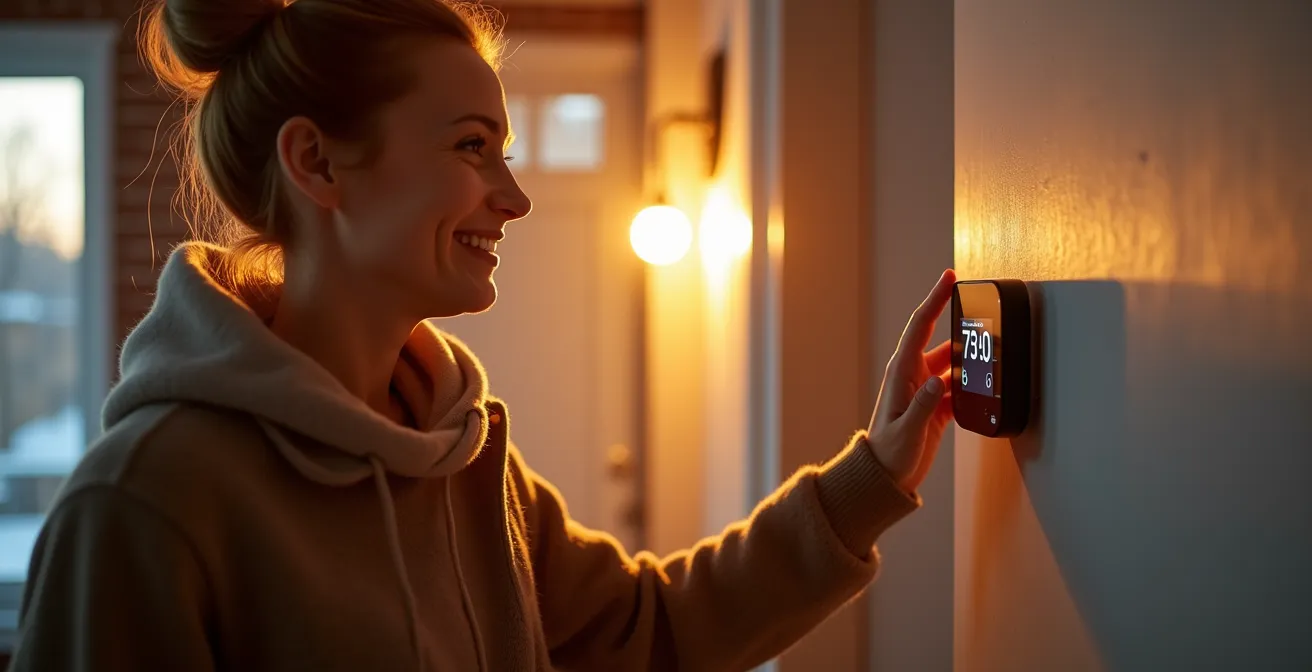
The upgrade makes sense when you want to: automate savings without sacrificing comfort, manage heating in different rooms independently (creating intelligent comfort zones), or integrate your heating into a larger smart home system. For Montrealers, a key trigger is the desire to connect with Hydro-Québec’s Hilo service, which offers rewards for reducing energy consumption during peak winter periods—a feat made easy with a programmable smart thermostat.
Why Does a Tankless Unit Require a 60-Amp Electrical Upgrade?
While discussing convector heaters, it’s wise to consider the entire electrical ecosystem of your condo, a concept of holistic electrification. An electric tankless water heater, another popular modern upgrade, illustrates this perfectly. Unlike a traditional hot water tank that keeps a large volume of water heated 24/7, a tankless unit heats water instantly on demand. This requires a massive, instantaneous surge of electrical power. While it saves energy by not heating water constantly, that power draw is substantial.
A typical electric tankless unit can require anywhere from 40 to 60 amps, or even more, on a dedicated 240V circuit. This is often more than the entire capacity of some very old electrical panels. An older Montreal condo might have a 60A or 100A main panel, which is simply insufficient to handle modern demands like an electric vehicle charger, multiple new convectors, and a tankless water heater simultaneously. Attempting to run such a powerful appliance on an undersized system is a serious fire hazard and will lead to constantly tripping breakers.
This is why a licensed master electrician is essential for such an upgrade. As specialists in Montreal’s housing stock note, projects like converting from an old oil furnace or upgrading an entire heating system are the perfect opportunity to upgrade the electrical panel itself, typically from 100A to a modern 200A standard. According to experts like Michel Guimont Entrepreneur Électricien, bundling a panel upgrade with other electrical work, like adding new circuits for convectors, can save thousands in labor compared to doing the projects separately. A CMEQ-certified electrician will ensure your panel has the capacity for all your modern aspirations, safely and to code.
When to Add Smart Blinds to Assist Your Heating System?
An intelligent heating system doesn’t work in isolation; it works in partnership with its environment. Adding smart blinds is the moment you decide to move from active heating to a proactive, passive solar partnership. In a city like Montreal, with its cold but often brilliantly sunny winter days, your windows are a powerful thermal asset. Smart blinds allow you to automate the process of harvesting free solar heat during the day and preventing heat loss at night.
During a sunny winter day, south-facing windows can let in a significant amount of solar radiation, warming your floors and furniture and reducing the workload on your convectors. You can program smart blinds to open automatically in the morning on these facades to capture this free heat. Then, as the sun sets, they can close automatically to create an insulating pocket of air between the blind and the window pane. This simple strategy can have a major impact; studies show that proper window treatments can result in up to a 25% reduction in heating demand.
The “when” is driven by a desire for ultimate efficiency and automation. It’s the right move once you have smart thermostats in place, as the two systems can work in concert. For instance, you can set a rule: “If it’s a sunny winter day and the indoor temperature is below 21°C, open the blinds before turning on the heat.” This approach, strongly recommended by local experts for Montreal’s climate, directly reduces your convector’s runtime and, consequently, your Hydro-Québec bill during the most expensive peak winter periods. It’s the final touch in creating a truly intelligent and efficient home.
Key Takeaways
- Upgrading to modern convectors is as much an aesthetic choice as a functional one, reclaiming space and improving room design.
- True heating efficiency comes from a complete system: well-placed smart thermostats, properly sized heaters, and unobstructed airflow.
- For Montrealers, leveraging local programs like Hydro-Québec’s Hilo and pairing heating with smart blinds for passive solar gain maximizes savings.
How to Start a Smart Home Ecosystem Without Overwhelming Complexity?
The idea of a “smart home” can seem daunting, conjuring images of complex wiring and incompatible gadgets. However, starting a smart home ecosystem focused on winter comfort in your Montreal condo can be a simple, step-by-step process. The key is to begin with a single, high-impact problem to solve: creating a comfortable and efficient heating system. Don’t try to automate everything at once.
The natural starting point is with smart thermostats designed for electric heat, such as those from Quebec-based brands Sinope or Mysa. These are your central hubs. Once installed, they immediately provide scheduling, remote control, and energy monitoring. This single step delivers about 80% of the “smart heating” benefits. From there, you can expand logically. The next step in your thermal aesthetics journey would be adding smart blinds to your south-facing windows to manage passive solar gain, as we’ve discussed.
For Montreal residents, a powerful next move is to connect your system to Hydro-Québec’s Hilo service. Hilo integrates with compatible thermostats and rewards you with cash back for allowing it to slightly reduce your energy use during peak demand events in the winter. If you’re renting or want to start even smaller, you can begin with portable devices like smart plugs for lamps or sensors that can trigger actions, all of which can be integrated into a central hub like Apple HomeKit, Google Home, or Amazon Alexa later on. The goal is to build your ecosystem piece by piece, ensuring each new device solves a real problem and adds tangible value.
Now that your heating is efficient, beautiful, and intelligent, the next logical step is to ensure it’s installed to the highest standards of safety and performance. To bring your vision to life, a consultation with a certified master electrician is essential to assess your condo’s specific needs and ensure a flawless execution.