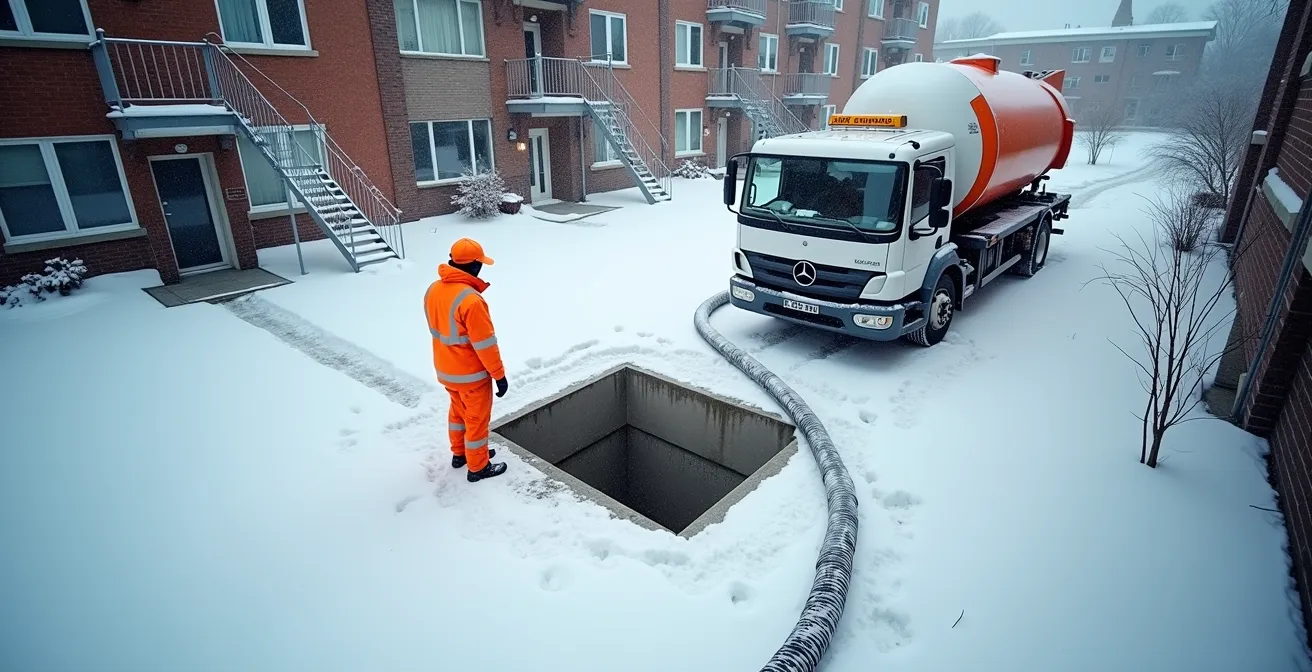
For a multi-unit Montreal building, a grease interceptor is not merely a plumbing fixture; it is a critical piece of infrastructure whose long-term performance and cost are dictated by engineering principles, not just initial price.
- Proper sizing depends on calculated flow rates and required retention times, not arbitrary unit counts.
- Material choice (polyethylene vs. steel) directly impacts lifespan and installation complexity in Montreal’s harsh climate.
- Proactive maintenance and adherence to municipal regulations are the most effective cost-mitigation strategies against emergency backups and fines.
Recommendation: Base your selection on a total lifecycle cost analysis, factoring in access for maintenance, material durability against corrosion, and compliance with Montreal’s specific pump-out and documentation requirements.
For a condo board managing a 50-unit building, particularly a mixed-use property with commercial tenants, the question of waste management extends far beyond standard plumbing. When dealing with fats, oils, and grease (FOG), the conversation elevates to the level of municipal infrastructure and long-term asset management. The installation of an external grease interceptor is often presented as a simple compliance requirement, but this view overlooks the significant engineering and financial implications that a mismanaged system can trigger. The real challenge is not deciding *if* you need one, but how to specify, install, and maintain one to avoid catastrophic failures and optimize lifecycle costs.
Many decision-makers focus on the upfront capital cost or the sheer volume of the tank. However, the true drivers of efficiency and compliance are more nuanced. They involve a deep understanding of fluid dynamics, material science under specific environmental duress—like Montreal’s freeze-thaw cycles and road salt corrosion—and the logistical realities of urban maintenance. An undersized or poorly specified interceptor does not just fail to meet regulations; it actively creates risk in the form of sewer backups, hazardous gas accumulation, and emergency service calls that can be exponentially more expensive than planned maintenance.
This guide moves beyond the basics to provide an engineering-focused perspective for condo boards. It frames the selection and management of a grease interceptor as a critical asset decision. We will deconstruct the core technical principles, from flow rate control to venting, and analyze the financial trade-offs between different technologies and materials. The objective is to equip you with the technical knowledge to engage with engineers and contractors, challenge assumptions, and make a decision that protects both your building’s infrastructure and its financial health in the specific context of Montreal’s regulatory and environmental landscape.
This article provides a detailed breakdown of the critical factors your board must consider. The following summary outlines the key areas we will explore to ensure your building’s waste management system is efficient, compliant, and cost-effective for the long term.
Summary: A Condo Board’s Guide to Grease Interceptors in Montreal
- Why Is Flow Rate Control Critical for Effective Grease Separation?
- How to Position Concrete Interceptors to Ensure Truck Access?
- Gravity Interceptor or Automatic Removal Unit: Which ROI is Better?
- The Error of Poor Venting That Causes Dangerous Gas Buildup
- When to Vacuum the Sludge Layer: Metrics for Industrial Pump-Outs
- Stainless Steel or Polyethylene: Which Trap Lasts Longer in Acidic Environments?
- Why Preventive Jetting Costs Less Than One Emergency Sewer Backup?
- Who Is Responsible for a Blocked Sewer Lateral: You or the City of Montreal?
Why Is Flow Rate Control Critical for Effective Grease Separation?
The single most common misconception when sizing a grease interceptor is focusing on the building’s size or the number of units. The effectiveness of an interceptor is not determined by its static volume but by its ability to manage dynamic flow rates. The fundamental principle of gravity separation is providing sufficient retention time for FOG to naturally rise to the surface and solids to settle. If the wastewater from kitchens and drains rushes through the tank too quickly, this separation process cannot occur, rendering the interceptor ineffective regardless of its size.
A flow control device is therefore not an optional accessory; it is an essential component of the system. Installed upstream, it creates a choke point that regulates the gallons per minute (GPM) entering the interceptor, ensuring the flow never exceeds the unit’s rated capacity. This guarantees the wastewater remains in the tank long enough for effective separation. Without this control, a sudden discharge from multiple sources (e.g., several commercial kitchen sinks draining simultaneously) can create a surge that flushes FOG directly into the municipal sewer system, leading to blockages and potential fines.
The engineering specification must be based on the total potential GPM from all connected fixtures, not an arbitrary building-wide estimate. This calculation determines the required size of both the interceptor and its corresponding flow control fitting. Neglecting this crucial step is the primary cause of undersized systems that fail prematurely and consistently violate municipal effluent standards. Proper flow control is the foundation of an efficient and compliant grease management strategy.
Ultimately, a correctly specified flow control device transforms a passive tank into a functioning separation system, safeguarding your investment and ensuring compliance.
How to Position Concrete Interceptors to Ensure Truck Access?
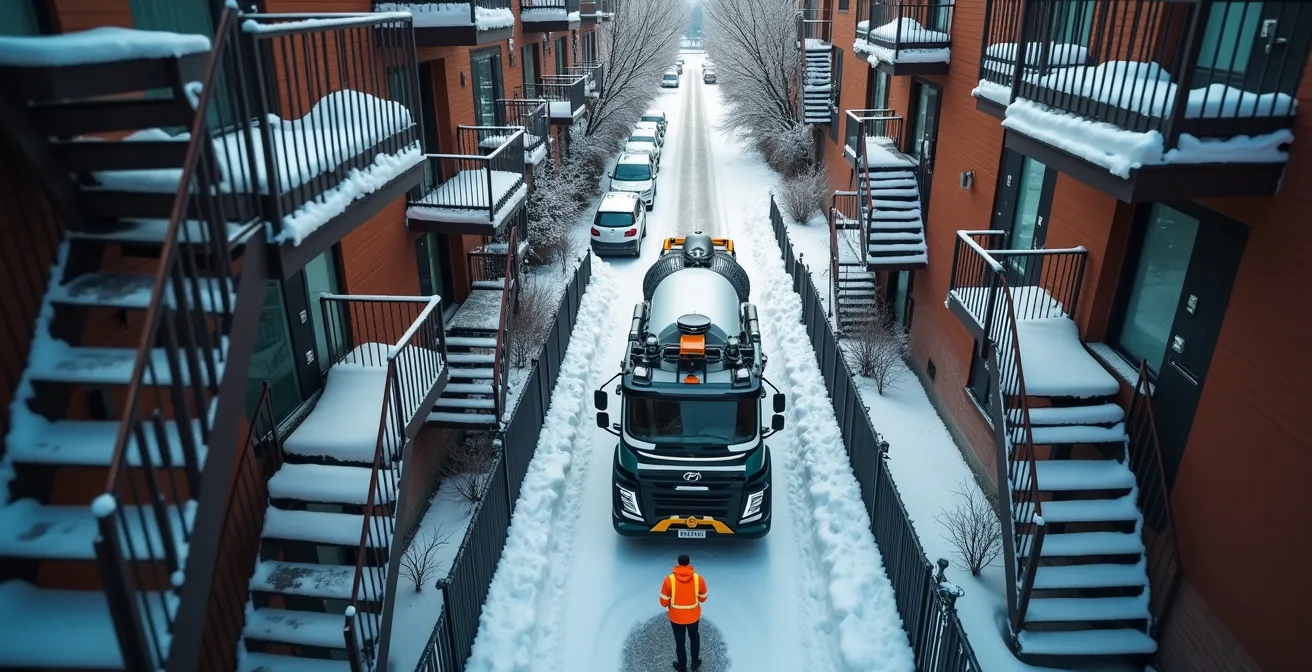
The location of a large, external concrete interceptor is a decision with long-term logistical consequences that extend far beyond the initial installation. While burying the unit out of sight is the goal, its placement must be dictated by the absolute necessity of access for a vacuum truck. In a dense urban environment like Montreal, this presents a significant challenge involving narrow alleys (ruelles), overhead wires, seasonal snowbanks, and tenant parking. The board must consider a “maintenance-first” approach to positioning.
The ideal location provides a clear, unobstructed path for a large service vehicle, typically requiring a minimum clearance of 3 to 4 meters in width and 4 to 5 meters in height. The access manholes of the interceptor should be as close as possible to the vehicle’s workable range, usually within 15-30 meters of a hard, stable surface where the truck can park. A site plan must account for the full turning radius of the truck and its operational footprint. Choosing a location that is convenient for installation but inaccessible for maintenance will lead to exorbitant service fees for extra hose length, or in the worst-case scenario, an inability to service the unit at all.
This image of a vacuum truck navigating a typical Montreal alley highlights the spatial constraints that must be factored into the initial design phase. Planning for winter conditions, when snow removal further narrows access routes, is particularly critical.
A failure to properly plan for logistical access effectively renders the interceptor a buried liability. The board must ensure that the civil engineer’s plans explicitly address and solve the problem of year-round service truck access before any excavation begins. This foresight prevents future operational nightmares and ensures the asset can be managed effectively throughout its lifespan.
This strategic positioning is as crucial to the system’s function as its internal mechanics.
Gravity Interceptor or Automatic Removal Unit: Which ROI is Better?
When selecting a grease management system, the board faces a fundamental choice between a traditional, large-volume concrete gravity interceptor and a more modern, compact Automatic Grease Removal Unit (AGRU). This decision should not be based on initial purchase price but on a comprehensive Return on Investment (ROI) analysis that considers installation, maintenance, and risk over the system’s entire lifecycle.
A gravity interceptor is a passive system. It relies on a large tank (often 1,000 gallons or more) to provide the retention time needed for FOG to separate. Its primary advantage is a lower upfront capital cost for the unit itself. However, its ROI is negatively impacted by several factors:
- High Installation Costs: Requires significant excavation, heavy machinery, and a large physical footprint.
- Regular Pumping Fees: The entire contents of the tank (water, FOG, and sludge) must be vacuumed out and transported for disposal, a recurring operational expense.
- Inefficiency Over Time: As FOG and sludge accumulate, the effective retention time decreases, reducing separation efficiency between pump-outs.
An AGRU, by contrast, is an active system. It automatically skims and removes FOG from the water on a daily or programmed basis, storing it in a separate, sealed container for easy collection. As a manufacturer like Goslyn Canada points out, this proactive approach offers distinct advantages.
Goslyn™ fully automatic grease interceptors prevent overflows and contamination issues resulting from piping blockages…because they virtually eliminate discharges and also capture solids from entering discharge piping
– Goslyn Canada, Canadian grease interceptor manufacturer documentation
The ROI for an AGRU is built on long-term operational savings. While the initial capital cost is higher, it often proves more economical over time due to a drastic reduction in pumping frequency and costs, consistently high efficiency, and a much smaller footprint, which can be critical in space-constrained urban retrofits. The choice depends on the board’s capital budget versus its tolerance for ongoing, variable operating expenses.
For a 50-unit building with commercial tenants, the higher, more consistent FOG load often makes the superior efficiency and lower operating costs of an AGRU a compelling long-term investment.
The Error of Poor Venting That Causes Dangerous Gas Buildup
A grease interceptor is a living ecosystem where organic matter decomposes. This anaerobic decomposition naturally produces sewer gases, including hydrogen sulfide (H₂S) and methane. These gases are not just foul-smelling; they are corrosive, toxic, and at certain concentrations, explosive. Proper venting is therefore a non-negotiable safety requirement, not an optional plumbing feature. A poorly vented interceptor is a significant liability.
The venting system serves two primary functions. First, it allows for the safe release of sewer gases to the atmosphere, typically through a connection to the building’s main vent stack that terminates above the roofline. This prevents a dangerous buildup of pressure and flammable gases within the interceptor and the building’s drainage pipes. Second, it prevents siphoning. A large volume of water suddenly draining can create a negative pressure vacuum that siphons water out of the interceptor and P-traps throughout the building, allowing sewer gas to enter occupied spaces.
The diagram below illustrates the critical components of a correctly configured venting system, including the external flow control and connections to the building’s vent stack. Adherence to plumbing codes like PDI G101 is essential for a safe and functional installation.
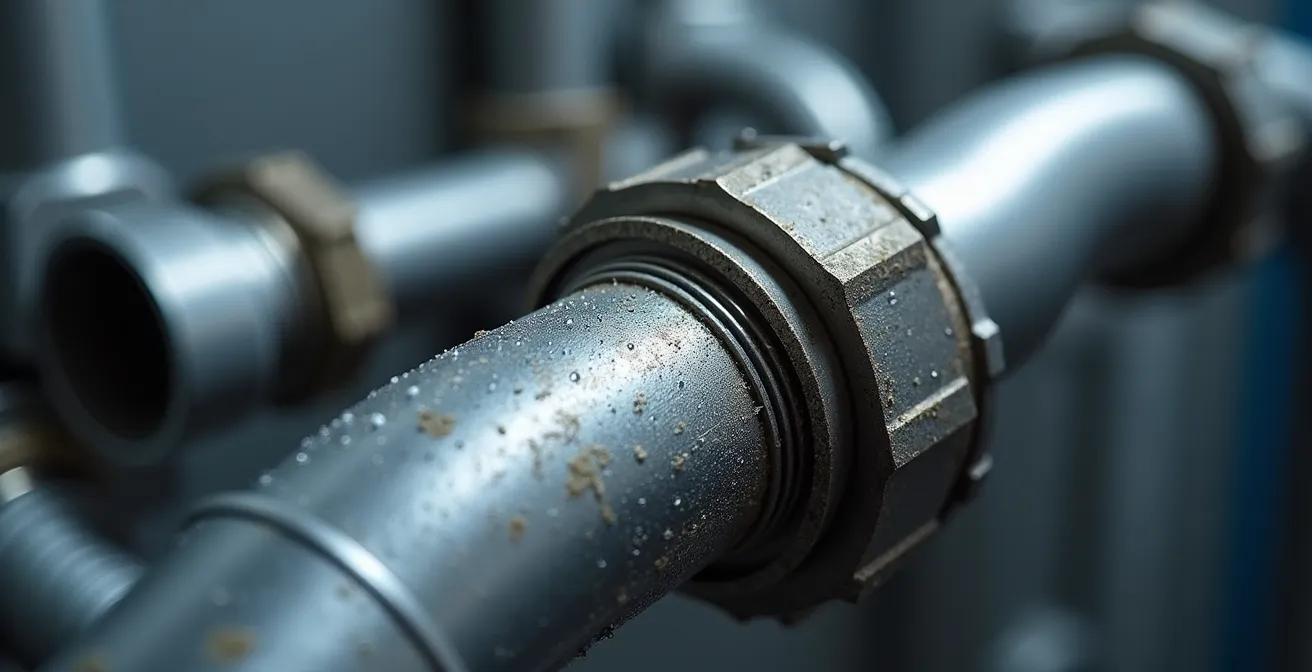
Essential venting practices include installing a vented external flow control upstream, ensuring the outlet of the interceptor is vented to prevent siphoning, and terminating air intakes well above the flood rim level of any connected fixtures. Any deviation from these standards compromises the safety of the building and its occupants, exposing the board to significant risk. Proper venting is a critical element of responsible asset management.
This aspect of the design should be scrutinized by the board’s consulting engineer to ensure full compliance and safety.
When to Vacuum the Sludge Layer: Metrics for Industrial Pump-Outs
Determining the pump-out frequency for a large interceptor cannot be based on a generic calendar schedule alone. While industry best practices recommend cleaning large outdoor interceptors approximately every three months, a data-driven approach is more efficient and ensures compliance. The primary metric for scheduling a pump-out is the “25% rule”: the interceptor must be cleaned when the combined thickness of the floating grease layer and the bottom sludge layer occupies 25% of the tank’s total liquid volume. Exceeding this threshold drastically reduces retention time, leading to FOG being discharged into the city sewer.
For a condo board in Montreal, managing this process involves more than just calling a pumping service. It requires a specific, localized strategy to ensure operational efficiency and regulatory compliance. The service provider must be licensed, and the board must obtain and archive the “bordereau de suivi” (waste manifest) after each service. This document is the legal proof that the waste was transported and disposed of at an authorized facility, which is a critical piece of documentation in the event of a municipal inspection or dispute.
Furthermore, scheduling must be adapted to Montreal’s unique climate and logistics. A pre-winter pump-out is crucial before the ground freezes and access becomes more difficult. All service must be coordinated with seasonal parking restrictions and snow removal operations. A proactive, metric-based, and locally-aware maintenance plan minimizes costs and ensures the system functions as designed.
Action Plan: Your Montreal-Specific Pump-Out Strategy
- Schedule a mandatory pre-winter pump-out before the ground freezes, typically in October or November, to ensure easy access.
- After every service, demand and securely file the ‘bordereau de suivi’ (waste manifest) as your official record for municipal compliance.
- Implement the 25% rule: regularly measure the grease and sludge layers and schedule a pump-out when their combined depth reaches one-quarter of the tank’s liquid depth.
- Consider quarterly testing of effluent samples to verify that FOG levels remain below the regulatory limits set by the City of Montreal.
- Coordinate all pump-out appointments with the city’s seasonal on-street parking restrictions and your building’s snow removal contractor’s schedule to avoid access issues.
This approach transforms maintenance from a recurring cost into a strategic practice for risk mitigation and long-term asset protection.
Stainless Steel or Polyethylene: Which Trap Lasts Longer in Acidic Environments?
The material of the interceptor itself is a critical long-term investment decision, especially in the demanding Montreal environment. The choice typically comes down to stainless steel versus modern engineered thermoplastics like polyethylene. While steel has a reputation for strength, polyethylene often offers a superior lifecycle cost and durability in this specific application.
Stainless steel interceptors are robust, but their vulnerability lies in their welds. Over time, exposure to acidic effluent (common from certain food waste) and, more critically in Montreal, corrosive road salt that seeps into the ground, can compromise these welded seams. The material’s rigidity also makes it susceptible to stress fractures during the region’s intense freeze-thaw cycles, which cause ground shifting. Installation is also more complex, often requiring multiple personnel or lifting equipment due to the significant weight.
Polyethylene interceptors, on the other hand, offer several distinct advantages. They are rotationally molded in a single piece, eliminating the welds that are the primary failure point in steel tanks. The material is inherently inert and completely resistant to the corrosive effects of both acidic waste and road salt. Furthermore, its natural flexibility allows it to adapt to ground movement during freeze-thaw cycles without cracking. This combination of factors typically gives polyethylene a longer effective lifespan in a Montreal climate. The lightweight nature of the material also dramatically simplifies installation, as highlighted in case studies where it can become a one-person, ‘plug and play’ job.
This comparative table, based on data from installation guides, summarizes the key differences for a decision in the Montreal context.
| Factor | Stainless Steel | Polyethylene |
|---|---|---|
| Freeze-thaw resistance | Rigid – stress at welds | Flexible – adapts to ground movement |
| Corrosion from road salt | Susceptible at welds | Fully resistant |
| Installation weight | Requires 2+ people or crane | One-person installation possible |
| UV degradation risk | None | Requires protection if exposed |
| Typical lifespan in Montreal | 15-20 years | 20-25 years |
For a long-term installation in a corrosive and seasonally dynamic environment, the superior resistance and flexibility of polyethylene often present a more reliable and cost-effective investment.
Key Takeaways
- Interceptor effectiveness is dictated by flow rate and retention time, not just tank volume. A flow control device is mandatory.
- Lifecycle cost, not initial price, is the correct metric for evaluation. This includes installation, maintenance frequency, and material longevity in Montreal’s climate.
- Proactive, data-driven maintenance (the 25% rule) combined with meticulous record-keeping (‘bordereau de suivi’) is the best strategy to mitigate financial and legal risks.
Why Preventive Jetting Costs Less Than One Emergency Sewer Backup?
For a condo board, the budget line for “preventive maintenance” can sometimes be viewed as an optional expense. When it comes to the building’s main drain lines, this mindset is a significant financial risk. The cost of regular, scheduled hydro-jetting of the sewer lines downstream from the interceptor is a fraction of the cost of a single emergency backup. A backup is not merely an inconvenience; it is a catastrophic event involving property damage, water remediation, potential health hazards, and emergency service fees.
Even with a perfectly functioning interceptor, a small amount of FOG will inevitably pass through and begin to accumulate on the walls of the sewer pipes. Over time, this buildup hardens and reduces the pipe’s internal diameter, leading to slower drainage and eventual blockages. Preventive hydro-jetting uses high-pressure water to scour the inside of the pipes, removing this accumulation before it can become a critical obstruction. This is a planned, controlled, and predictable expense.
In contrast, an emergency call for a sewer backup involves immediate, and often after-hours, mobilization of technicians and equipment. The financial impact is multifaceted: the cost of unblocking the pipe, the expense of cleaning and sanitizing flooded areas, and the potential for resident displacement or commercial tenant business interruption. Industry data is clear on this point: according to service cost analyses, emergency grease trap cleaning can cost up to three times more than regularly scheduled service. The true cost of a full sewer backup is even higher.
Viewing preventive jetting as an insurance policy against a far greater financial and operational disaster is the correct framework for any building asset manager.
Who Is Responsible for a Blocked Sewer Lateral: You or the City of Montreal?
One of the most contentious and costly issues a condo board can face is a blocked main sewer lateral. The critical question is determining the precise location of the blockage, as this dictates financial responsibility. In Montreal, the sewer line is divided into a private section and a public section. The demarcation point is your property line. As the building owner, the condo corporation is responsible for the entire length of the pipe from the building to the property line. The City of Montreal is responsible for the pipe from the property line to the main sewer connection under the street.
If a blockage occurs, you cannot simply call the city. The onus is on the property owner to prove the location of the problem. This requires hiring a CMMTQ-certified plumber to perform a camera inspection of the line. The video from this inspection is your essential piece of evidence. If the camera clearly shows the blockage is located on the public side of the property line (e.g., under the sidewalk or street), you can then contact the city by calling 311 and provide them with this evidence. The city will then be obligated to dispatch their own crews to resolve the issue.
Without this definitive video proof, any claim against the city will likely be rejected, leaving the board to cover the full cost of repairs, even if the fault lies on public property. This is particularly crucial in cases involving tree roots from city-owned trees, which is a common cause of lateral damage. Meticulous documentation, including the plumber’s report and video file, is your primary tool for defending your building’s financial interests in a dispute with the municipality.
Action Plan: Montreal Sewer Lateral Responsibility Procedure
- At the first sign of a main drain blockage, immediately call a plumber certified by the CMMTQ (Corporation of Master Pipe-Mechanics of Quebec) to perform a professional camera inspection.
- Instruct the plumber to clearly document the location of the blockage with video evidence, specifically noting its distance from the building and relation to the property line.
- If the video evidence confirms the blockage is on the public side (beyond your property line), call 311 to open a file with the City of Montreal, referencing your evidence.
- Retain copies of the plumber’s invoice, written report, and the full video file. This documentation is critical for any potential billing disputes with the city.
- For blockages caused by roots from city-owned trees, submit a formal claim to Montreal’s public works department, including all supporting documentation from your plumber.
To ensure your condo corporation is protected, an immediate and professional diagnosis is the only correct course of action. For a compliant installation and expert diagnosis of your grease trap and sewer line issues in the Montreal area, consulting with a certified specialist is the essential next step to safeguard your property.