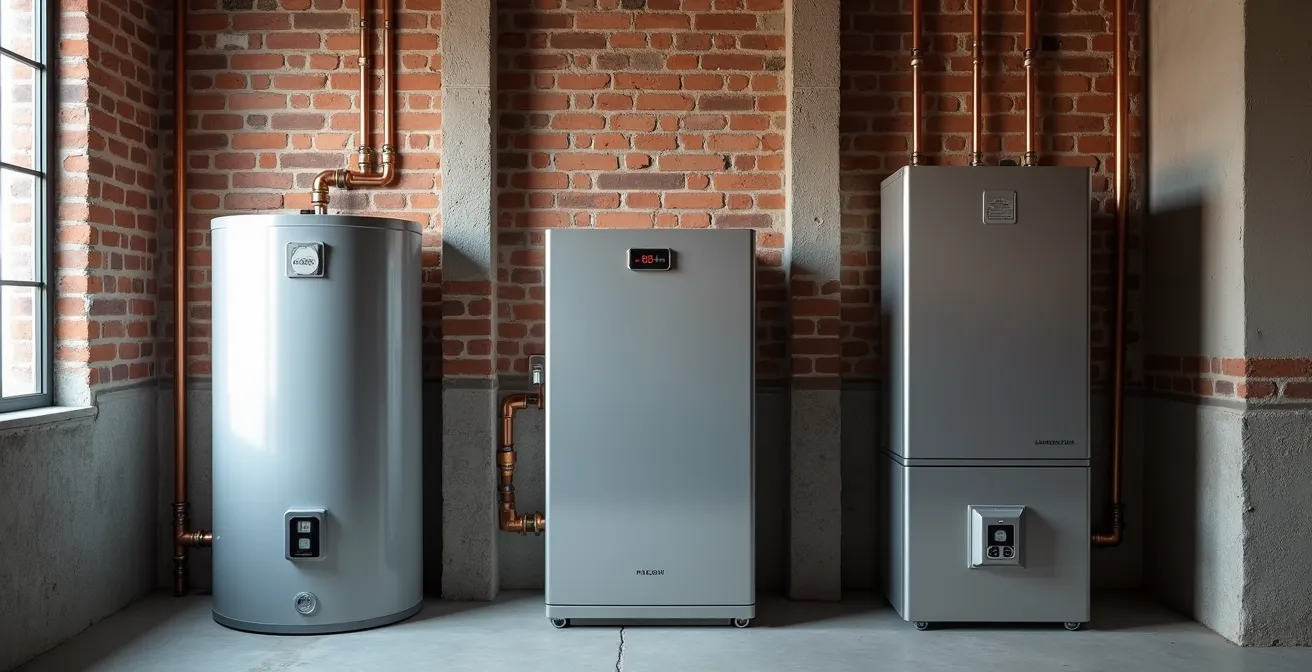
The higher upfront cost of an Energy Star water heater is misleading; a Total Cost of Ownership (TCO) analysis for Montreal reveals it’s often the cheaper option within a few years.
- The Uniform Energy Factor (UEF) is a far more critical metric than tank size, directly impacting long-term costs in Quebec’s cold climate.
- Stacking provincial grants (like LogisVert) with federal credits can significantly reduce the initial purchase price of high-efficiency models like heat pumps.
Recommendation: Focus your comparison on the UEF and First Hour Rating (FHR), and factor in installation and grant eligibility, not just the sticker price.
You’re standing in the aisle of a Montreal hardware store, looking at two water heaters. One has a familiar blue Energy Star label and a price tag that’s several hundred dollars higher. The other is a standard, no-frills model that seems like the sensible, budget-friendly choice. The immediate cost difference is stark, and the common wisdom often whispers to save money upfront. Many buyers assume the long-term savings of an Energy Star unit are negligible or simply marketing fluff.
This decision feels simple, but it carries financial implications for the next decade. The average residential water heater in Quebec has a lifespan of about 8 to 12 years, and heating water accounts for a significant portion of a home’s energy use— as much as 20% of Canada’s energy consumption in the residential sector. Choosing the wrong unit based on sticker price alone is a common and costly mistake.
But what if the entire premise of comparing purchase prices is flawed? The true value isn’t on the price tag. It’s hidden in a calculation that most consumers never perform: the Total Cost of Ownership (TCO). This article abandons the simple price comparison. Instead, we will adopt the mindset of a procurement specialist, analyzing the complete financial picture for a Montreal homeowner. We will break down how the Uniform Energy Factor (UEF), provincial grants, and right-sizing your unit are the real drivers of value, proving that the more expensive label can often lead to the lowest overall cost.
This guide provides a clear, data-driven framework to help you make an informed investment, not just a purchase. Discover the key metrics and local factors you need to evaluate to see which water heater is truly the most economical choice for your home.
Summary: The Definitive Cost-Benefit Analysis of Energy Star Water Heaters in Montreal
- Why Is the Energy Factor More Important Than the Tank Size?
- How to Check if a Model Qualifies for Provincial Grants?
- Hybrid Electric vs. Standard: Which Has the Best Energy Star Score?
- The Error of Buying an Efficient Tank That Is Too Small for the Family
- When Do Energy Star Standards Change: Buying Before Regulations Tighten
- Why Does a Tankless Unit Require a 60-Amp Electrical Upgrade?
- When Will the LogisVert Grants for Heat Pumps End?
- Is a Tankless Water Heater Worth the Investment in Quebec?
Why Is the Energy Factor More Important Than the Tank Size?
When comparing water heaters, the most visible specification is often the tank capacity in gallons or litres. However, for evaluating long-term cost, this is secondary to a more critical metric: the Uniform Energy Factor (UEF). The UEF measures a water heater’s overall energy efficiency in a standardized way. A higher UEF means the unit converts more energy into hot water, resulting in lower operating costs. For a Montreal home, where incoming water temperature in winter can be as low as 4-5°C, a high UEF is paramount for efficient operation.
A standard electric tank heater might have a UEF between 0.63 and 0.95, meaning it operates at 63-95% efficiency. In contrast, ENERGY STAR certified heat pump water heaters typically achieve a UEF of 3.3 to 4.1. This translates to an incredible 330% to 410% efficiency because they don’t create heat—they move it from the surrounding air into the water, using significantly less electricity.

As the image above illustrates, the vast temperature difference between frigid winter water and the desired hot output places immense demand on a heating system. A unit with a low UEF will struggle, consuming massive amounts of energy to bridge this gap. A high-UEF model, like a heat pump, performs this task far more economically. Therefore, focusing on the highest possible UEF within your budget will deliver far greater savings over the unit’s lifespan than debating between a 40-gallon and a 60-gallon tank of a less efficient model.
How to Check if a Model Qualifies for Provincial Grants?
A major component of the TCO calculation in Quebec is the availability of government grants, which can dramatically lower the upfront cost of a high-efficiency water heater. Programs like Hydro-Québec’s LogisVert and federal initiatives are specifically designed to incentivize the purchase of Energy Star certified products. However, not every product with the blue label automatically qualifies. It is crucial to verify a specific model’s eligibility before purchase.
The process involves cross-referencing information from both federal and provincial sources. The primary resource is the official list maintained by Natural Resources Canada. As their guidance states: “Find certified products using the ENERGY STAR Product Finder. (Note: you will be redirected to the US ENERGY STAR website. Click “Canada” as your market).” Once you have a list of certified models, you must then check the specific eligibility criteria for provincial programs like LogisVert, which may have additional performance requirements or be limited to certain types of technology.
It’s important to note the scope of these regulations. According to Natural Resources Canada, while various types of water heaters are regulated for minimum performance, not all are promoted by the Energy Star program. They clarify this distinction:
The following ENERGY STAR certified water heaters are subject to Canada’s Energy Efficiency Regulations: gas storage tank water heaters, tankless water heaters, commercial gas water heaters that are storage or tankless (“instantaneous”). Electric or oil-fired storage tank water heaters are regulated but are NOT eligible for ENERGY STAR certification.
– Natural Resources Canada, ENERGY STAR Water Heaters Program
This means that for electric options, homeowners should specifically look for heat pump (hybrid) models, as standard electric resistance tanks do not qualify for the Energy Star label or the associated high-tier grants. Always confirm with your CMMTQ-certified installer, as they will have the most up-to-date information on qualifying models and installation requirements.
Hybrid Electric vs. Standard: Which Has the Best Energy Star Score?
When it comes to electric water heaters, the difference in efficiency between a standard model and an Energy Star certified hybrid (heat pump) model is not incremental—it’s monumental. A standard electric tank uses resistive heating elements, similar to a giant kettle, to heat water. This process is simple but inefficient, with a UEF score typically below 0.95. In contrast, a hybrid or heat pump water heater works like a refrigerator in reverse, pulling warmth from the surrounding air and transferring it to the water in the tank.
This method allows hybrid models to achieve UEF scores that are multiples of what standard tanks can offer. An ENERGY STAR certified heat pump water heater uses up to 70% less energy to heat the same amount of water. This efficiency is directly reflected in its UEF score and its potential for long-term savings, despite a higher initial installation cost in Montreal.
The following table breaks down the performance and typical installation costs for different water heater types in the Montreal area, highlighting the clear superiority of heat pump models from an efficiency standpoint.
| Water Heater Type | UEF Range | Efficiency % | Montreal Installation Cost* |
|---|---|---|---|
| Standard Electric Tank | 0.63 to 0.95 | 63-95% | $800-$1,500 |
| Tankless Gas | 0.93 | 93% | $2,000-$3,500 |
| Heat Pump (Hybrid) | 3.3 to 4.1 | 330 to 410% | $2,500-$4,000 |
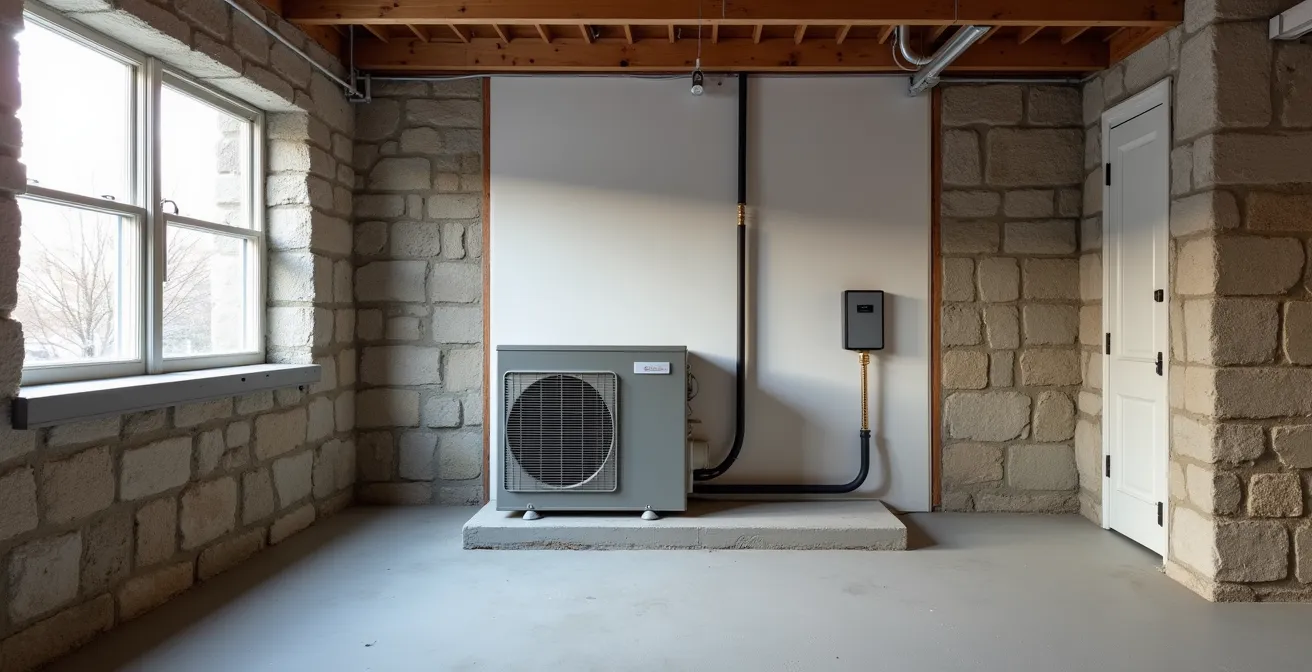
While the upfront cost for a heat pump is highest, its 330-410% efficiency means the payback period, especially when combined with grants, is often surprisingly short. It’s crucial, however, to ensure your basement or installation area meets the requirements, as these units need adequate clearance for air circulation to function effectively, a key consideration in the often-cramped basements of Montreal duplexes and triplexes.
The Error of Buying an Efficient Tank That Is Too Small for the Family
Selecting a high-UEF water heater is a smart financial move, but its efficiency gains can be completely negated if the unit is improperly sized for your household’s needs. A common mistake is choosing a smaller tank to save on the initial purchase price, assuming its high efficiency will compensate. This leads to a situation where the tank is constantly depleted, forcing the backup electric resistance elements to run continuously to keep up with demand. This effectively turns your hyper-efficient hybrid unit into a standard, energy-hungry one, erasing your potential savings.
To avoid this, you must look beyond the tank’s gallon capacity and focus on the First Hour Rating (FHR). As defined by Energy Star, the First Hour Rating (FHR) is an estimate of the maximum volume of hot water in gallons that a storage water heater can supply within an hour, starting with a full tank of hot water. This metric tells you how well the unit can handle peak demand—like multiple showers running back-to-back in the morning.
A professional plumber can help you calculate your home’s peak hour demand to determine the appropriate FHR you need. Investing in a properly sized unit from the start is critical. Given that the average lifespan of a water heater in Quebec is 10 to 12 years, a sizing mistake is one you’ll be paying for—both in frustration and on your Hydro-Québec bill—for a very long time. A slightly larger, correctly-sized efficient tank that rarely needs its backup elements will always be cheaper to operate than an undersized one that runs them daily.
When Do Energy Star Standards Change: Buying Before Regulations Tighten
The Energy Star program is not static. Its standards for energy efficiency are periodically updated to reflect technological advancements and push the market towards greater performance. As Natural Resources Canada states, “Canada’s Energy Efficiency Regulations establish minimum performance standards for energy efficiency and help eliminate the least efficient products from the Canadian marketplace.” This means that a model considered “high-efficiency” today might be the baseline standard in a few years.
This continuous improvement has two key implications for a buyer. First, purchasing the most efficient model available today ensures your investment remains “future-proof” for longer, continuing to deliver savings even as standards rise. Second, incentive programs are often tied to these evolving standards. Grants and tax credits are designed to promote the top tier of products currently on the market. For instance, many programs require a unit to be on the “ENERGY STAR Most Efficient” list, not just the standard certified list.
A prime example is the federal incentive for heat pump models. Heat pump water heaters that have earned the ENERGY STAR are eligible for a federal tax credit of 30% up to $2,000. As new, more stringent “Version 5.0” or “Version 6.0” standards are introduced, the models eligible for such lucrative credits may change. Buying a top-tier unit just before a standards update can be a strategic move, locking in a high-performance device that meets current grant qualifications before the bar is raised and less-efficient models are disqualified.
Why Does a Tankless Unit Require a 60-Amp Electrical Upgrade?
While tankless water heaters are often marketed as a pinnacle of efficiency due to their on-demand heating, their practicality in many older Montreal homes is limited by a significant hidden cost: electrical system upgrades. Unlike a tank-style heater that draws a moderate amount of power over a longer period to heat and maintain water temperature, an electric tankless unit demands a massive, instantaneous surge of power. This often requires a dedicated 60-amp circuit, or sometimes even more, depending on the model’s flow rate and the frigid temperature of incoming city water.
Most older homes in Montreal, particularly in boroughs like the Plateau or Rosemont, were built with 100-amp or 125-amp main electrical panels that are already servicing other major appliances. Adding a 60-amp load for a tankless heater can easily overwhelm the system, necessitating a costly upgrade of the entire electrical panel to 200 amps. This isn’t a simple handyman job; it requires a licensed master electrician and can add thousands of dollars to the total installation cost.
The cost of the electrical work alone can easily exceed the price of the tankless unit itself. With Montreal electricians charging hourly rates, which can range from $90 to $150 per hour, a complex panel upgrade can quickly inflate the TCO, making the tankless option far less attractive from a purely financial perspective compared to a 30-amp hybrid heat pump model that can often be installed on an existing circuit. This is a critical factor that is frequently overlooked when just comparing the retail prices on the shelf.
When Will the LogisVert Grants for Heat Pumps End?
Provincial grant programs like Hydro-Québec’s LogisVert are powerful tools for reducing the upfront cost of an Energy Star heat pump water heater, but they are not permanent. These programs operate with a finite budget and a specific timeframe. Once the allocated funds are exhausted or the program’s end date is reached, the incentive disappears. For a buyer, this creates a window of opportunity that can close at any time, making prompt action a key part of the purchasing strategy.
The LogisVert program, for example, offers substantial financial assistance for installing eligible high-efficiency appliances. However, its continued availability depends on government funding cycles and policy priorities. There is no guarantee that once the current program ends, it will be renewed with the same terms or funding levels. This uncertainty means that waiting to make a purchase could result in missing out on thousands of dollars in rebates, which would drastically alter the TCO calculation and extend the payback period for a high-efficiency unit by several years.
To secure these grants, a homeowner must act decisively and follow the correct procedure. As all certified products are tested to strict standards, the key is ensuring your chosen model is on the current eligibility list and that your installation is performed by a qualified professional.
Action Plan: Secure Your Montreal Water Heater Grant
- Verify model eligibility on the Natural Resources Canada ENERGY STAR list and cross-reference with the current LogisVert program requirements.
- Choose a CMMTQ-certified plumber who has experience with grant applications and can offer the best value.
- Request a detailed, all-inclusive quote to avoid any unexpected costs related to installation or compliance.
- Submit your grant application promptly after installation, before the program’s funding is potentially exhausted.
Ultimately, the best time to leverage these grants is now, while they are active and available. Delaying the decision carries the financial risk of the program ending, making the investment significantly less attractive.
Key Takeaways
- Total Cost of Ownership (TCO) is the most accurate way to evaluate a water heater, factoring in price, grants, and long-term energy costs.
- The Uniform Energy Factor (UEF) and First Hour Rating (FHR) are more important decision-making metrics than tank capacity or brand name.
- In Montreal, a high-efficiency heat pump water heater, despite its higher upfront cost, often provides a faster return on investment than standard or tankless models due to massive energy savings and available grants.
Is a Tankless Water Heater Worth the Investment in Quebec?
The final question in our TCO analysis pits the two “high-end” options against each other: the modern, on-demand tankless unit versus the hyper-efficient Energy Star hybrid heat pump. For many Quebec homeowners, the allure of endless hot water makes the tankless option seem appealing. However, when we move beyond features and focus strictly on the 10-year Total Cost of Ownership in a Montreal context, the data tells a starkly different story.
The primary barrier for tankless electric heaters is the previously mentioned need for a 60-amp or greater electrical upgrade, a cost that simply doesn’t exist for a 30-amp hybrid model. This single factor can add $1,500 to $2,500 to the project before the unit is even turned on. Furthermore, tankless electric models are currently not eligible for the most significant provincial and federal grants, while heat pump models are the primary target of these incentives.
When you combine the higher installation cost, lack of rebates, and the still-significant energy consumption required for instantaneous heating in a cold climate, the financial case for tankless heaters weakens considerably. The following table provides a conservative 10-year TCO estimate for both technologies in Montreal.
| Cost Component | Tankless Electric | Heat Pump (Hybrid) |
|---|---|---|
| Unit Cost (average) | $1,500-$2,500 | $2,500-$3,500 |
| 60-Amp Upgrade | $1,500-$2,500 | $0 (30-amp standard) |
| Installation (Montreal) | varies depending on several factors | $800-$1,500 |
| Grant/Rebate | $0 | -$1,000 to -$2,000 |
| 10-Year Energy Cost* | $4,500 | $1,800 |
| Total 10-Year Cost | $9,000-$11,500 | $4,100-$6,800 |
From a purely procurement-focused perspective, the conclusion is unavoidable. The hybrid heat pump offers a far superior return on investment. Its total 10-year cost can be less than half that of a tankless system, making it the clear winner for the value-conscious Montreal buyer.
By applying this Total Cost of Ownership framework, you can confidently choose a water heater that provides not only comfort and reliability but also the best possible financial value over its entire service life.
Frequently Asked Questions on Water Heaters in Montreal
How much does a water heater installation cost in Montreal?
The total cost for a water heater project in Montreal varies. For a standard 40 or 60-gallon electric tank, expect to pay between $800 and $1,500. For a high-efficiency heat pump model, the cost is higher, typically $2,500 to $4,000 before grants. Tankless models can be even more expensive, from $2,000 to $3,500 for the unit and installation, plus an additional $1,500-$2,500 if a major electrical upgrade is required.
How long does a water heater replacement take?
The standard replacement of a residential tank-style water heater in Montreal usually takes between 2 to 4 hours. This timeline depends on factors like the accessibility of the location and whether any plumbing or electrical modifications are needed. For a straightforward swap, the job is often completed in a single morning or afternoon.
What is the average lifespan of a water heater in Quebec?
In Quebec, the average service life of a residential water heater is between 8 and 12 years. Factors like the model’s quality, regular maintenance, and the hardness of the local water supply can influence this lifespan. After 10 years, the risk of leaks and failures increases significantly, making replacement a proactive measure to prevent water damage.