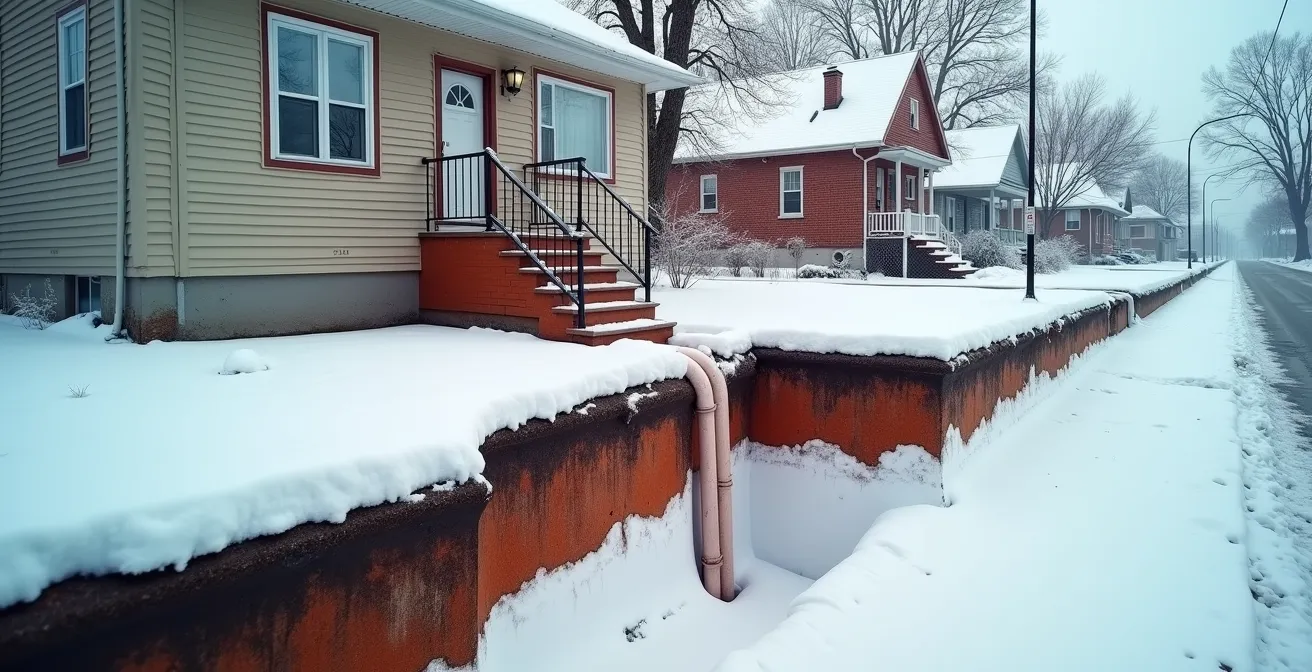
The line is clear: homeowners are 100% responsible for the sewer lateral from their house to the municipal connection point, but liability is complicated by Montreal’s shared infrastructure.
- Your private pipe’s failure is often triggered by systemic pressures from the city’s aging combined sewers and public trees.
- Borough-specific bylaws, especially regarding backwater valves and downspouts, are a critical factor in determining insurance coverage after a backup.
Recommendation: Proactively determine your pipe’s condition and your property’s compliance status before a disaster occurs; do not wait for a backup to investigate.
The sight of murky water seeping across your basement floor is a moment of pure panic for any Montreal homeowner. Immediately, the question of blame—and financial liability—arises. Is this your problem, or is the city at fault? The standard answer you’ll find is simple: you are responsible for the sewer pipe on your property, and the city is responsible for the main sewer line under the street. While factually correct, this answer is dangerously incomplete. It fails to account for the complex, dynamic relationship between your private sewer lateral and Montreal’s vast, aging public infrastructure.
The reality is that most private sewer failures are not isolated incidents. They are often the result of immense pressure from external, public-facing systems. Issues like overwhelmed combined sewers during a storm, invasive roots from a city-owned tree, or ground shifts from our notorious thaw cycles all happen outside your property line but have devastating consequences inside it. Simply knowing where your pipe ends is not enough. True protection comes from understanding this shared ecosystem and your specific legal obligations within it.
This guide moves beyond the simple property line distinction. As a liaison on municipal infrastructure, my purpose is to clarify the boundaries and explain the systemic pressures that lead to backups. We will examine why heavy rains are so problematic in older boroughs, how to handle damage from public trees, the modern repair options available, and the critical, borough-specific bylaws you must follow to protect yourself legally and financially. This is your guide to navigating the true infrastructure interface between your home and the city.
To navigate this complex topic, this article breaks down the crucial points of interaction between your private property and the city’s network. The following sections provide a clear roadmap for understanding your responsibilities and the resources available to you as a Montreal homeowner.
Summary: Blocked Sewer Lateral: Your Guide to Montreal’s Rules
- Why Do Heavy Rains Cause Sewage Backups in Older Neighborhoods?
- How to Stop City Tree Roots from Crushing Your Clay Pipes?
- CIPP Lining vs. Open Trench: Which Is Best for Public Connection Repairs?
- The Error of Flushing Wipes That Clog Municipal Pumps
- When to Disconnect Downspouts from the Sewer Network?
- Why Ground Shifts During Thaw Misalign Your Main Sewer Line?
- Why Does the Flapper Close Only When Sewer Water Rises?
- Do You Legally Need a Backwater Valve in Your Montreal Borough?
Why Do Heavy Rains Cause Sewage Backups in Older Neighborhoods?
During a torrential downpour, do you hear gurgling sounds from your drains? This is the first sign that the municipal sewer system is at capacity, and your home is at risk. The primary cause is not your personal plumbing but the legacy of Montreal’s development: the combined sewer system. This older design, still present in over 60% of Montreal’s older boroughs, merges sanitary sewage (from homes) and storm water (from streets and roofs) into a single pipe. During intense rainfall, the volume of storm water can overwhelm this single pipe, causing the combined wastewater to flow backward up the path of least resistance—your private sewer lateral—and into your basement.
This places an immense and unfair pressure on your private infrastructure. Even a perfectly maintained lateral can be defeated by the sheer volume of a surcharged city main. Homeowners in areas like the Plateau-Mont-Royal or Rosemont are particularly vulnerable. The key is to recognize the early warning signs of this systemic pressure. Slow drainage from a basement floor drain or distinct sewer odors during a storm are not minor issues; they are red flags indicating the public network is overloaded and your property is the next release valve. This is not a failure of your pipe alone, but a symptom of its connection to a larger, overburdened system.
Recognizing these immediate signs is critical. Do not dismiss gurgling sounds or slow drains as normal. They are your earliest indication that the shared ecosystem is under duress and your basement is in the direct line of fire. Monitoring these signals allows you to take preemptive measures, but understanding the root cause—the combined sewer—is fundamental to grasping your home’s inherent risk profile in Montreal.
How to Stop City Tree Roots from Crushing Your Clay Pipes?
One of the most common points of conflict between a homeowner and the city involves something seemingly benign: a beautiful, mature tree on the public sidewalk. Unfortunately, the root systems of these public assets are aggressive seekers of water and nutrients, and the joints of your older, private clay sewer pipe offer an irresistible source. Over years, these roots can infiltrate, expand, and ultimately crush your lateral, causing a complete blockage. The responsibility for repairing this damage falls squarely on the homeowner, as you are liable for the entire lateral from your home to the municipal connection point. This remains true even if the damage is caused by a city-owned tree.
However, you are not without recourse. While you must pay for the repair, the City of Montreal has a process for situations where a public tree is the proven culprit. You can file a claim to have the city’s team assess the situation, which may lead to corrective work on the tree itself or assistance, but the initial step is on you. This process requires clear, indisputable evidence. A simple claim of a blockage is insufficient; you must prove the cause is the public tree’s roots.
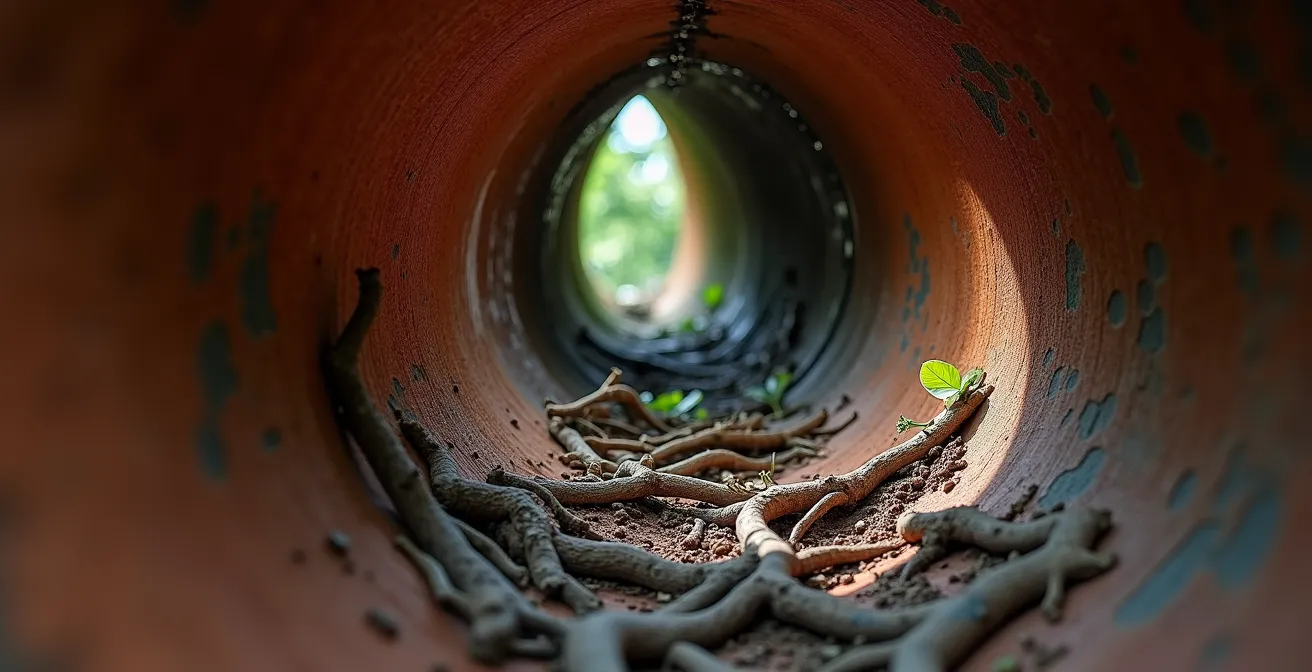
As the image shows, roots can create a complete and impassable obstruction inside a pipe. To establish the city tree as the cause, you must follow a strict procedure. This is a clear example of the infrastructure interface, where a public asset directly impacts your private property, requiring a formal, evidence-based approach to resolution. The onus is on the homeowner to provide definitive proof.
Your Action Plan: Filing a Claim for Public Tree Root Damage
- Contact a CMMTQ-accredited plumber to perform and record a video camera inspection that clearly shows tree root infiltration and damage inside your sewer lateral.
- File an application with your borough using the official corrective work form, ensuring you attach the video file as primary evidence.
- Call 311 to create a separate report for the specific public tree causing the damage, and reference your corrective work application number.
- Keep meticulous copies of all reports, plumber’s invoices, video files, and correspondence with the city, as the review process depends entirely on the quality of your documentation.
CIPP Lining vs. Open Trench: Which Is Best for Public Connection Repairs?
When your sewer lateral fails at or near the infrastructure interface with the city main, you face two primary repair methodologies: the traditional open trench excavation and the modern Cured-in-Place Pipe (CIPP) lining. As the homeowner responsible for this section of pipe, the choice you make has significant implications for cost, disruption, and long-term durability, especially within Montreal’s dense urban environment.
The open trench method involves excavating a large trench along the path of the damaged pipe to replace it entirely. While often perceived as less expensive for the pipe itself, its true cost escalates dramatically in a city like Montreal. It requires extensive digging, which can destroy landscaping, driveways, and sidewalks. Furthermore, excavating in winter through frozen ground can increase costs by 30-50%. In dense areas like Old Montreal or the Plateau, where buildings are close together, this method can be physically impossible without massive disruption and expensive street closure permits.
Conversely, CIPP lining is a trenchless technology. A flexible, resin-saturated liner is inserted into the existing damaged pipe and inflated. The resin then cures, forming a new, seamless, and durable pipe within the old one. This requires only a small access point, involves no major excavation, and can be completed in a fraction of the time, often in just one or two days. While the upfront material cost may be higher, the total project cost is often more predictable and can be lower when factoring in the avoidance of landscape restoration and complex permits.
The following table, based on recent analysis of Montreal repair costs, breaks down the key decision factors for a homeowner.
| Factor | CIPP Lining | Open Trench |
|---|---|---|
| Average Cost (Montreal) | $8,000-$15,000 CAD | $6,000-$12,000 CAD |
| Winter Feasibility | Year-round possible | +30-50% cost in frozen ground |
| Disruption Time | 1-2 days | 3-7 days |
| Permit Cost | $200-$500 | $200-$500 + street closure fees |
| Best for Dense Areas | Ideal (Plateau, Old Montreal) | Nearly impossible |
The Error of Flushing Wipes That Clog Municipal Pumps
The responsibility for a sewer backup can sometimes originate not from a broken pipe, but from the cumulative effect of small, everyday actions. The most significant modern culprit is the “flushable” wipe. Despite marketing claims, these wipes do not disintegrate in the sewer system like toilet paper. Instead, they bind together with fats, oils, and grease to form massive, concrete-like blockages known as “fatbergs.” While a single wipe from your home is unlikely to cause an immediate blockage in your own lateral, it contributes to a much larger, systemic problem that ultimately comes back to haunt homeowners.
These accumulations travel from private laterals into the public sewer mains, eventually reaching municipal pumping stations. There, they clog the industrial-grade pumps that are essential for moving wastewater across the city. The result is a catastrophic failure at the municipal level, which can cause widespread sewage backups into homes and costs the city millions of dollars annually to clear. According to municipal maintenance reports, clearing “flushable” wipes from the system is a major and recurring operational expense.

The scene above is a direct consequence of what goes down millions of toilets. When these pumps fail due to wipe blockages, the entire upstream network, including your neighbourhood, is at high risk of a surcharge and backup. This is a clear case where the collective actions of residents create a systemic pressure that can overwhelm both public infrastructure and private homes. Therefore, part of being a responsible steward of your property involves recognizing your role in the health of the entire shared ecosystem. The only things that should ever be flushed are human waste and toilet paper.
When to Disconnect Downspouts from the Sewer Network?
A homeowner’s responsibility extends to managing the water that falls on their own property. In many of Montreal’s older neighbourhoods with combined sewers, downspouts from roof gutters are often connected directly to the home’s sewer lateral. This practice, once standard, is now a major contributor to sewer backups during heavy rains. By funneling thousands of litres of clean rainwater into a sewer system already struggling to handle sanitary waste and street runoff, connected downspouts dramatically increase the systemic pressure that leads to basement flooding across the neighbourhood.
Recognizing this, the City of Montreal and its boroughs have implemented regulations and programs to encourage or mandate the disconnection of downspouts. This is a crucial act of proactive stewardship for any homeowner in a combined sewer zone. Disconnecting your downspouts and redirecting the water onto your lawn, into a rain garden, or into a rain barrel is one of the most effective actions you can take to reduce the load on the shared sewer ecosystem and, in turn, protect your own basement from backups.
This is not just a suggestion; it is increasingly a legal requirement. The city is enforcing bylaw compliance in designated zones, and failure to disconnect your downspouts can have financial consequences. Under Montreal’s bylaws for properties in combined sewer zones, homeowners can face fines of up to $1,000 for non-compliance. To offset the cost of this work, many boroughs offer attractive subsidy programs. Homeowners should check the city’s interactive map to see if their property is in a mandatory disconnection zone and explore available subsidies, which can range from $500 to $2,000 depending on the borough and the alternative solution installed.
Why Ground Shifts During Thaw Misalign Your Main Sewer Line?
Montreal’s infamous freeze-thaw cycle is more than an inconvenience; it’s a powerful geological force that directly impacts your home’s most critical connection to city infrastructure. Much of the Montreal area is built on Leda clay, a type of marine clay that is notoriously unstable. During the winter, frost penetrates deep into the ground, causing the moisture-rich clay to expand and heave upwards. In the spring, as the ground thaws, it doesn’t settle evenly. This differential settlement can cause sections of your rigid, underground sewer lateral to shift, crack, or become misaligned, particularly at the joints.
A “belly” or low spot can form in the pipe, allowing solid waste and paper to accumulate and create a blockage. More seriously, the joints can separate, allowing soil to enter the pipe or wastewater to leak out, eroding the ground supporting the pipe and worsening the problem over time. This ground movement is a slow, insidious form of systemic pressure that can lead to a sudden and catastrophic backup with little warning. The problem is most pronounced in homes built before the 1980s, which often used shorter sections of clay or concrete pipe with more vulnerable joints.
Because this damage happens out of sight, proactive stewardship is your only defense. Waiting for a backup to occur is a reactive and costly strategy. A regular inspection schedule, particularly after the major spring thaw, is the key to identifying misalignments or bellies before they cause a complete failure. This allows for planned, preventative maintenance rather than an emergency excavation. The costs for such repairs can be significant, with traditional excavation ranging from $6,000 to $12,000 and trenchless methods costing between $8,000 and $15,000, with costs increasing by 30-50% for pipes deeper than 8 feet.
Your Action Plan: Spring Sewer Maintenance for Pre-1980 Homes
- Schedule a professional sewer camera inspection in late April or early May, after the ground has fully thawed, to get a clear picture of your pipe’s condition.
- Visually inspect your yard for any new dips, soft spots, or depressions along the path of the sewer line, which can indicate pipe settlement or a leak.
- Monitor your basement drains and toilets for any signs of slower drainage compared to previous seasons, as this can be the first symptom of a developing misalignment.
- Document the findings of any camera inspection, including saving the video file, to establish a baseline for future comparisons and for potential insurance claims.
Why Does the Flapper Close Only When Sewer Water Rises?
A backwater valve is your home’s last line of defense at the infrastructure interface. It is a simple but critical device installed on your main sewer lateral, designed to protect your property from the devastating effects of a municipal sewer surcharge. The core of the valve is a flapper, a hinged gate that allows wastewater to flow out of your home under normal conditions. Gravity keeps it in a slightly open position so that your home’s sewage can exit unimpeded.
The magic happens during a surcharge event. When the city’s main sewer becomes overwhelmed and wastewater begins to flow backward toward your home, the pressure of the rising sewer water pushes the flapper shut. This creates a seal that physically blocks the sewage from entering your home’s plumbing and flooding your basement. The valve is entirely passive; it requires no electricity or manual intervention. It operates solely on the principle of backpressure. Once the pressure in the city main subsides, the flapper falls back to its normal open position, allowing your home’s plumbing to drain again.
However, this device is not a “set it and forget it” solution. Its effectiveness depends entirely on its ability to create a perfect seal. Debris from your own home—such as hair, grease, or improperly flushed items—can get caught under the flapper, preventing it from closing completely. A small piece of debris is all it takes to render the valve useless, allowing sewage to pour into your basement despite its presence. Therefore, regular inspection and cleaning of the valve, typically through an accessible cover, is a non-negotiable part of homeowner maintenance and proactive stewardship.
Key Takeaways
- Your responsibility as a homeowner goes beyond your property line; you must manage your lateral as part of a shared, interconnected system.
- Proactive inspection is not an expense, but an investment. Identifying issues with tree roots, pipe misalignment, or backwater valves before a crisis is the most cost-effective strategy.
- Compliance with borough-specific bylaws regarding backwater valves and downspouts is not optional—it is essential for protecting your home and ensuring insurance coverage.
Do You Legally Need a Backwater Valve in Your Montreal Borough?
The question of whether a backwater valve is a good idea is settled: it is the single most effective device to protect a home from sewer backups. The more critical question for a Montreal homeowner is: are you legally required to have one? The answer is increasingly “yes,” and ignoring this obligation can have catastrophic financial consequences. Bylaw compliance is not a technicality; it is a fundamental part of your legal responsibility and a prerequisite for many insurance claims.
Montreal’s boroughs have been progressively updating their plumbing codes to mandate the installation of backwater valves in new constructions and in homes undergoing major renovations. More importantly, many now require them in existing homes located in designated flood-risk zones or areas serviced by combined sewers. It is the homeowner’s absolute responsibility to know and comply with the specific bylaws of their borough. Ignorance of the law is not a valid defense when your basement is full of sewage.
The financial stakes are enormous. As stated in municipal flood prevention literature, the legal standing of insurance claims can be directly tied to this compliance.
In case of a sewer backup, Montreal-based insurance companies can deny a claim if the homeowner was legally required to have a valve but failed to install one.
– Montreal Insurance Guidelines, Municipal Flood Prevention Requirements
To encourage compliance, many boroughs offer generous subsidy programs to help offset the cost of installation. These programs vary significantly, highlighting the importance of checking with your local borough office. Below is a summary of typical subsidy offerings.
| Borough | Subsidy Amount | Eligibility |
|---|---|---|
| Lachine | Up to $2000 | Properties in flood-risk zones |
| LaSalle | Up to $1500 | All residential properties |
| Ahuntsic-Cartierville | Up to $2000 | Combined sewer areas only |
| Other boroughs | $500-$1500 | Varies by location |
To protect your property and fulfill your obligations, the next logical step is to have your sewer lateral professionally inspected by a CMMTQ-certified plumber to assess its condition and ensure your home is in full compliance with current municipal and borough bylaws.