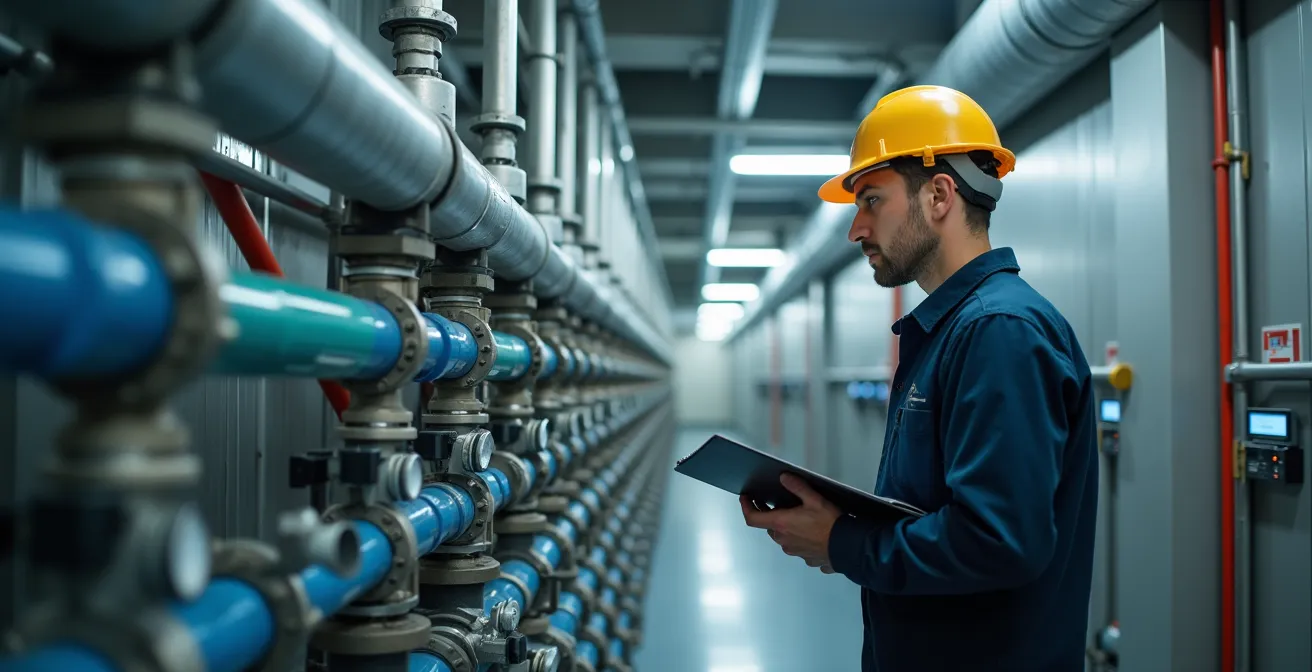
Reducing emergency plumbing costs by 30% is not about finding a cheaper plumber; it’s about shifting to a proactive asset management model for your building’s entire plumbing infrastructure.
- Proactive measures like preventive jetting generate significant ROI by avoiding catastrophic failures and business downtime.
- Digital asset tracking enables you to predict failures, justify capital expenditures, and move from reactive repairs to strategic planning.
Recommendation: Implement a data-driven inspection and maintenance schedule tailored to your Montreal property’s age, use, and specific regulatory requirements.
As any seasoned Montreal property manager knows, few calls are more dreaded than one reporting a major sewer backup in a mixed-use commercial building—especially during a freezing January. The immediate costs of emergency repairs are just the beginning. The real damage lies in business interruption for your tenants, potential health code violations, tenant dissatisfaction, and ultimately, a direct hit to your property’s reputation and asset value. The conventional wisdom of “fixing leaks quickly” and “not pouring grease down the drain” is fundamentally inadequate for managing the complex plumbing systems of a commercial portfolio.
The standard approach treats plumbing as a series of unpredictable operational expenses (OpEx). An emergency happens, you pay a premium to fix it, and you hope it doesn’t happen again. This reactive cycle is a significant, unmanaged financial risk. The true path to reducing costs and preserving asset value is to reframe the entire conversation. It’s time to stop thinking like a maintenance technician and start acting like a strategic asset manager. Your building’s plumbing is not a collection of pipes; it is a critical system with a predictable lifecycle, manageable risks, and opportunities for significant ROI.
This shift requires moving from simply reacting to problems to proactively managing the health of the entire plumbing asset. This means understanding the financial leverage of preventive actions, using technology to predict failures, making strategic resourcing decisions, ensuring strict regulatory compliance to avoid costly penalties, and knowing precisely when to invest in long-term capital upgrades versus short-term fixes. It’s about transforming an unpredictable cost center into a managed component of your building’s long-term financial strategy.
This guide provides a strategic framework for Montreal property managers to achieve this shift. We will dissect the business case for proactive maintenance, explore data-driven management techniques, evaluate staffing models, navigate Quebec’s specific regulatory landscape, and outline clear indicators for crucial capital investment decisions.
Summary: A Strategic Guide to Cutting Commercial Plumbing Costs by 30% in Montreal
- Why Preventive Jetting Costs Less Than One Emergency Sewer Backup?
- How to Track Plumbing Assets Digitally to Predict System Failures?
- Contractor or In-House Team: Which Is Best for a 50-Unit Building?
- The Error of Ignoring RBQ Codes That leads to Heavy Fines
- When to Retrofit an Entire Building: Signs Your Stacks Are Failing
- When to Schedule Jetting to Prevent Restaurant Downtime?
- When to Call a Pro: The 3-Year Inspection Rule for 50-Year-Old Homes
- How to Inspect Your Plumbing System Annually to Avoid $5,000 in Repairs?
Why Preventive Jetting Costs Less Than One Emergency Sewer Backup?
The most compelling argument for preventive hydro-jetting is found by comparing its cost to the alternative. A single emergency sewer backup in a commercial setting isn’t just an inconvenience; it’s a financial catastrophe. Emergency repairs for commercial properties can easily range from $2,000 to $15,000, factoring in after-hours labour, equipment, and the cost of repairing water damage. This doesn’t even account for the significant hidden costs of business interruption for your commercial tenants, which can lead to rent abatement claims and damaged relationships. In contrast, a scheduled, preventive hydro-jetting service can cost as little as $600, especially when negotiated as part of a regular maintenance contract.
The math is starkly in favour of proactivity. In Montreal, emergency plumbing call-outs carry a significant premium. A review of 2025 Greater Montreal plumbing rates data shows after-hours emergency services can cost between $150 to $200 per hour, compared to $110 to $125 per hour for standard daytime service. By scheduling maintenance, you are not only preventing the high cost of a failure but also paying a lower rate for the service itself. Preventive jetting is not an expense; it is an investment in risk mitigation.
Regularly scheduled hydro-jetting does more than just clear existing clogs. It systematically removes the buildup of grease, scale, and debris that inevitably accumulates in commercial lines, especially in buildings with food service tenants. This process restores pipes to their optimal flow capacity, significantly improving system efficiency and drastically reducing the likelihood of future blockages. By documenting these services, you also build a valuable maintenance history that can be crucial for insurance claims and demonstrating due diligence in liability situations. It is a calculated business decision that directly protects your bottom line.
How to Track Plumbing Assets Digitally to Predict System Failures?
Moving from a reactive to a proactive maintenance model is impossible without data. Manually tracking the condition of hundreds of plumbing components across a property portfolio is inefficient and prone to error. The solution lies in implementing a digital asset tracking system, often as part of a broader Computerized Maintenance Management System (CMMS). This technology transforms your plumbing infrastructure from a series of passive components into an actively monitored asset base. By cataloging every critical piece of equipment—from boilers and backflow preventers to individual pumps and main stacks—you create a centralized database for all maintenance activities.
Each time a repair or inspection is conducted, the details are logged against the specific asset. Over time, this data reveals patterns. You can track the frequency of repairs on a specific component, monitor the aging of different pipe materials, and compare performance against manufacturers’ recommended service lives. This data-driven approach allows you to move beyond guesswork and start making informed predictions about when a system or component is likely to fail. Industry benchmarks suggest that businesses adopting these preventive maintenance tactics can see savings of up to 18% on associated costs by optimizing labour and preventing major failures.
For a property manager, this historical data is a powerful tool for financial planning. Instead of being surprised by a catastrophic failure that requires emergency funding, you can use the repair frequency data to build a compelling business case for a capital expenditure (CapEx) replacement. Presenting a report that shows a specific pump has required four expensive repairs in 18 months provides clear justification for a planned replacement, allowing you to budget effectively and schedule the work with minimal disruption. It’s the definitive way to shift from costly operational “firefighting” to strategic, data-driven asset lifecycle management.
Your Action Plan: Implementing Digital Plumbing Asset Tracking
- Identify & Categorize: Inventory all critical plumbing systems, equipment, and components, including HVAC systems, electrical panels, and key plumbing lines.
- Consult Guidelines: Collect and integrate manufacturer’s guidelines for recommended maintenance schedules and operational procedures for each asset.
- Structure Tasks: Create a structured framework within your CMMS to prioritize and organize maintenance tasks based on asset criticality and risk.
- Build a Calendar: Map out and schedule all recurring monthly, semi-annual, and annual maintenance tasks within a digital calendar for your team.
- Track & Justify: Diligently track repair frequency and costs on specific components to build data-driven reports that justify capital expenditure requests for upgrades and replacements.
Contractor or In-House Team: Which Is Best for a 50-Unit Building?
For a 50-unit mixed-use building, the decision between maintaining an in-house plumbing team versus relying on external contractors is a critical strategic choice with major financial implications. An in-house team offers immediate response times for minor issues and a deep familiarity with the building’s unique systems. However, this comes at the fixed cost of full-time salaries, benefits, training, and the significant capital investment in specialized equipment like hydro-jetters and diagnostic cameras. You also bear the full responsibility for their certification and liability.
This paragraph introduces the complex decision between in-house staff and external contractors. To better visualize this choice, the illustration below contrasts the tools of basic in-house maintenance with the specialized equipment of a professional contractor.
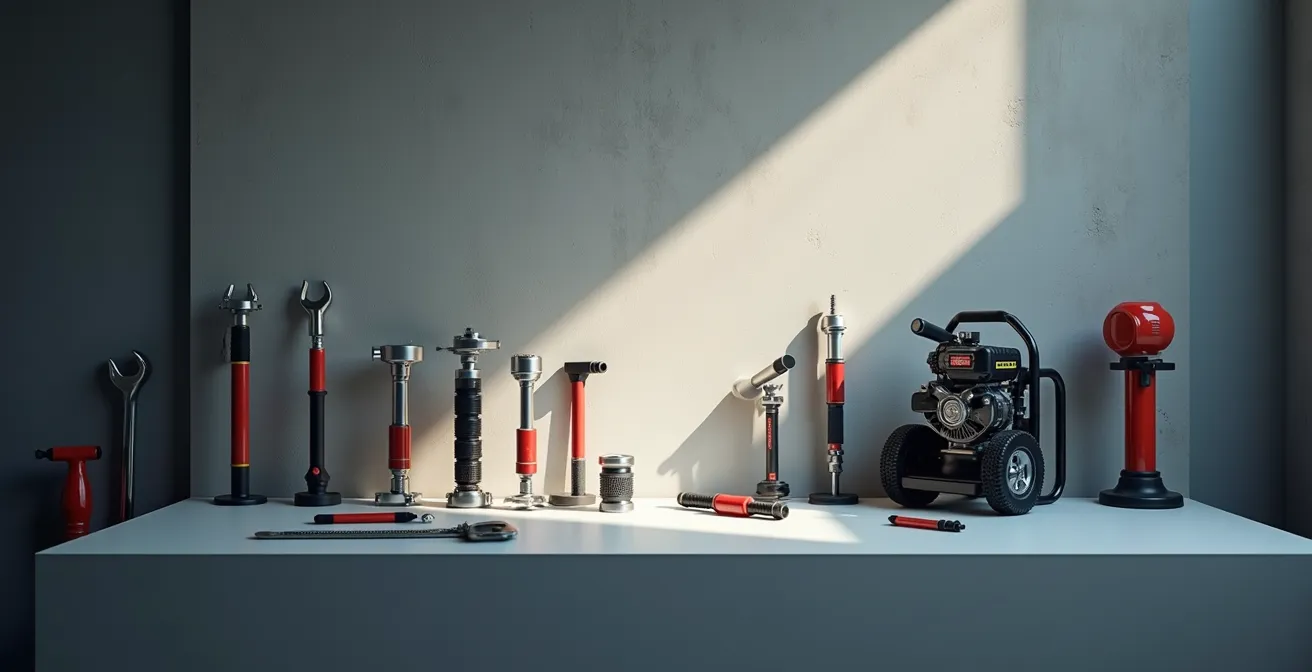
As the image suggests, the capabilities are vastly different. Outsourcing to a certified commercial plumbing contractor provides access to a wider range of expertise and cutting-edge equipment without the upfront investment. While hourly rates may seem higher, you only pay for the service when you need it, converting a fixed cost into a variable one. Furthermore, a reputable contractor carries their own liability insurance and is responsible for staying current with all regulatory codes, shifting a significant compliance burden off your shoulders.
In Quebec, this decision is heavily influenced by the regulatory framework. The Building Act holds designers and contractors accountable for compliance with the Construction Code. By hiring a licensed contractor, you are engaging a party with a legal and professional obligation to perform work to code, which is a powerful form of risk mitigation. For most 50-unit properties, a hybrid model is often the most cost-effective solution: an in-house handyman or small team for immediate, minor repairs (leaky faucets, toilet clogs), and a dedicated relationship with a trusted commercial plumbing contractor for scheduled preventive maintenance, emergency services, and all work requiring specialized certification or equipment.
This table, based on an analysis of Quebec plumbing costs, breaks down the financial considerations.
| Service Type | Commercial Rate | In-House Considerations |
|---|---|---|
| Hourly Rate | $100-$160/hour | Full-time salary + benefits |
| Emergency Service | 1.5-3x regular rate | Overtime pay required |
| CMMTQ Reference Rate | $103.21/hour | Must meet certification requirements |
| Equipment Costs | Included in service | Company must purchase/maintain |
The Error of Ignoring RBQ Codes That leads to Heavy Fines
In the province of Quebec, the Construction Code, particularly Chapter III concerning plumbing, is not a set of recommendations; it is the law. For a commercial property manager, treating these codes as an afterthought is a grave financial error. Fines from the Régie du bâtiment du Québec (RBQ) for non-compliance can be substantial, but the direct penalties are often dwarfed by the secondary costs. An installation found to be non-compliant may require being completely torn out and redone correctly, multiplying costs. Furthermore, in the event of a failure causing damage, an insurance company could deny a claim if it’s discovered that the plumbing did not adhere to code, leaving the property owner with full liability.
Violations are often not malicious but arise from ignorance or corner-cutting during renovations or repairs. As plumbing experts in Quebec point out, the issues are frequently technical and specific.
Some of the most common plumbing code violations include neglecting to have sufficient clearance around a toilet, unsuitable venting, incorrect pipe sloping, and the use of illegal or improper materials.
– RénoQuotes, Plumbing Code – What Are the New Regulations in Quebec?
Ensuring compliance is a continuous responsibility. It involves a commitment to using only licensed contractors who are members of the CMMTQ (Corporation des maîtres mécaniciens en tuyauterie du Québec) for all significant work. It also means having a working knowledge of the key requirements yourself, so you can properly vet contractor proposals and spot potential issues during site inspections. For instance, you must ensure that any new installations or major alterations are designed and executed in full compliance with the current Chapter III of the Construction Code, which includes stringent rules on everything from venting systems to the types of certified materials permitted for use in commercial buildings.
Ultimately, strict adherence to RBQ codes is a core pillar of risk management. It protects you from fines, ensures the long-term safety and functionality of your building, validates your insurance coverage, and safeguards your asset’s value. The cost of doing things right the first time is always lower than the cost of remediation and penalties.
When to Retrofit an Entire Building: Signs Your Stacks Are Failing
One of the most significant capital expenditure decisions a property manager will face is when to move from piecemeal repairs to a full-building plumbing retrofit. Postponing this decision for too long can be a costly mistake, as you end up throwing good money after bad on frequent “spot repairs” while the underlying system continues to decay. With Q2 2025 data from Statistics Canada showing a +3.7% quarterly increase in plumbing construction costs, delaying the inevitable only makes the final project more expensive. The key is to recognize the warning signs that your building’s main stacks (the large vertical pipes that carry waste) are nearing the end of their functional life.
These signs are often subtle at first but become more frequent and severe over time. They include recurring clogs affecting multiple units on different floors along the same vertical line, persistent sewer odors, or the presence of sewer flies. For older buildings with cast iron pipes, you might notice rust flakes in the water or visible corrosion and deterioration on exposed sections of pipe. A crucial metric to track is the frequency and cost of emergency calls. If your digital asset log shows you are repeatedly calling plumbers to snake the same stack, it’s time to calculate the ROI of a full replacement versus continuing with endless repairs.
A full retrofit is a major undertaking, but it is a strategic investment in the building’s long-term health and value. It eliminates the constant risk of catastrophic failure, improves system performance for all tenants, and resets the clock on your plumbing asset’s lifecycle. For buildings over 50 years old, a proactive camera inspection of the main stacks every 3-5 years is essential to assess their condition and plan for this inevitable capital expense on your own terms, rather than in response to a building-wide disaster.
Checklist: Warning Signs of Stack Failure
- Monitor System Performance: Keep a log of tenant complaints regarding low water pressure, discolored water, frequent clogs, and unusual gurgling sounds from drains.
- Track Clog Location: Check for recurring, localized clogs that appear on multiple floors along the same vertical line, indicating a problem in the main stack.
- Visually Inspect Pipes: Look for rust flakes, signs of moisture, or visible deterioration on any exposed cast iron pipes in basements or mechanical rooms.
- Calculate Repair ROI: Document the frequency and total cost of spot repairs on a specific stack to calculate when a full replacement becomes more cost-effective.
- Investigate Odors & Pests: Note any persistent sewer odors or the presence of sewer flies, as these are strong indicators of cracks or breaks in the drainage pipes.
- Schedule Proactive Inspections: Mandate professional camera inspections of all main stacks every 3 years for any building over 50 years old to assess internal condition.
When to Schedule Jetting to Prevent Restaurant Downtime?
For a mixed-use building with restaurant tenants, the plumbing system is a direct lifeline to their revenue. A sewer backup or even a slow drain during peak hours can shut down a kitchen, leading to lost sales, wasted inventory, and significant damage to their reputation. As a property manager, ensuring the operational continuity of your food service tenants is paramount, and preventive hydro-jetting is the single most effective tool for this. The high volume of grease, oil, and food solids from a commercial kitchen makes their drainage lines uniquely susceptible to severe blockages.
Industry best practice, supported by plumbing professionals, is to schedule hydro-jetting for commercial restaurant plumbing systems at least once a year. However, the timing of this service is as important as the frequency. Scheduling the work during the restaurant’s slowest periods is critical to eliminate any impact on their business. This could mean overnight, on a day they are closed (like a Monday), or during a planned seasonal closure. For Montreal restaurants, the post-holiday slump in January or the quiet period in late summer can be ideal windows.
This paragraph explains the importance of timing for restaurant maintenance. The image below captures the result of such proactive care: a pristine, fully functional kitchen drain.

The goal is to maintain this state of readiness. Coordinating closely with your restaurant tenants to identify these optimal service windows demonstrates a partnership mentality and adds significant value to your management services. This proactive scheduling transforms a potential operational disaster into a routine, invisible part of building maintenance, protecting your tenants’ business and, by extension, your rental income stream.
When to Call a Pro: The 3-Year Inspection Rule for 50-Year-Old Homes
While the “3-year rule” is a common guideline for older residential properties, the principle is even more critical for aging commercial and mixed-use buildings in Montreal, many of which are designated as heritage structures. For these properties, the stakes are higher, and the inspection protocol must be more rigorous. While a good general guideline is an inspection once every two years for a newer system, for a building over 50 years old, a comprehensive professional inspection every 3 years is the absolute minimum for responsible asset management.
This professional assessment must go far beyond a simple visual check for leaks. It should be a detailed diagnostic evaluation of the entire plumbing asset. For Montreal’s older building stock, this involves several key, non-negotiable actions:
- Main Drain Camera Inspection: A camera must be run through the main drain line all the way to the city’s connection to identify cracks, root intrusion, or collapses in aging clay or cast iron pipes.
- Backflow Preventer Verification: Annual testing and certification of all backflow prevention devices is a mandatory requirement by the City of Montreal to protect the municipal water supply.
- Material Condition Assessment: An expert assessment of the remaining lifespan of the building’s pipe materials is crucial for long-term capital planning.
- Thermal Imaging: For heritage structures where pipes are often hidden behind irreplaceable historic finishes, using thermal imaging cameras to detect hidden leaks without destructive investigation is an essential, modern technique.
Thoroughly documenting every professional inspection provides an invaluable historical record. This documentation is not just for internal planning; it becomes a critical asset during insurance negotiations, in the event of a liability claim, and for demonstrating compliance with City of Montreal requirements. It is the formal process of verifying the health of your asset and is a cornerstone of professional property management.
Key takeaways
- Shifting from reactive repairs (OpEx) to proactive maintenance (strategic CapEx) is the foundation of cost control.
- Digital asset tracking provides the data necessary to predict failures, justify budgets, and manage the entire plumbing lifecycle.
- Strict adherence to Quebec’s RBQ codes and leveraging licensed contractors is a non-negotiable form of financial and legal risk mitigation.
How to Inspect Your Plumbing System Annually to Avoid $5,000 in Repairs?
While comprehensive professional inspections are essential for long-term planning, a structured in-house annual inspection program is your first line of defense against costly repairs. A systematic, year-round inspection process, conducted by your on-site staff, can catch minor issues before they escalate into major emergencies costing thousands. For a Montreal property, this checklist should be adapted to the challenges of our four distinct seasons, ensuring that you are checking for the right things at the right time. A detailed logbook of these inspections is also crucial for record-keeping, especially for managing tenant issues and potential disputes with the Tribunal administratif du logement (TAL).
Your seasonal inspection plan should be a core operational procedure. In the spring, after the thaw, is the time to hunt for signs of winter damage; check for moisture or water stains around toilets, under sinks, and near water heaters. In the summer, with cooling systems running, test water temperatures at various faucets to ensure mixing valves are functioning correctly. In the fall, the focus shifts to winter preparation; examine all accessible pipes for corrosion and ensure any exposed pipes in unheated areas are properly insulated to prevent freezing. Finally, in the winter, check boiler pressure regularly and ensure drain covers in high-traffic areas like kitchens and restrooms are clear and secure.
This consistent, documented vigilance allows you to build an intimate knowledge of your building’s performance. It creates a baseline of what is “normal,” making it easier to spot anomalies quickly. This routine is not about performing complex repairs; it is about systematic observation. It is the most cost-effective way to protect your property, ensuring small drips don’t turn into devastating floods and that your building remains safe, functional, and profitable year-round.
To truly shift your plumbing from a cost center to a managed asset, the next logical step is to formalize this strategic approach. Begin by implementing a digital asset log and scheduling your first comprehensive, data-driven maintenance plan with a certified commercial partner.
Frequently Asked Questions on How to Reduce Emergency Plumbing Costs by 30% for Commercial Buildings?
How do I calculate ROI for preventive maintenance?
Compare the costs saved by preventing problems with the costs of the preventive maintenance program. Divide the savings by the preventive maintenance costs and multiply by 100 to get a percentage. For example, if you avoid a $10,000 emergency repair by spending $1,500 on annual maintenance, your savings are $8,500. The ROI is ($8,500 / $1,500) * 100 = 567%.
What are the main causes of pipe deterioration?
Pipe corrosion is a complex process but generally happens due to three main factors: the chemical composition of the water (acidity or mineral content), the age of the plumbing system and materials used, or the amount of dissolved oxygen in the water, which can accelerate oxidation in metal pipes.
How can I reduce water waste in my commercial building?
Beyond fixing leaks, a significant reduction in water waste can be achieved by upgrading to modern fixtures. For high-traffic areas like restrooms, installing hands-free sensor faucets is highly effective. They reduce water waste by ensuring water runs only when needed and also improve hygiene by minimizing the spread of germs.